
Anthropic In-House Chip Team Takes Aim at Nvidia's Pricing Power
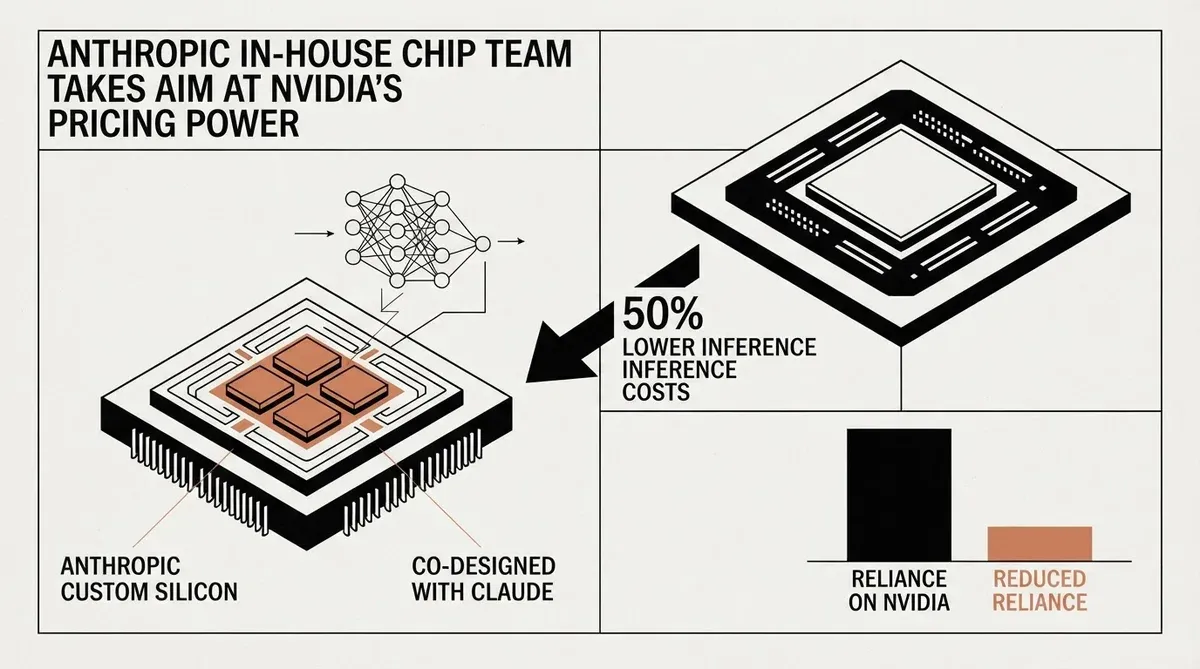
The Anthropic in-house chip team is confirmed: the company will design custom silicon for its Claude models, marking its first public acknowledgment of a semiconductor effort it had previously declined to discuss. The confirmation landed on August 5 through a job listing for a senior engineer with chip design experience and a supporting company statement, and it places Anthropic alongside OpenAI, Google, Meta, and, reportedly, Mistral as frontier labs pull hardware design in-house.
The new group will focus on co-designing hardware and models together, shaping chips around Claude's specific workloads instead of adapting general-purpose accelerators to them. An Anthropic spokesperson said the company will keep a "multi-chip approach," continuing to buy hardware from other vendors as its own designs come online. Existing partnerships with AWS, Google, Nvidia, and AMD remain central to the plan, and the effort runs alongside a reported commitment to as many as one million Google TPUs.
The scale of that Google relationship is part of the same story. A commitment of that size is among the largest hardware arrangements in the industry, and it shows that even while designing its own chips, Anthropic intends to keep buying at massive scale from partners. The in-house effort is a long-term hedge layered on top of near-term capacity bets, while the near-term compute bill still runs through outside suppliers.
The timing tracks a supply problem. The move responds to surging demand for Claude and to processor shortages that have made it harder to secure capacity for training and running advanced models. For a lab shipping some of the most compute-intensive systems in the industry, access to accelerators has become a strategic bottleneck in its own right, comparable in importance to talent and funding.
The confirmation also closes a months-long rumor cycle. Earlier reporting had linked Anthropic to Samsung as a potential manufacturing partner, and the job listing now gives the plan concrete shape: a senior engineer who has shipped semiconductor designs, working inside a dedicated "custom silicon team."
Co-Design and Compute Economics
The economics explain why Anthropic chose this path rather than simply buying more GPUs. The co-design program is targeting roughly a 50 percent cut in per-token inference costs, the unit that determines what Anthropic charges for Claude and what margins it keeps on API traffic. Inference is the cost that repeats: every API call carries a per-token price, so a chip built around a model's exact attention and routing patterns attacks the recurring expense directly rather than the one-time training bill.
Co-design changes the optimization loop. Today, model developers take a fixed chip and reshape their software around its constraints. With in-house silicon, the instruction set, memory hierarchy, and interconnect can be tuned to the math Claude actually performs, and each new model generation can inform the next chip revision.
The hiring effort is aggressive. Job postings tied to the new team advertise salaries up to $485,000, a premium that reflects how scarce experienced silicon engineers are relative to the number of labs now competing for them. The organizational signal is just as telling: the lab now competes for chip engineers with Nvidia, Google, and Meta, on top of its existing recruiting battles for machine learning researchers.
Underneath the engineering is a straightforward strategic calculation. Much of the industry runs on Nvidia hardware, and that concentration gives Nvidia pricing power over every lab that trains frontier models. Dependence on a single dominant supplier is the strongest driver behind the vertical integration now sweeping the model makers.
What the Anthropic In-House Chip Team Means for Nvidia
Anthropic's in-house chip team joins a wave already in motion. OpenAI announced Jalapeño, a custom chip developed with Broadcom and designed for LLM inference in data centers, as the direct competitive parallel. Google has run its models on its own TPU hardware for years. Meta has designed and deployed its own accelerators. Mistral is reported to be exploring the same route. The shared motivation is the same in every case: inference at frontier scale is expensive enough that owning the silicon increasingly beats buying it from a supplier with pricing power.
The table below summarizes where each major lab stands:
| Lab | In-house silicon status | Notes |
|---|---|---|
| Anthropic | Custom silicon team confirmed August 2026 | Co-designs hardware with Claude; keeps multi-chip approach; reported Samsung manufacturing talks |
| OpenAI | Jalapeño chip with Broadcom | Built for data-center LLM inference |
| TPUs in production for years | Runs its own models on its own hardware | |
| Meta | Own chips designed and deployed | Already in production |
| Mistral | Exploring custom silicon (reported) | Not yet confirmed |
For Nvidia, the pattern erodes the customer base at the top of the market. The labs that buy the most accelerators are exactly the ones building alternatives, and every design that reaches production removes a block of demand from Nvidia's pricing power. Nvidia's list of frontier-lab training customers is quietly getting shorter, even as GPUs remain the near-term default for training. The transition will take years, because custom chips require multiple design cycles to reach volume, but the direction of travel is consistent: the most influential AI buyers are becoming their own suppliers.
The pricing implication cuts both ways. As long as GPUs stay the default, Nvidia keeps its leverage, and the custom designs now in development will not change that within the next one or two product cycles. But every lab that reaches production removes demand from the top of the market, and pricing power is the first thing to erode when the biggest customers have a credible alternative.
The stakes for Nvidia go beyond a single customer. Anthropic's reported commitment to as many as one million Google TPUs already shows a willingness to diversify beyond GPUs, and custom silicon is the logical next step in that shift: it replaces dependence with optionality, and optionality is what erodes a supplier's pricing power.
What It Means for Enterprises
For enterprise buyers, the stakes are indirect but concrete. If the custom silicon hits its cost targets, inference prices fall across the market, both because Anthropic can price Claude more aggressively and because Nvidia faces more credible competition for the workloads that anchor its margins. The next infrastructure cycle will be decided on per-token cost as much as on model quality, and procurement teams negotiating AI contracts have a new metric to track: where per-token pricing is heading alongside benchmark performance.
The practical effect on procurement is worth spelling out. Anthropic sells Claude access through API pricing measured per token, and its rates help set expectations across the enterprise market. If inference costs drop by half, the company gains room to cut prices, reinvest in capability, or both, and rivals must either match the new cost curve or justify a premium. That competitive dynamic is what the custom silicon effort sets in motion.
The execution risk is real. Designing a chip is one thing; manufacturing, validating, and deploying it at the scale Claude demands is another, and Anthropic is entering a discipline where Google, Meta, and Nvidia hold years of institutional experience. The confirmation removes any doubt about intent: frontier AI is now a hardware business as much as a software one.
Why This Matters
The Anthropic in-house chip team is a direct answer to the industry's biggest cost and constraint: the price and availability of accelerators. If co-designed silicon delivers the targeted inference-cost reductions, Claude becomes cheaper to run and to sell, and Nvidia's grip loosens one lab at a time. For anyone buying AI compute, this is the clearest signal yet that the next competitive battle will be fought in silicon.
AI-generated image.
Related Articles
- Anthropic Eyes Microsoft Maia 200 AI Chips to Power Future Claude Models
- Google's $150B Anthropic Chip Financing Machine Beats Nvidia on Borrowing Costs
- Anthropic Debuts Claude Fable 5 and Mythos 5 With Massive Performance Gains
✔Human Verified
Researched and cross-referenced against primary sources by the Bytevyte editorial team. This article was generated with the assistance of artificial intelligence and reviewed by the Bytevyte editorial team.