
AWS and NVIDIA Streamline Humanoid Robot Training via SageMaker AI Integration
AWS and NVIDIA integrate Isaac Lab with SageMaker AI to accelerate humanoid robot training using high-fidelity reinforcement learning simulations.
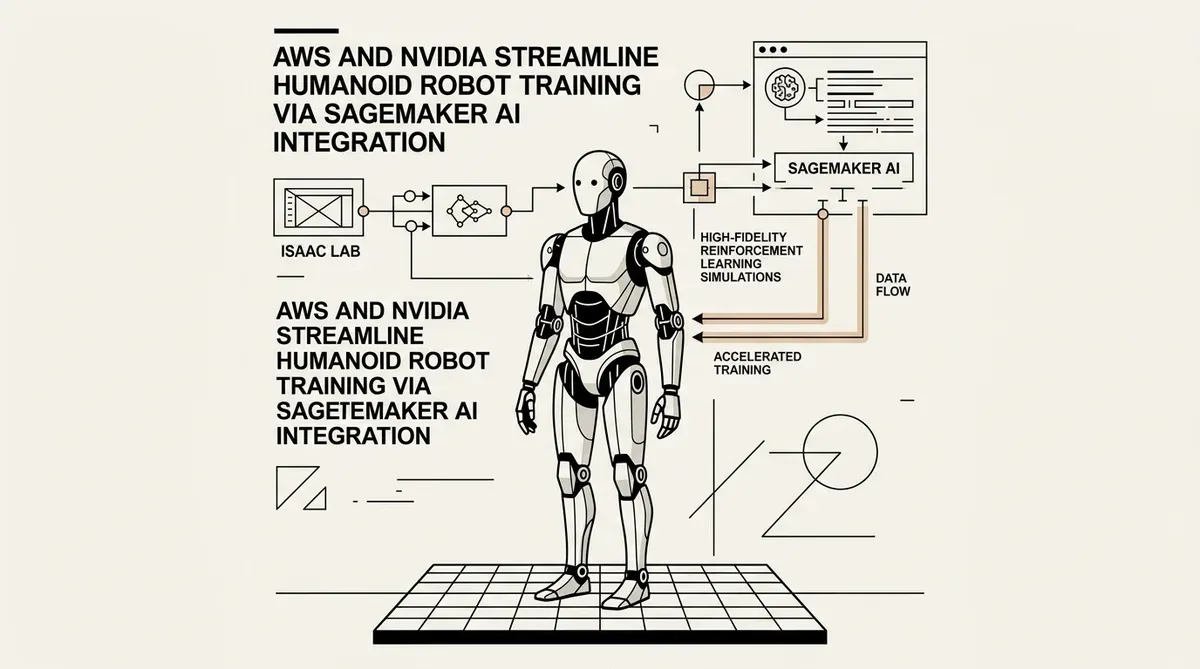
Amazon Web Services has integrated NVIDIA Isaac Lab into its Amazon SageMaker AI platform, creating a streamlined pathway for humanoid robot training using reinforcement learning. The collaboration, announced this week, aims to move physical AI from isolated research environments into scalable production by leveraging high-fidelity simulation. By combining NVIDIA's specialized robotics simulation framework with Amazon's managed machine learning infrastructure, the two companies are addressing the significant compute and configuration hurdles that have historically slowed the development of complex robotic behaviors.
The integration specifically targets the Unitree H1 humanoid as a reference hardware platform. Training robots in the real world is often slow, expensive, and potentially hazardous, particularly when teaching machines to move through unpredictable environments. This new setup allows developers to use GPU-accelerated simulation to compress months of physical training into a few hours of virtual learning. Amazon SageMaker AI handles the underlying infrastructure, including instance provisioning and driver configuration, which allows robotics researchers to focus on policy development rather than server management.
Strategic Impact on Physical AI Development
The humanoid robot training workflow on SageMaker AI is a shift toward standardized infrastructure for the robotics industry. Historically, robotics startups and research labs had to build custom simulation clusters, a process that required deep expertise in both hardware orchestration and physics engines. By offering a managed service that supports NVIDIA Isaac Lab, AWS is lowering the barrier to entry for companies developing autonomous systems. This move positions SageMaker AI as a central hub for the entire robotics lifecycle, from initial simulation to cloud-based monitoring of deployed units.
For decision-makers, the primary value lies in the speed of iteration. The ability to run multiple experiments in parallel on high-performance GPU instances means that complex locomotion tasks, such as walking on rough terrain or maintaining balance under external pressure, can be refined rapidly. Amazon confirmed that the necessary code and configuration files are now available in official AWS GitHub repositories, allowing teams to begin deploying these training pipelines immediately.
This partnership also reinforces the growing ecosystem around NVIDIA's robotics stack. As more cloud providers integrate Isaac Lab, the software becomes a de facto standard for reinforcement learning in robotics. For AWS, the move ensures that its cloud platform remains competitive for the next wave of AI workloads, which are increasingly moving beyond text and image generation into the physical world. The focus on humanoid forms like the Unitree H1 suggests that both companies anticipate a rise in general-purpose robotic applications across logistics and manufacturing sectors.
While we strive for accuracy, bytevyte can make mistakes. Users are advised to verify all information independently. We accept no liability for errors or omissions.
Sources
Scale Robot Reinforcement Learning with NVIDIA Isaac Lab on Amazon SageMaker AI
AI-generated image.
Related Articles
- NVIDIA Brings Nemotron 3 Ultra to AWS to Power High-Efficiency Autonomous Agents
- LG Group and NVIDIA Build AI Factory for Robotics and Mobility
- AWS, NEURA Partner for Cognitive Robotics Deployment
✔Human Verified