
AWS Nvidia GPU expansion adds 2 million GPUs for 2027-2028
The AWS Nvidia GPU expansion adds 2 million chips for 2027-2028, tripling the companies' AI infrastructure commitment to roughly 3 million GPUs.
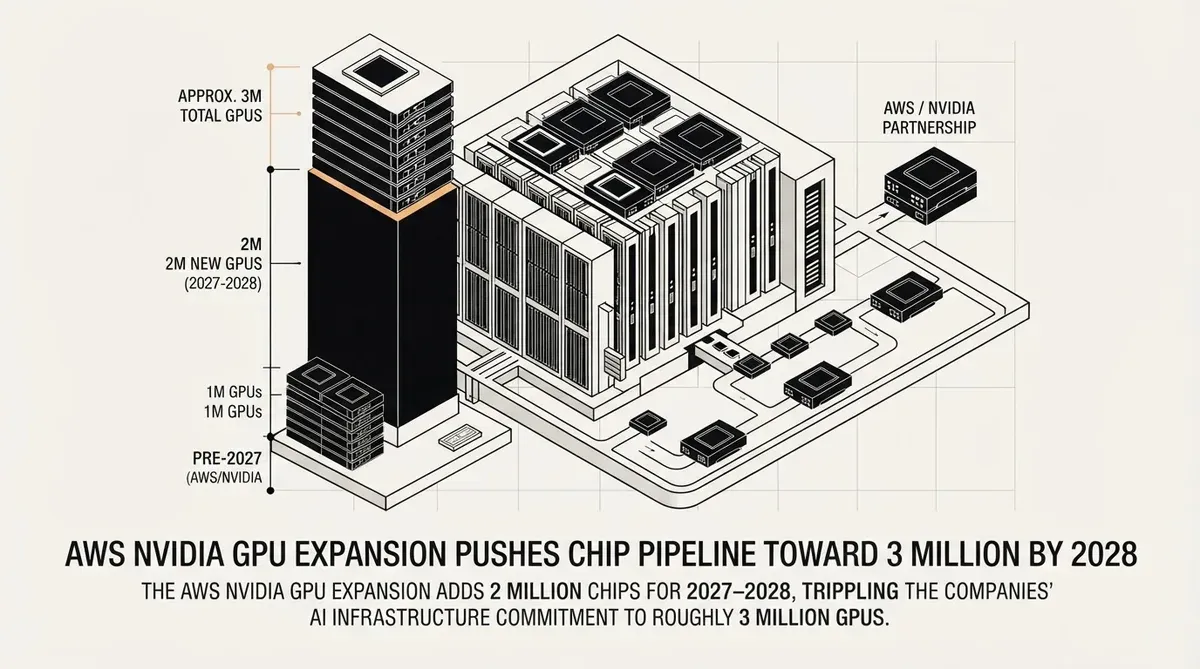
AWS has committed to deploying 2 million additional Nvidia GPUs across its global data-center footprint in 2027 and 2028, roughly tripling the AI infrastructure plans the two companies laid out five months ago. The AWS Nvidia GPU expansion, announced this week alongside Nvidia's second-quarter earnings call, extends a partnership that has run for 16 years and adds Blackwell Ultra, Rubin, and Rubin Ultra silicon to the pipeline.
The earlier commitment, made at Nvidia's GTC conference in March, covered more than 1 million GPUs starting in 2026. Both companies say demand has already absorbed that tranche, which is why the follow-on order targets the next two years. Neither side has disclosed the contract value, unit pricing, or how deliveries will split between chip generations.
Nvidia frames the expanded relationship as infrastructure for agentic and physical AI rather than a straightforward capacity purchase. The joint program spans AI factories, CPUs, networking, open models, and robotics, a sign that the work reaches beyond GPU supply into how Nvidia's full stack is wired into AWS. Nvidia cites surging demand from enterprises, sovereign programs, and frontier research labs as the driver, and the companies note that the March tranche has already been fully consumed.
What the AWS Nvidia GPU expansion includes
The 2 million additional GPUs in the AWS Nvidia GPU expansion cover three Nvidia architectures. Blackwell Ultra is the current-generation upgrade path; Rubin and Rubin Ultra are the next two releases, with deliveries concentrated in 2027 and 2028. Nvidia is also bringing Vera CPU-based infrastructure to AWS, and its chief financial officer said during the earnings call that Vera units would ship in undisclosed quantities, some paired with Rubin systems and some delivered standalone.
The CPU layer is a notable expansion of the relationship. Server CPUs have long been a segment where AWS favors its own Graviton processors, so Vera gives Nvidia a seat in the general-purpose compute tier of the data center as well as the accelerator tier. For customers, that means the control plane and the compute plane of an AWS cluster can both run on Nvidia silicon, a configuration the two companies are positioning as standard.
Two technical pieces stand out. NVLink Fusion, Nvidia's scale-up interconnect, is being extended with custom high-bandwidth memory into racks built around AWS's own Trainium accelerators, so Nvidia's networking now carries traffic from Amazon's in-house chips rather than only from Nvidia GPUs. Separately, AWS is expanding its Blackwell fleet with RTX PRO 4500 Blackwell Server Edition GPUs for Amazon EC2 G7 instances, which the companies say deliver a 4.6x improvement in inference performance and a 2.1x gain on graphics workloads compared with the prior G6 generation.
| Component | What is included |
|---|---|
| GPU commitment | 2 million additional units in 2027-2028 |
| Chip generations | Blackwell Ultra, Rubin, Rubin Ultra |
| CPU infrastructure | NVIDIA Vera, partly integrated with Rubin systems |
| U.S. government AI factories | 100,000 GPUs on secure AWS |
| Interconnect | NVLink Fusion with custom high-bandwidth memory in Trainium racks |
| Physical AI | Amazon Robotics on NVIDIA Isaac and Omniverse |
The agreement also carries a public-sector component. AWS and Nvidia plan to build AI factories for the U.S. government on secure AWS infrastructure, a program sized at 100,000 GPUs for national security workloads. That positions AWS as a delivery channel for sovereign AI capacity in a federal market where procurement cycles run long and vendor relationships tend to persist.
Physical AI is the other new front. Amazon Robotics, Amazon's warehouse automation unit, will run on Nvidia's Isaac and Omniverse stack, which covers robot simulation, training, and development. It is the clearest signal yet that the two companies intend to compete for embodied AI workloads in addition to cloud training and inference.
Software is the quieter thread running through the announcement. The two companies list open models and data processing among the shared workstreams alongside the hardware commitments. Nvidia has been distributing its open-weight model releases through cloud partners, and AWS's position in that flow matters because the value of a GPU fleet is determined by what actually runs on it; raw capacity does not translate into usable performance without the model, framework, and networking layers around it.
What the tripled commitment signals
Taken together with the March pledge, the AWS Nvidia GPU expansion puts AWS's Nvidia pipeline at roughly 3 million GPUs through 2028. For Nvidia, the AWS Nvidia GPU expansion locks in two full product cycles as booked demand: Blackwell Ultra in the near term, Rubin and Rubin Ultra further out. Orders of this size from a cloud of AWS's scale let Nvidia plan wafer allocation and packaging capacity years ahead, and they reduce the risk that its roadmap outruns its order book.
The 16-year partnership gives this commitment a track record that a new entrant could not replicate. AWS has carried Nvidia hardware through multiple product generations, and the escalation follows an established pattern of preview instances, capacity build-outs, and enterprise adoption. What is new is the volume, which exceeds anything the two companies have planned in a single window before.
The AWS Nvidia GPU expansion is a hedge for AWS, executed in both directions. Amazon keeps developing Trainium, its own accelerator line, and the NVLink Fusion work means Nvidia's interconnect will carry Trainium traffic inside AWS racks. At the same time, AWS locks in the industry's most sought-after silicon for customers who prefer the mainstream Nvidia path, so the cloud can serve both procurement routes without forcing buyers to pick sides.
The AWS Nvidia GPU expansion landed on Nvidia's earnings day, when investors are weighing whether the AI capital-spending cycle can hold its pace. A customer as large as AWS extending commitments through 2028 is concrete evidence that the build-out has not peaked among the biggest buyers, and it pressures rival hyperscalers to match the scale of their forward orders, since GPU delivery windows are negotiated years in advance.
For Nvidia, the commitment gives investors a measurable anchor for 2027 and 2028. Data-center revenue is concentrated among a handful of hyperscaler buyers, and public multi-million-GPU pledges from those customers carry weight with anyone asking how long the AI build-out can last. Disclosing volumes while keeping pricing private lets both sides manage expectations without ceding negotiating leverage.
For enterprise buyers, the effects are more immediate. The G7 inference gains lower the cost per token for production workloads, and the incoming volume of capacity makes GPU scarcity a smaller constraint for AWS customers planning large-scale agentic AI deployments through the end of the decade. The open question is pricing: with contract values undisclosed, there is no public reference point for what Rubin-era capacity will cost once it reaches general availability.
The robotics piece has a financial logic of its own. Amazon Robotics runs one of the largest warehouse automation deployments in commerce, and moving its simulation and training onto Nvidia's Isaac and Omniverse stack ties a high-volume internal workload to Nvidia's physical AI roadmap. That gives Nvidia a reference deployment it can point to when selling the same stack to other logistics operators.
Why this matters
The AWS Nvidia GPU expansion is a demand signal with a two-year horizon. It tells enterprise planners that GPU capacity on Amazon's cloud will keep growing through 2028, and it tells Nvidia that its next two architectures already have one of the biggest buyers on the hook. For AWS customers building agentic and physical AI systems, that translates into planning confidence; for the rest of the cloud market, it raises the bar on forward commitments.
Sources
AWS and NVIDIA expand partnership for next-gen AI ...
AI-generated image.
Related Articles
- AWS Debuts Amazon EC2 P6-B300 Instances Featuring NVIDIA Blackwell Ultra GPUs
- AWS Launches NVIDIA Blackwell-Powered Amazon EC2 P6-B200 Instances for AI Training
- AWS Integrates NVIDIA Blackwell GPUs into SageMaker with New G7e Instances
✔Human Verified
Researched and cross-referenced against primary sources by the Bytevyte editorial team. This article was generated with the assistance of artificial intelligence and reviewed by the Bytevyte editorial team.