
California's No Robo Bosses Act would end AI-only firings as 6 in 10 managers admit using AI in layoffs
California's No Robo Bosses Act would force human review of AI firings with $500 penalties, as managers admit unsupervised AI layoffs are already routine.
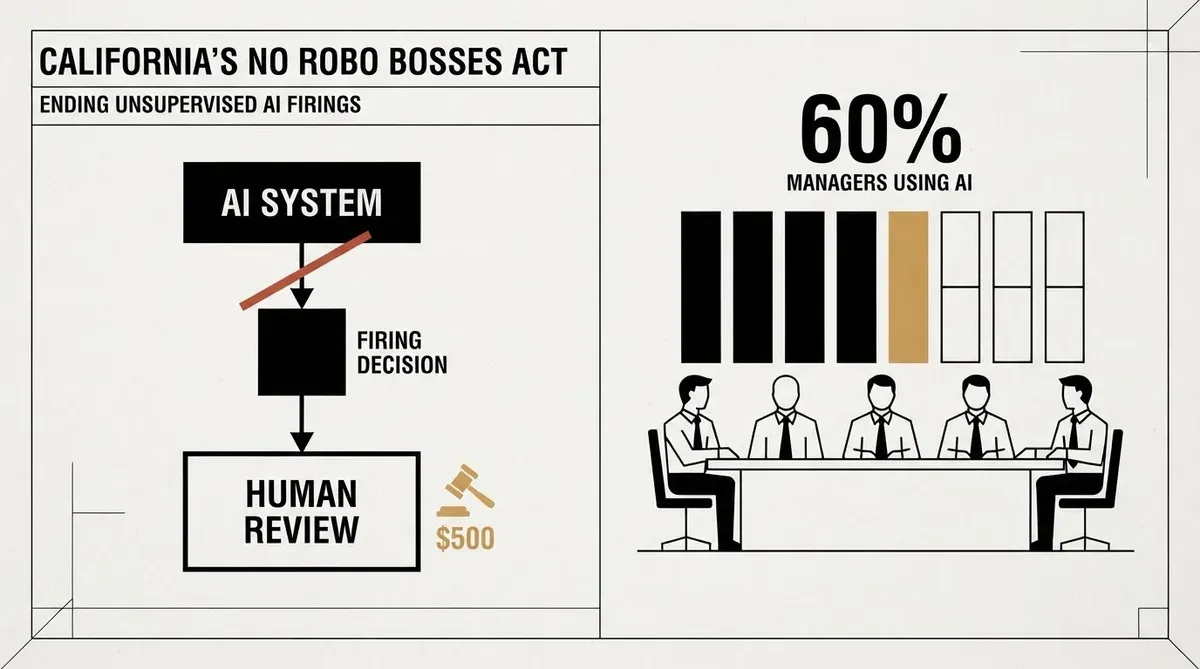
Under California's No Robo Bosses Act, an employer could no longer fire or discipline a worker on an algorithm's output alone. Before any adverse action, a human reviewer would have to examine what the automated system produced, verify it on the merits, and confirm it. State Sen. McNerney introduced the bill, with Sen. Reyes and Assembly Members Kalra and Ward as coauthors. It awaits a floor vote before the session ends Aug 31; if it becomes law, the provisions take effect July 1, 2027.
The bill arrives as that behavior has become ordinary practice. A survey published this week found almost six in ten managers consult AI when choosing which workers to lay off; another 58% use it to determine who should be let go. Among managers who rely on AI for layoffs, 43% said the system sometimes made the call with no human oversight. That is the current baseline in the American workplace, which means the human-review requirement would regulate mainstream practice, not a fringe experiment, and it would reach most sizable employers in a state that anchors a large share of the country's technology and service employment.
What the No Robo Bosses Act actually requires
The bill amends how the state Labor Code treats automated decision systems, or ADS. Companies may still use AI to inform personnel decisions, but a termination or disciplinary action can no longer rest on machine output alone. A specific person must investigate the system's result independently and validate it before the employer acts. The affected worker must also get written notice when AI was a primary factor in the decision.
The data rights are the part employers tend to underestimate. A worker could request a description of the personal data the ADS used over the preceding 12 months, which forces a company to keep a legible record of what its models were fed and when. The bill exempts national-security federal contracts and certain collective-bargaining agreements, and it prices violations at $500 each.
The bill's language leaves employers to define when AI becomes a "primary factor" in a disciplinary decision. That ambiguity cuts both ways: companies that under-disclose risk penalties multiplied across a workforce, while companies that over-disclose hand employees a litigation hook. The practical answer will be conservative disclosure, which means more written notices, not fewer.
The accountability gap is a pricing problem
Here is where I stop being neutral about the numbers. Uber is facing an €825 million GDPR fine in Europe for suspending drivers automatically with no human review, the same class of behavior priced on a scale California does not approach. Europe's enforcement regime scales penalties with revenue; California's bill charges a fixed sum per incident. An employer that runs a flawed model across a 2,000-person reduction exposes itself to roughly $1 million in penalties, an amount most finance teams would treat as a rounding error against the savings the layoff was meant to deliver.
The Uber case also carries a lesson for US companies that operate in both markets: the same automated systems used to manage California workers are already running inside the EU, where revenue-linked fines are a live threat. The $500 state penalty is the cheap side of that equation, not the expensive one.
The strongest argument against the bill is that it does not ban AI-assisted firing at all. It demands a human signature, and signatures can become rubber stamps. Nothing in the text requires the reviewer to be skeptical, to dig past the system's output, or to carry personal liability for a wrong call. If companies treat the requirement as a checkbox, the law adds a form without changing an outcome.
I think that objection misses what the bill actually changes. The survey tells us unsupervised decisions are already routine, so the compliance cost lands on a practice that is widespread rather than exotic. The reviewer has to investigate and corroborate, the employee has to receive written notice, and the company has to be able to reconstruct 12 months of data inputs on request. The written-notice rule matters on its own: once every disciplinary letter discloses AI's role, that disclosure becomes evidence in wrongful-termination claims, and employers will have to stand behind the process they used. An audit trail that must survive inspection changes behavior even when the penalty is small.
Employers are not priced for the July 2027 deadline
The calendar makes the deadline closer than it appears. SB 947 passed the Senate 29-9 on May 19, received a 5-1 and then a 10-4 vote in the Assembly Privacy Committee, won approval from Assembly Appropriations on July 1, and survived the Aug 13 suspense hearing before advancing to third reading on Aug 21. It is among 21 AI bills awaiting final votes before the legislature adjourns Aug 31. A companion bill, SB 951, would require 90 days' notice when technological displacement affects a quarter or more of a workforce. The 29-9 margin and the lopsided committee votes suggest this is not a fringe proposal.
For a decision-maker, the practical work starts now rather than in 2027. The first step is an audit: which tools touch termination or discipline decisions, and can anyone in the organization reconstruct what each tool was given? The second is defining what independent investigation means in practice, because a supervisor glancing at a score is not the same as one rechecking the underlying inputs. The third is budgeting for the new data access requirement, because responding to a 12-month description request carries real engineering cost. HR software vendors will feel it too, because every workforce-management platform sold into California now carries a documentation requirement its buyers must meet. All of it is cheaper to build before a compliance deadline than after a violation.
The state-level pattern is clear. New Jersey has already enacted its FAIR Act to block algorithmic inflation of rental prices, New York is weighing rules on children's chatbot safety and training-data transparency, and Europe has demonstrated what revenue-scale enforcement looks like. California's No Robo Bosses Act is one floor vote from becoming the template for American regulation of algorithmic employment decisions, and the $500 penalty is best read as the floor of compliance cost, not the ceiling.
Why this matters
The central issue is accountability: letting an algorithm fire people with no human checking its work has become normal, and California is moving to make it unlawful. The $500-per-violation price is weak next to the €825 million Europe is seeking from Uber for the same class of behavior, but the law's real leverage is the audit trail: written notice, data rights, and a required human review. Employers who have treated AI as a free pass on personnel decisions should treat July 2027 as the deadline they are not yet priced for.
AI-generated image.
Related Articles
- The AI Layoff Boomerang: Why 55% Regret Cutting Workforce
- Companies Blame AI for Layoffs They'd Have Made Anyway
- AI Productivity Gap Widens as Layoffs Climb
✔Human Verified
Researched and cross-referenced against primary sources by the Bytevyte editorial team. This article was generated with the assistance of artificial intelligence and reviewed by the Bytevyte editorial team.