
ClickUp Cuts 22% of Staff to Pivot Toward 100x Efficiency with 3,000 Internal AI Agents
ClickUp cuts 22% of staff to deploy 3,000 internal AI agents, aiming for 100x efficiency and offering million-dollar salaries for automation talent.
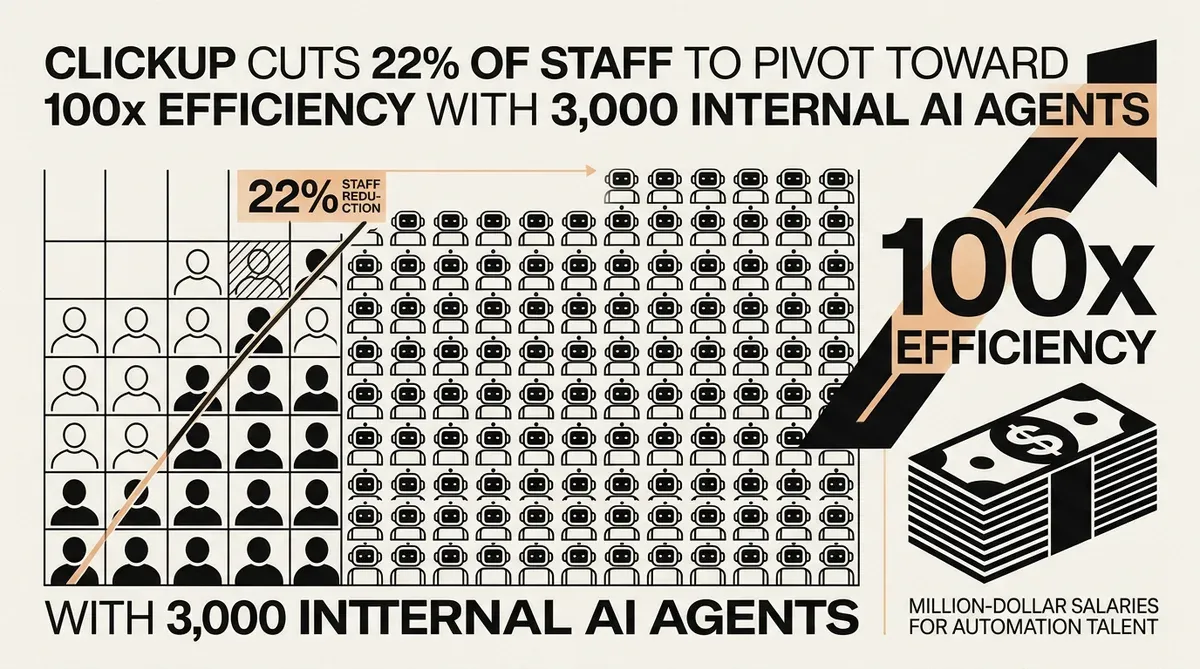
ClickUp has initiated a significant corporate restructuring, reducing its workforce by 22% as it transitions toward an operational model powered by 3,000 internal AI agents. CEO Zeb Evans announced the shift this week, framing the layoffs not as a traditional cost-cutting measure, but as a strategic pivot to become a 100x organization where software handles execution and humans focus on oversight.
The productivity software startup, which reached a $4 billion valuation in 2021, is a primary test case for autonomous enterprise operations. By deploying thousands of specialized agents to manage internal tasks, the company aims to drastically increase output while maintaining a leaner headcount. This restructuring signals a fundamental change in how high-growth technology firms may scale in the future, prioritizing algorithmic efficiency over human-centric expansion.
Strategic Shift to Internal AI Agents
The deployment of internal AI agents at ClickUp is one of the most aggressive internal applications of autonomous software in the SaaS sector. These agents are designed to handle complex operational workflows that previously required manual intervention. According to Evans, the goal is to move employees away from direct execution and into roles where they act as reviewers and strategists for the AI systems they manage.
To support this transition, ClickUp is reallocating the capital saved from the workforce reduction into significantly higher compensation for remaining staff. The company has introduced new salary bands that include potential million-dollar packages for individuals who successfully automate their own roles or departments. This incentive structure is designed to attract and retain talent capable of building and maintaining the internal AI agents that now form the backbone of the company's operations.
Implications for the Tech Labor Market
ClickUp's move reflects a broader trend in the technology industry where AI is used to compress organizational structures. By replacing 22% of its staff with automated systems, the company is betting that a smaller, highly compensated team of AI orchestrators can outperform a larger traditional workforce. This strategy challenges the conventional wisdom that headcount growth is a primary indicator of a startup's success and scaling potential.
For decision-makers and strategists, the ClickUp restructuring is a blueprint for the next phase of enterprise efficiency. The focus is shifting from using AI as a simple productivity tool to integrating it as a core component of the workforce. As of 2026-05-26, the success of this 100x organization model will likely influence how other venture-backed firms approach hiring and automation in an increasingly competitive market.
The transition at ClickUp is currently ongoing, with the company focusing on the integration of these autonomous systems across its product development and customer support divisions. The industry will be watching closely to see if the reduction in human staff, balanced by the massive deployment of internal AI agents, results in the promised exponential gains in efficiency and innovation.
While we strive for accuracy, bytevyte can make mistakes. Users are advised to verify all information independently. We accept no liability for errors or omissions.
AI-generated image.
Related Articles
- Cloudflare and Upwork Cut Staff to Accelerate Pivot Toward Agentic AI Models
- Freshworks AI-led Strategic Realignment Triggers 11% Workforce Reduction
- Meta Realigns Workforce with $135 Billion AI Infrastructure Push
✔Human Verified