
Databricks Unveils Enterprise Strategy for Scaling Autonomous AI Agents
Databricks outlines a new strategy for scaling autonomous AI agents in enterprises, focusing on unified governance and shadow deployment to ensure security.
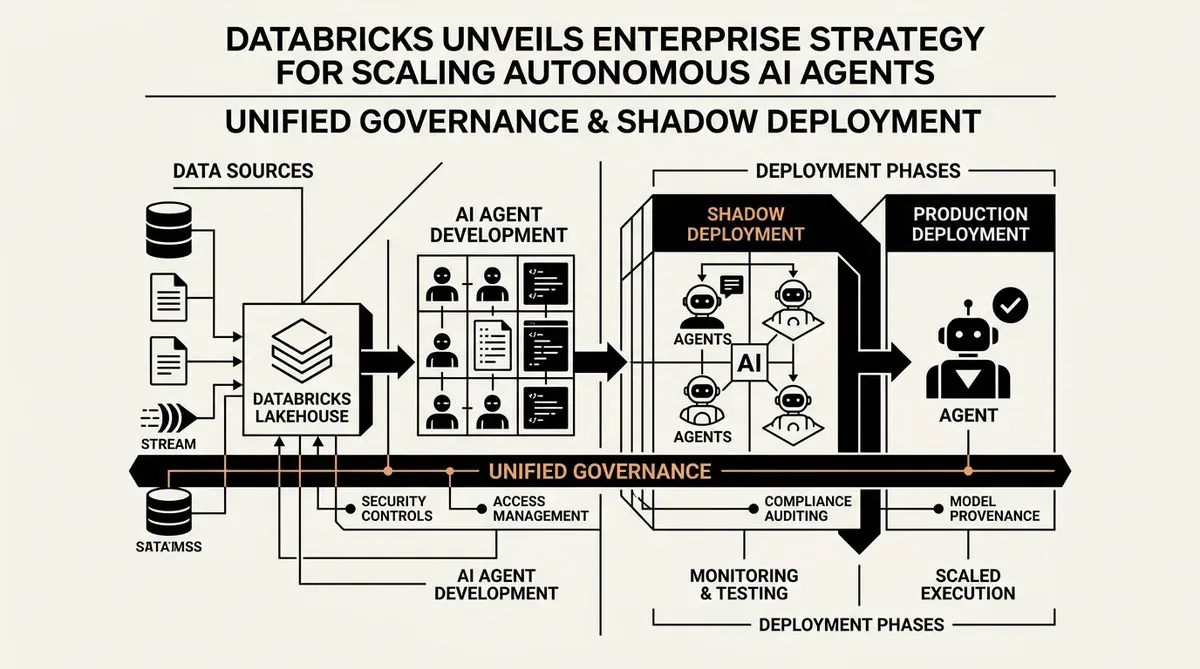
Databricks has released a strategic framework for scaling autonomous AI agents within large organizations, signaling a shift from simple task-based assistants to outcome-focused systems. The company identified integrated governance and unified data architecture as the primary requirements for moving these agents from experimental phases into production. This strategy addresses the growing demand for AI that can handle complex, multi-step workflows rather than isolated queries.
The Databricks approach emphasizes the use of shadow deployment to mitigate the risks associated with autonomous systems. Under this model, organizations run AI agents in the background as challengers to existing legacy software. This allows teams to compare AI-generated outcomes against established systems without granting the agents direct control over live operations. By using these sandboxes, firms can perform continuous risk assessments and re-evaluate model profiles before a full rollout.
Overcoming Governance Barriers for Autonomous AI Agents
Governance remains the most significant obstacle to the adoption of autonomous AI agents in the enterprise sector. To solve this, the framework advocates for a single secure architecture where compute, data, and governance are fully integrated. This unified structure ensures that every action taken by an agent is traceable and remains within the security boundaries of the organization. Without this integration, scaling becomes nearly impossible due to fragmented accountability and data silos.
The strategy also highlights the importance of workforce readiness and early wins to build institutional confidence. Databricks suggests that leaders should focus on automating internal workflows, such as employee onboarding, to demonstrate immediate return on investment. By providing natural-language interfaces, companies can allow non-technical staff to interact with these agents, effectively up-skilling the workforce while maintaining high security standards.
Beyond internal workflows, the framework addresses the technical necessity of a data-centric foundation. For autonomous AI agents to function reliably, they require access to high-quality, real-time data that is governed by the same policies as the rest of the enterprise. Databricks argues that the separation of AI compute from the underlying data layer often leads to security vulnerabilities and inconsistent performance. By consolidating these elements, businesses can ensure that agents operate with the most current information while adhering to strict compliance mandates.
As of May 2026, the transition toward agentic AI is accelerating as businesses seek to automate entire business processes. The Databricks framework suggests that the path to success lies in treating AI agents as part of a broader data ecosystem rather than standalone tools. Future deployments will likely depend on how well organizations can balance the speed of innovation with the necessity of rigorous, automated oversight. The company plans to continue refining these governance tools as more enterprises move their agentic pilots into full-scale production environments.
While we strive for accuracy, bytevyte can make mistakes. Users are advised to verify all information independently. We accept no liability for errors or omissions.
Sources
How enterprise leaders are scaling AI agents across their organization
AI-generated image.
Related Articles
- Databricks Debuts Agent Bricks for Managed Corporate AI Workflows
- Databricks and AWS Launch New AI Governance Tools for Agentic Workloads
- Databricks Launches Genie Agent Mode for Data Analysis
✔Human Verified