
DeepMind A24 AI Filmmaking Partnership: Google's $75M Deal
The DeepMind A24 AI filmmaking partnership pairs $75M from Google with filmmaker-driven AI research, while keeping A24's library off-limits for training models.
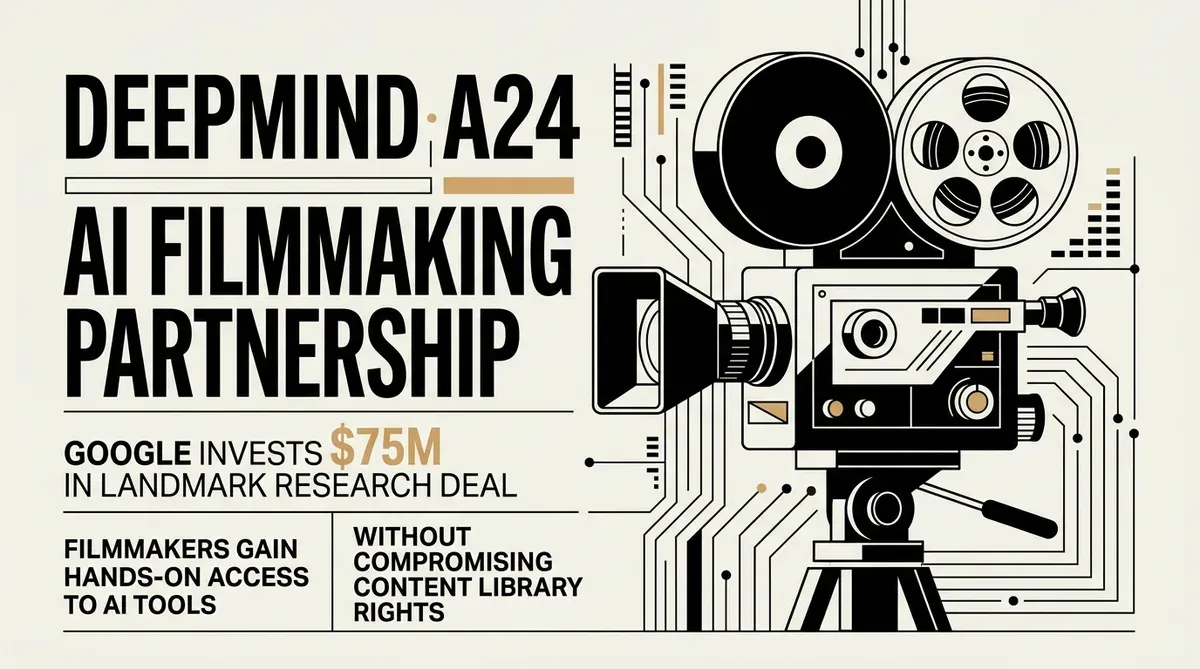
Google DeepMind has entered a research partnership with independent film studio A24, pairing the AI lab with a filmmaker-focused production company in a multiyear collaboration announced this week. The DeepMind A24 AI filmmaking partnership includes a roughly $75 million equity investment from Google, marking the company's first direct stake in a film studio. This marks a shift from Google's prior strategy of licensing content for AI training toward direct equity stakes in content producers.
Under the deal, A24's filmmakers can use DeepMind's research infrastructure directly, while DeepMind receives input from working directors as it develops new creative tools. The multi-project, multiyear scope of the agreement signals a deeper integration than a typical vendor relationship would provide.
Structure and Boundaries of the DeepMind A24 AI Filmmaking Partnership
Unlike several high-profile licensing deals between AI companies and content owners, this partnership explicitly does not give Google access to A24's existing film and television library or its content data for training purposes. The agreement is structured as a nonexclusive, multiyear research collaboration rather than a data licensing arrangement. That structure distinguishes the deal from earlier licensing agreements between AI firms and publishers or studios, where training data access was central.
This distinction matters for the broader entertainment industry. Previous tensions between AI developers and Hollywood have centered on whether copyrighted material can be used to train models without permission. By walling off its library, A24 maintains control over its intellectual property while still exploring how generative AI can assist in pre-production and development work.
The collaboration is anchored within the creative process itself, meaning the tools being built are shaped by the filmmakers who would use them rather than developed in isolation and then marketed to studios. This approach contrasts with selling pre-built tools to studios.
Strategic Rationale for Both Parties
For Google DeepMind, the partnership provides a real-world testing ground for AI tools in a high-stakes creative environment. Film production involves complex workflows spanning storyboarding, cinematography, editing, visual effects, and sound design, each of which presents distinct opportunities for AI assistance. Direct engagement with A24 filmmakers gives DeepMind researchers access to use cases and pain points that might not surface in a more theoretical lab setting.
The $75 million investment also gives Google a foothold in independent film at a moment when the industry is grappling with how AI will reshape production economics. A24 has built a reputation for distinctive, filmmaker-driven projects that achieve both critical acclaim and commercial success with recent hits including Backrooms and Obsession. Aligning with a culturally influential studio strengthens Google's position in entertainment technology discussions.
For A24, the partnership offers access to advanced AI research infrastructure without the capital expenditure of building such capabilities internally. The Google investment also provides financial resources that can be directed toward production and development. For A24, the deal avoids the cost of building its own AI research team while still giving its directors early exposure to generative tools.
Broader Industry Dynamics
The partnership arrives as AI companies increasingly seek relationships with creative industries to demonstrate practical applications for their technology. Competitors including OpenAI and Adobe have also pursued relationships with entertainment companies, though the structures of those deals vary considerably.
What sets this collaboration apart is the research-first framing and the explicit separation between the partnership and any content licensing arrangement. Most AI-entertainment deals to date have involved either licensing content for training data or providing tooling on a vendor basis. The DeepMind-A24 model positions the collaboration as a joint research endeavor, with both sides contributing expertise and sharing what they learn.
The nonexclusive nature of the agreement also means A24 remains free to work with other technology partners. This flexibility matters in a rapidly changing environment where production workflows and available tools are evolving month by month.
What This Means for Studio Executives
For studio executives and production companies evaluating AI partnerships, the DeepMind-A24 structure offers a potential template. The deal demonstrates that it is possible to collaborate with AI researchers without surrendering content libraries or creative control. The walled-off data approach may become more common as studios seek to explore AI capabilities while managing legal and reputational risks.
Several factors make A24 a particularly suitable partner for this kind of research collaboration. The studio is known for giving directors significant creative autonomy, which means its filmmakers are accustomed to experimenting with new techniques and tools. Its relatively lean operation compared to major studios also means decisions about adopting new technologies can move faster. A24's recent track record of producing culturally resonant films gives the partnership visibility within the industry that a smaller or less established studio could not provide.
For AI companies targeting the entertainment sector, this partnership validates the value of direct collaboration with working creatives during the development process. Products built in consultation with end users are likely to see higher adoption rates than those designed solely by engineers. The feedback loop between DeepMind researchers and A24 filmmakers could produce tools that address genuine production bottlenecks rather than perceived needs.
The deal also carries implications for talent relations. Hollywood has seen significant debate around AI's role in filmmaking, with writers' and actors' strikes in recent years partly driven by concerns about automation. By positioning the partnership as artist-empowering rather than efficiency-driven, both companies are attempting to frame AI adoption in terms that working creatives might find more acceptable. Whether this framing holds as specific tools emerge and are deployed on actual productions remains an open question.
Investment Signal for Technology Investors
Technology investors should note that Google's first equity stake in a film studio signals a willingness to deploy capital alongside research partnerships to secure strategic positions in key industries. This model could extend to other verticals where AI has clear applications but adoption depends on trust and collaboration with incumbent players.
The $75 million investment amount is relatively modest by Google's standards but strategically significant as a precedent. If Google applies this partnership-plus-equity model to other industries such as healthcare, finance, or manufacturing, the cumulative investment across sectors could become material. Each such deal would provide DeepMind with domain-specific feedback loops that pure lab research cannot replicate.
For the independent film sector, the Google investment is one of the larger technology sector infusions into a studio. Other AI companies may follow with their own entertainment partnerships, though the terms and structures will likely vary based on each studio's negotiating position and tolerance for technology experimentation.
Sources
Google DeepMind and A24 announce first-of-its-kind research partnership
AI-generated image.
Related Articles
- Google Cloud Launches $750M Agentic AI Partner Fund
- DeepSeek Targets $45 Billion Valuation in $10 Billion Funding Round
- Google AI Partnership Singapore: New Healthcare and Research Expansion Announced
✔Human Verified
Researched and cross-referenced against primary sources by the Bytevyte editorial team. This article was generated with the assistance of artificial intelligence and reviewed by the Bytevyte editorial team.