
EU AI Gigafactories: Europe's €30B Sovereign Compute Bet
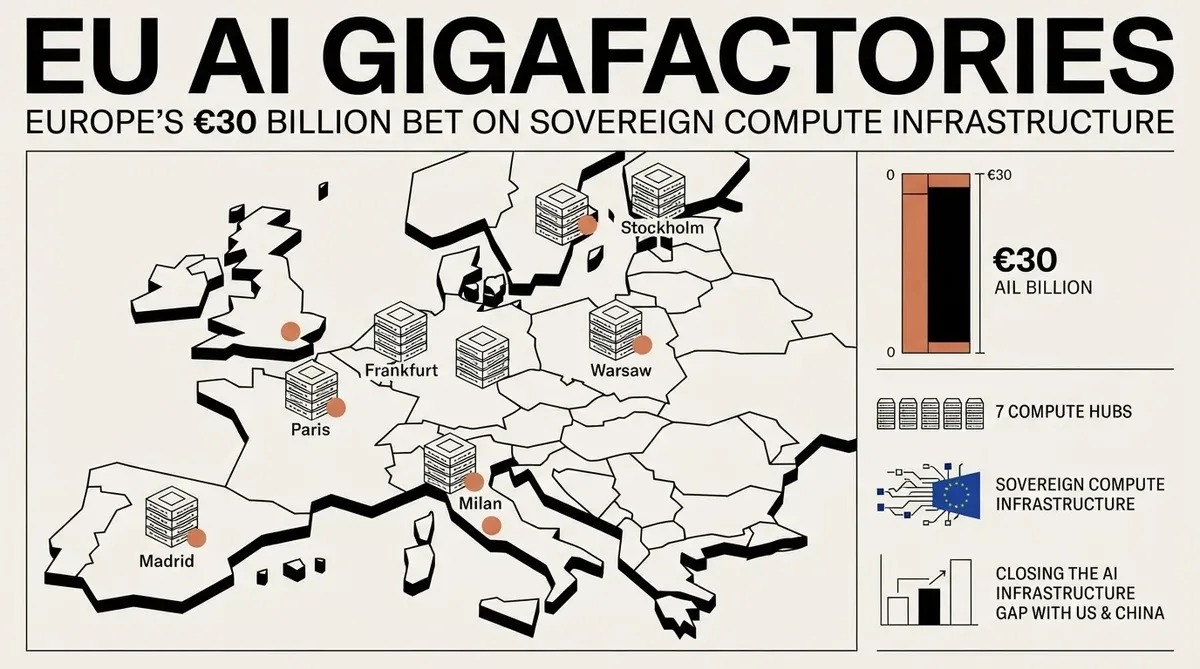
The European Commission has launched its most ambitious bid to close the AI compute gap with the United States and China. A €30 billion programme to build seven EU AI gigafactories across the bloc is now formally open for bids. The call-for-tender, published on Thursday, commits €5 billion in direct EU funding, matched by €5 billion from participating member states, with the aim of attracting at least €20 billion in private capital. The total investment is a significant scale-up from the original February 2025 blueprint, when Commission President Ursula von der Leyen targeted four gigafactories at roughly half the current public outlay.
Eighteen EU countries have expressed interest in hosting the facilities, which are divided into two tiers. Three large gigafactories, each equipped with at least 100,000 advanced AI chips, will anchor the network. Four medium-sized hubs will carry up to 75,000 chips each. Germany, Italy, Spain, Portugal and Greece are among the countries vying for the large sites, while France, Poland, Finland, Denmark and Czechia have signalled interest in the medium tier. The Commission has indicated that the infrastructure should be operational by mid-2028.
The EU AI Gigafactories Infrastructure Bet
Each gigafactory is designed to deliver roughly four times the compute power of current EU data centres, more than doubling the region's total AI training capacity. The underlying economics reflect a deliberate strategic choice. Rather than relying solely on US hyperscalers such as Microsoft Azure, Amazon Web Services and Google Cloud, the EU is attempting to build sovereign AI infrastructure that keeps training data under European governance frameworks, including the AI Act and the Digital Services Act.
The public-private funding model carries its own logic. The €5 billion EU contribution comes from the Digital Europe Programme and Horizon Europe, while the matching €5 billion from member states ties national budgets to a coordinated pan-European architecture. The €20 billion private investment target, if realised, would give the project a leverage ratio of roughly 3:1, with every euro of public money drawing three euros from industry. The AION consortium in France, which includes private equity firm Ardian alongside Iliad, Orange, EDF and Scaleway, has already submitted a bid for a campus outside Paris valued at approximately €10 billion, signalling that the private sector is engaging early.
The scale of interest is notable. The European Commission received 76 expressions of interest for the original gigafactory initiative, far exceeding the number of available slots. This demand suggests that the private sector sees a viable business case for European AI compute, even before the final funding terms are set. The expanded scope from four to seven facilities was a direct response to this strong engagement from industry and member states alike.
Scale vs. Sovereignty: The Trade-Off
The decision to expand from four to seven gigafactories reflects strong political demand from member states, but it also introduces a structural tension. A network of seven distributed hubs spreads compute capacity across more countries, which satisfies national ambitions for AI infrastructure investment. However, it fragments the total chip allocation, roughly 600,000 advanced chips across all seven sites, into smaller clusters than a single, concentrated data centre campus would allow. US hyperscalers operate clusters of 100,000 H100-equivalent GPUs as individual training runs. The EU's three largest hubs will match that number per site, but the four medium hubs will run at 75,000 chips each, a scale that may limit the size of the largest models they can train efficiently.
The fragmented model also introduces coordination costs. Eighteen interested countries must negotiate site selection, energy supply, grid connections and regulatory approvals across different jurisdictions. The Commission has not disclosed how it will adjudicate competing bids, and the procurement process is likely to favour consortia that can demonstrate readiness, including available power capacity, fibre connectivity and construction timelines, over purely political considerations. This creates an inherent advantage for member states with existing data centre clusters in Germany, France or Spain, while potentially leaving smaller or less-connected countries on the sidelines.
On the sovereignty dimension, the EU gains a clear advantage. Training data for models developed on EU AI gigafactories will remain subject to European data protection rules, reducing reliance on third-country cloud providers for sensitive applications in healthcare, defence and public administration. The ability to certify that a model was trained on sovereign infrastructure could become a procurement requirement for EU public-sector AI deployments, giving the gigafactories a captive demand base that US-based compute providers cannot easily serve.
Comparing the Competitive Field
US hyperscalers are not standing still. Microsoft, Amazon and Google collectively committed more than $100 billion to AI infrastructure in 2025 alone, with individual data centre campuses exceeding 500,000 GPUs. The 600,000-chip network of EU AI gigafactories, even at full build-out, equals about six months of US hyperscaler expansion at current rates. China's state-backed investment in AI compute, while harder to quantify precisely, has accelerated through national programmes that integrate chip manufacturing, data centre construction and model development under central coordination, an approach the EU's multi-country model cannot replicate.
Where the EU can differentiate is on operating cost and energy mix. Several of the interested member states, including Spain, Portugal and Greece, offer access to low-cost renewable energy, which is a growing share of total data centre expenditure as chip power densities rise. The Commission's requirement that gigafactories meet sustainability criteria could give European sites a long-term cost advantage over US facilities in regions with higher grid prices or less renewable penetration. Greece, in particular, has positioned itself as a potential energy-efficient hub for AI compute, leveraging its solar capacity and plans for subsea fibre connections to Asia and Africa.
The timeline to mid-2028 also matters. By the time these gigafactories come online, the US and China will have deployed two more generations of AI hardware and likely moved to even larger training clusters. The EU is effectively betting that catching up in compute capacity in 2028 is still early enough to matter for model development. That bet depends on whether algorithmic efficiency gains can compensate for a four-year hardware lag, or whether the compute divide has become self-reinforcing by that point. European researchers have been among the leaders in efficient training techniques, which could narrow the effective gap even if raw chip counts lag behind.
An additional factor is the emerging competition among member states for hosting rights. The AION consortium's €10 billion bid for a French site demonstrates that national consortia are willing to commit significant private capital upfront, potentially giving them an edge in the selection process. Other member states will need to assemble similarly credible proposals to compete. The Commission's decision on which bids succeed will shape the geographic distribution of European AI capability for at least a decade. The procurement process also requires bidders to show how their facilities will integrate with the existing EuroHPC supercomputing network, adding another layer of technical requirements.
Why this matters
The EU AI gigafactories are a deliberate departure from the market-driven model that has defined AI infrastructure to date. By injecting €10 billion in public money to crowd in private capital, the Commission is testing whether state-coordinated compute infrastructure can compete with the scale of hyperscaler investment. The outcome will determine if Europe trains its own frontier models and whether a sovereignty-first approach to AI infrastructure can work. That question matters beyond Brussels, as other mid-sized economies watch the bet's result.
Sources
European approach to artificial intelligence
AI-generated image.
Related Articles
- EU AI Gigafactory Project Stalls as Funding Gaps and Delays Alienate Partners
- EU Tech Sovereignty Initiative Targets Independence from US and Asian Supply Chains
- European Commission Proposes Cloud and AI Development Act to Expand Digital Infrastructure
✔Human Verified
Researched and cross-referenced against primary sources by the Bytevyte editorial team.