
EU Android AI Assistant Ruling Forces Google to Open Gemini-Level Access on Android
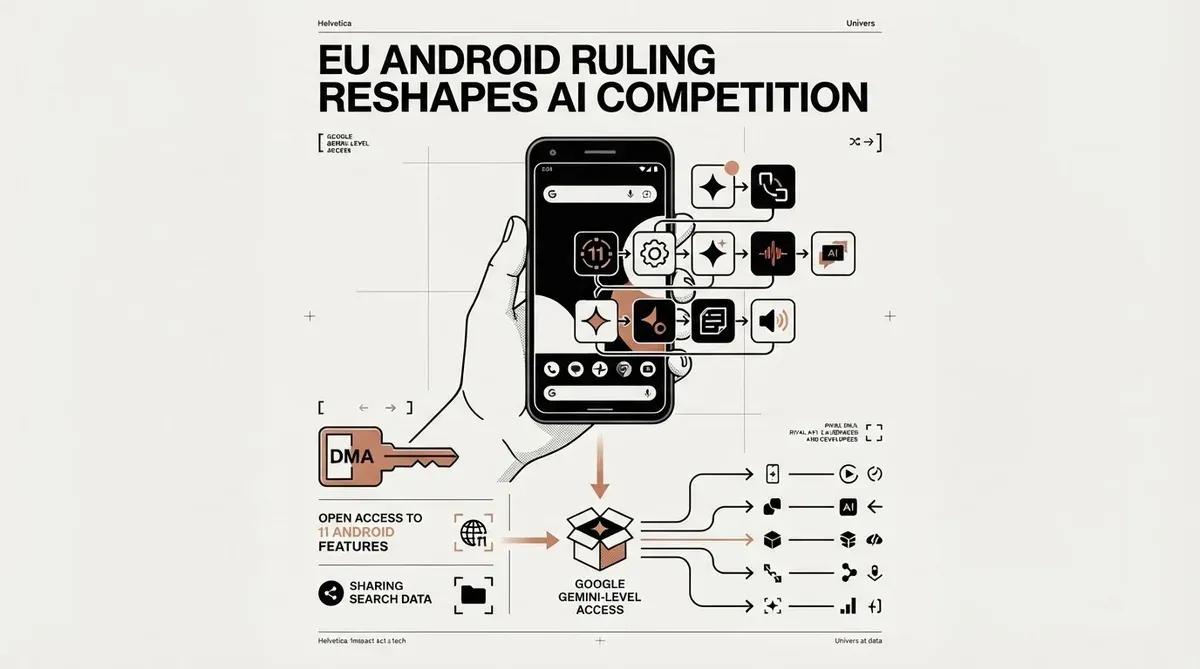
The European Commission has issued two binding orders that compel Google to give rival artificial intelligence assistants the same access to Android device features that its own Gemini service enjoys. The decisions, announced under the Digital Markets Act on July 16, represent the first regulatory blueprint anywhere in the world defining what fair AI assistant access on a mobile operating system must look like.
The measures arrive weeks after the EU's highest court permanently sealed a €4.1 billion antitrust fine against Google for past Android monopoly abuse. Together, the twin rulings signal that Brussels is shifting from punishing past conduct to proactively shaping how the next generation of AI powered platforms operates.
What the Orders Require
The binding specification measures target two distinct parts of Google's ecosystem. The first covers Android interoperability. Google must open up 11 system-level features to third-party AI services by July 2027. These include voice wake-word activation, screen context reading, and app hooks that Gemini already uses. Currently, rival AI assistants cannot match Gemini's deep integration with the operating system. The EU says this gives Google an unfair competitive advantage on the dominant mobile platform in Europe.
The second set of measures addresses search data. Starting January 2027, Google must share anonymised ranking, query, click, and view data with rival search engines and AI chatbots on fair, reasonable, and non-discriminatory (FRAND) terms. An independent third party will evaluate Google's anonymisation methods to ensure user privacy is genuinely protected. This data sharing requirement explicitly extends to AI chatbots, meaning services like ChatGPT and Claude could tap into Google's search signals to improve their own responses.
User Choice Screen for AI Assistants
Android users across the European Union will see a choice screen for AI assistants, similar to the existing browser choice screen already mandated under EU rules. Once a user selects a preferred assistant, that service will be summonable via voice commands and capable of performing agentic actions. This capability is currently reserved for Gemini on most Android devices.
The choice screen mechanism is a direct parallel to the browser ballot screen that the EU previously forced Microsoft to implement and later applied to Android browsers. In that case, the measure led to measurable shifts in market share, and the Commission appears to expect a similar dynamic for AI assistants. The goal, according to regulators, is to prevent Google from using its mobile OS dominance to box out competing AI services.
Google's Privacy and Security Objections
Google's President of Global Affairs, Kent Walker, published a detailed response on July 16 arguing that the ruling threatens to undermine privacy and security for millions of Europeans. Walker stated that the decisions discount extensive evidence of user harm and that AI assistants already safely access Android's capabilities through existing phone maker vetting processes.
He warned that granting external apps sensitive device permissions without adequate safeguards would expose Europeans' private searches to unfamiliar companies, weaken privacy, risk business trade secrets, and endanger national security. Google also noted that it had repeatedly offered solutions to safeguard users while satisfying the DMA's goals, but those proposals were discounted by regulators.
The company's core argument is that phone manufacturers already serve as gatekeepers who vet which AI assistants can access Android's deep features. Introducing a regulator-mandated open access model, Google contends, removes that safety layer and replaces it with a system where anonymisation quality and permission controls become the sole responsibility of an independent evaluator rather than the device maker.
Enforcement and Timeline
Non-compliance carries significant financial risk. The European Commission can levy fines of up to 10 percent of Google's annual worldwide turnover for violations of the DMA orders. Given Alphabet's recent annual revenue of approximately $350 billion, a theoretical maximum fine could run into the tens of billions, though the Commission has historically applied fines well below the statutory ceiling.
The staggered timeline gives Google roughly one year to implement each set of changes, with search data sharing due by January 2027 and Android interoperability by July 2027. This pacing mirrors the approach the Commission took with other DMA compliance deadlines, providing a structured transition rather than demanding immediate restructuring.
Broader Implications for Competing AI Services
The ruling creates what amounts to a new regulatory category: mandated AI platform interoperability. For smaller AI developers and search engines operating in Europe, the orders open technical pathways that were previously unavailable. A startup building an AI assistant can now design for the same depth of Android integration that Google's own team had, including voice activation from the lock screen and the ability to read and act on on-screen content.
For larger competitors such as Microsoft with Copilot, OpenAI with ChatGPT, and Meta with its AI services, the EU Android AI assistant ruling provides a legal mechanism to bypass Google's control over the Android AI layer without needing separate negotiations with every phone manufacturer in Europe. The single regulatory order supersedes what would otherwise be hundreds of bilateral commercial agreements.
Why This Matters
This ruling shifts the competitive dynamics of the smartphone AI market in Europe from one where Google controls access to the core capabilities of its operating system to one where rivals can compete on equal technical footing. For consumers, the practical effect will be the ability to choose any AI assistant as their default voice interface on Android, a choice that did not meaningfully exist before. For the broader industry, the EU Android AI assistant ruling creates a regulatory template that other jurisdictions may follow when assessing whether dominant platform operators are unfairly locking out AI competition. The decisions also reinforce the DMA as the primary legal instrument through which the EU intends to govern AI platform competition, well before any dedicated AI legislation matures.
Sources
The DMA should not undercut security & privacy for Europeans
Commission provides guidance to Google for AI ...
AI-generated image.
Related Articles
- Google Finance AI expansion brings Gemini-powered market research to Europe
- Google Brings Gemini Memories and AI Migration Tools to UK Users
- UK Regulator Mandates Google AI Overviews Opt-Out for News Publishers
✦AI Quality Certified
Researched and cross-referenced against primary sources by the Bytevyte editorial team.