
Fluidstack $1.5B funding round, led by Jane Street, lifts neocloud valuation past $18B
The Fluidstack $1.5B funding round, led by Jane Street, pushes its valuation past $18B. Here's what the deal signals for AI infrastructure buyers.
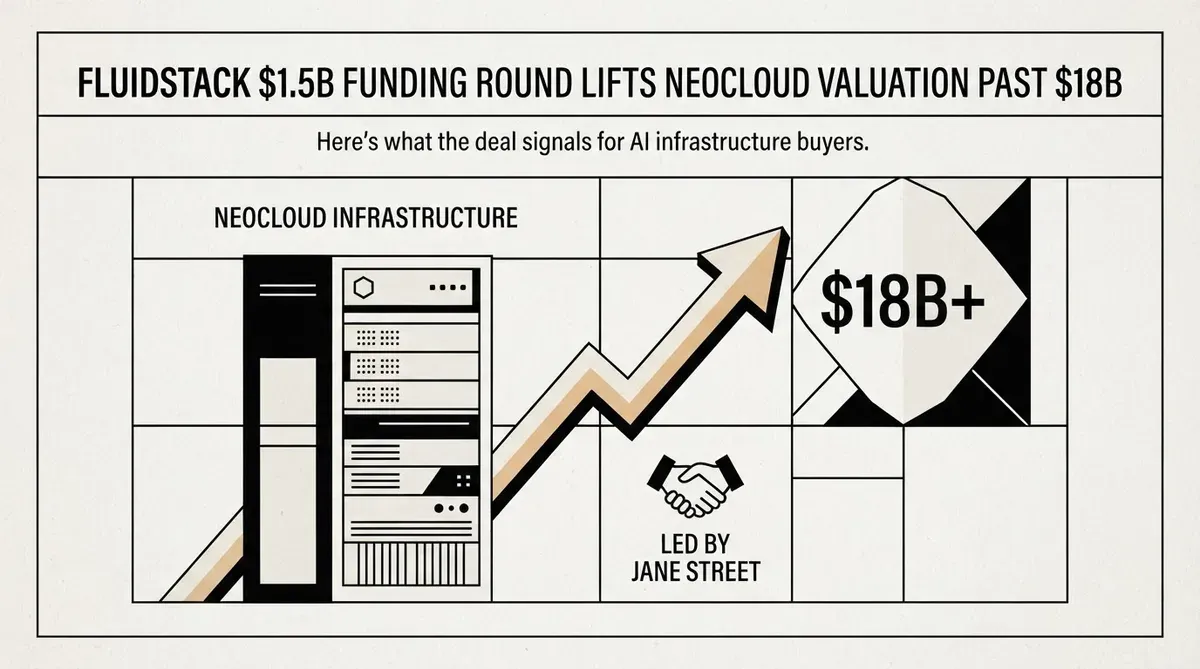
Fluidstack has closed a $1.5 billion funding round led by Jane Street at a valuation above $18 billion, more than doubling the value the New York neocloud carried when it raised $750 million in July. The Fluidstack $1.5B funding round is the company's largest to date and lifts its total capital raised to just over $2.6 billion.
Fluidstack builds and operates GPU and data center infrastructure for AI workloads, yet it owns no chips of its own. The company is chip-agnostic, assembling capacity through supplier and service agreements rather than hardware purchases, and it projects about $660 million in revenue for 2026, a roughly 365-fold increase from the $1.8 million it posted previously. That growth curve has placed it among the largest independent GPU-cloud operators, alongside CoreWeave and Nebius.
The neocloud category sits between hyperscalers and commodity hosting. Operators assemble large GPU clusters quickly, often in leased or newly built data centers, and sell that capacity to labs whose training runs outgrow public cloud queues. Frontier labs are locking in capacity years ahead of need, and much of that demand now lands outside the traditional cloud providers. Fluidstack's capacity work has also extended to Google, which has been expanding its own AI data center footprint; serving two of the largest AI buyers at once is rare among independent operators and helps explain the scale of the contracts behind this valuation.
The transaction arrived in a week when AI infrastructure dominated venture funding. Crusoe closed a $3 billion Series F at a $30 billion valuation in the same stretch, and the two deals took the top slots among the week's largest rounds. Nscale, another operator in the category, sought $3.5 billion toward an IPO at the same $30 billion mark, an early sign that the biggest independent clouds are being priced on converging terms.
The week's funding data shows the concentration. AI infrastructure operators claimed the two largest spots among the ten biggest rounds reported, and the remaining slots leaned toward the same sector. In 2026 the largest venture checks have increasingly gone to the companies that supply compute rather than to the labs that consume it.
Inside the Fluidstack $1.5B funding round
The repricing has been fast. July's $750 million round valued Fluidstack at $7.5 billion, so the new figure is more than twice the level set about two months earlier. Before the transaction closed, the company had been reported to be in talks to raise roughly $1 billion at an $18 billion valuation; Jane Street and its co-investors ended up committing 50 percent more. The raise was structured as a private equity investment, a fit with Jane Street's expanding role as a direct owner of infrastructure stakes rather than a passive venture backer.
The price rests on contracted demand rather than owned assets. Fluidstack operates as a primary infrastructure partner to Anthropic, which has deliberately spread its compute purchasing across vendors to avoid dependence on any single supplier. At $18 billion against $660 million in projected 2026 revenue, the round implies a forward multiple near 27 times sales, a level that only signed, long-duration contracts can support given the company's minimal hardware base.
The financing wave has built in parallel with the contract wave. Anthropic's aggregate compute commitments across vendors have been reported above $275 billion for 2026, a figure that includes the $50 billion Fluidstack capacity deal alongside similar arrangements with other operators. Equity at the scale raised this week lets neoclouds fund construction and lock in supplier capacity years before the contracted revenue reaches their income statements.
Owning no chips changes the shape of the business. Fluidstack sources hardware through supplier agreements rather than buying it, so its balance sheet stays light while its revenue depends on keeping contracted clusters running at high utilization. Income only starts when capacity is live, which is why delivery schedules will decide whether the revenue projections hold.
Why Jane Street is backing AI infrastructure
Jane Street's involvement goes beyond supplying capital. The quantitative trading firm runs its own models and trading systems on large GPU fleets, which makes it both an investor in and a customer of the businesses it backs. In the same period it signed a roughly $13 billion cloud computing agreement with Crusoe, the highest-profile customer Crusoe has announced for its cloud business, and it led the round that doubled Etched's valuation to $21 billion after installing Etched's first shipped AI cluster. Its disclosed commitments to AI infrastructure now exceed $21.5 billion across these positions.
That customer-shareholder position broadens the set of players financing AI compute. Quantitative finance has joined frontier labs as a source of contracts worth tens of billions of dollars, and the Crusoe agreement in particular shows compute consumption moving into trading firms and other compute-intensive industries. The timing draws attention as well: Jane Street reportedly absorbed a $15 billion trading loss in July tied to an AI-themed strategy, and it has followed that with continued multibillion-dollar, long-term positions in the same sector.
Guaranteed access to large GPU fleets is an operational asset for a firm that trades across global markets, and contracts of the kind signed with Crusoe buy certainty of supply that spot GPU capacity cannot offer. That helps explain why Jane Street has moved from renting clusters to taking equity in the companies that build them.
The pattern across Fluidstack, Crusoe, and Etched is consistent. Jane Street buys equity, signs large contracts, and installs hardware, in effect wiring AI infrastructure into its own trading operation. That combination of roles, rare among financial backers, gives the firm direct exposure to the operators' delivery performance as well as their returns.
What the round signals for AI infrastructure buyers
For enterprises and labs renting GPU capacity, the round widens the set of well-capitalized alternatives to the largest cloud providers. Fluidstack, CoreWeave, and Nebius now operate with balance sheets sized for multi-year capacity contracts, and anchor customers such as Anthropic are deliberately splitting workloads among them. That structure gives compute buyers negotiating room that did not exist when a small group of hyperscalers controlled most of the supply.
The less visible part of the story is delivery. Fluidstack's projected $660 million in 2026 revenue is a small fraction of its $50 billion Anthropic commitment, roughly 1 percent of that total, which shows how early the ramp remains and how much execution is priced into an $18 billion valuation. The gap between the roughly $2.6 billion the company has raised and the scale of what it has contracted to deliver also explains why infrastructure operators pair equity with debt financing; buildouts of this size are rarely funded from paid-in capital alone. Investors here are underwriting order books rather than factories, which concentrates risk in contract terms and delivery discipline.
Recent raises across the sector show how quickly those valuations are moving.
| Company | Round | Valuation | Timing |
|---|---|---|---|
| Fluidstack | $1.5B led by Jane Street | Above $18B | September 2026 |
| Crusoe | $3B Series F | $30B | September 2026 |
| Nscale | $3.5B toward IPO | $30B target | September 2026 |
| Etched | $700M led by Jane Street | $21B | August 2026 |
| Fluidstack | $750M | $7.5B | July 2026 |
Read together, these transactions sketch a pricing convention for independent AI infrastructure: roughly $18 billion for an operator anchored by a single flagship capacity deal, and about $30 billion for the category leaders. The convergence raises the bar for smaller entrants, whose fundraising stories must now show marquee, long-duration demand to justify comparable multiples.
Why this matters
The Fluidstack $1.5B funding round shows capital chasing contracted AI demand rather than hardware alone, and it places financial firms at the center of how AI infrastructure gets financed. For technology decision-makers, the result is a deeper pool of independent GPU suppliers and more negotiating room against hyperscaler pricing. The test ahead is operational: converting the $50 billion Anthropic commitment and similar contracts into working capacity on schedule.
AI-generated image.
Related Articles
- Firmus AI Infrastructure Funding Reaches $10.5B Valuation
- Nvidia Nebius Investment: 9.3% Stake in Neocloud Platform Signals Strategic Shift
- Groq neocloud pivot: AI chip pioneer raises $350M at $3.5B
✔Human Verified
Researched and cross-referenced against primary sources by the Bytevyte editorial team. This article was generated with the assistance of artificial intelligence and reviewed by the Bytevyte editorial team.