
Gartner Forecasts Sovereign AI and Decision Governance as Top 2026 Data Trends
Gartner identifies Sovereign AI and decision governance as top 2026 trends, predicting 10% of enterprises will be AI-first by 2030.
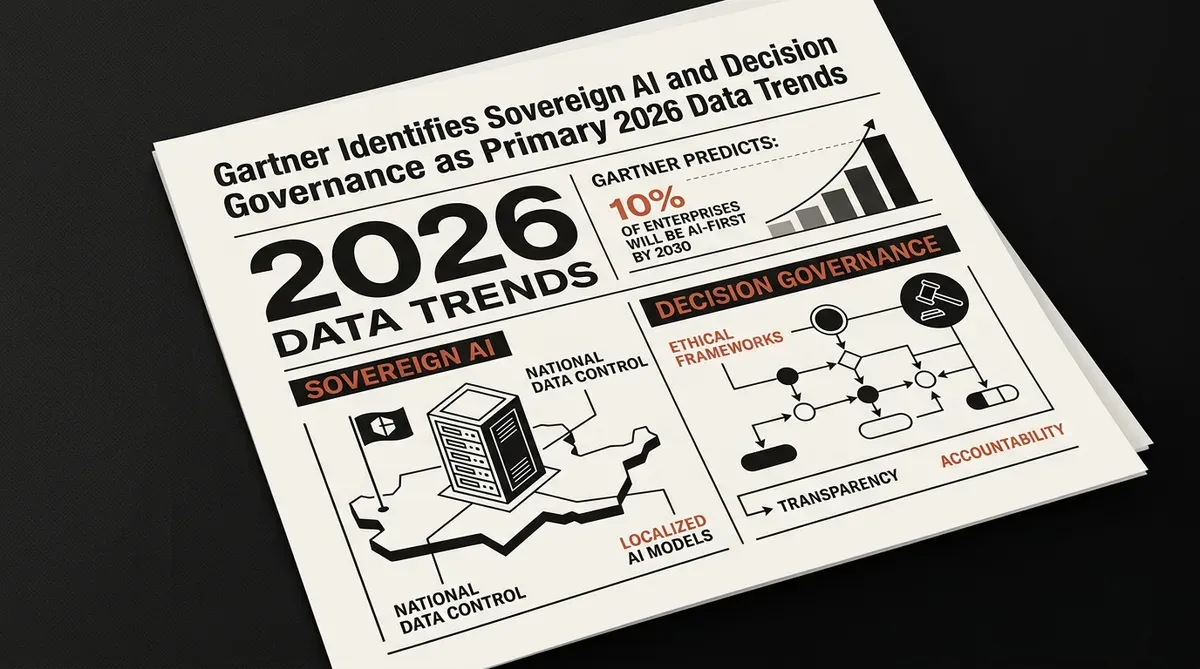
Gartner analysts identified primary data and analytics trends for 2026 during the Gartner Data & Analytics Summit in Sydney. The research firm projects that more than 10% of enterprises will adopt an AI-first posture by 2030. This shift centers on Sovereign AI and the implementation of decision governance as organizations transition toward autonomous operations. According to Gartner, this transition requires organizations to move away from centralized control toward agentic systems that learn and adapt in real-time.
The rise of Sovereign AI indicates a global movement where nations and organizations prioritize control over digital infrastructure and data. By developing localized AI capabilities, entities aim to reduce dependence on foreign technology providers to increase economic and geopolitical resilience. Gartner analysts suggest this trend will require multinational corporations to manage various regional AI requirements. Unified AI governance platforms are becoming a requirement for maintaining compliance across different jurisdictions.
The Role of Decision Governance
Decision governance is a framework for managing legal and reputational risks as autonomous agents begin to handle strategic choices. According to Gartner, traditional oversight methods are often insufficient for AI systems that operate with high levels of independence. The firm recommends that leaders implement structured governance to ensure AI-driven decisions remain consistent with organizational values and regulatory standards. The deployment of autonomous agents without these safeguards could lead to unintended consequences that are difficult to trace.
Enterprises are also adopting GraphRAG, a technology that combines knowledge graphs with large language models, to support these systems. Gartner predicts that 40% of enterprises will use GraphRAG by 2029 to improve the factual accuracy of AI outputs. This approach addresses hallucinations in generative AI by grounding model responses in structured, verifiable data. According to the report, the integration of semantic intelligence allows for more reliable reasoning in high-stakes business applications.
Agentic Data Management and Real-Time Intelligence
Data infrastructure is moving toward agentic data streaming and management. These self-learning systems handle the large volumes of information required for real-time intelligence. By automating data flow and processing, organizations can respond to market changes and internal operational needs. Gartner reports that AI-first enterprises that integrate these converged data and analytics platforms are expected to outperform competitors over the next decade.
The shift toward AI-first operations involves the adoption of new tools and a change in how organizations treat data as a strategic asset. Technology leaders are currently moving from experimental AI projects to the creation of governed, sovereign ecosystems designed to support growth in an automated economy.
AI-generated image.
Related Articles
- Enterprises Shift Toward Sovereign AI Amid Rising Geopolitical Risks
- Snowflake Summit 2026: Data Infrastructure Becomes the New Priority for Enterprise AI Production
- IBM Study: 76% of Global Firms Appoint a Chief AI Officer
✔Human Verified