
Halliburton Achieves 95% Seismic Workflow Acceleration via Amazon Bedrock AI
Halliburton achieves 95% seismic workflow acceleration using Amazon Bedrock and AI, automating complex data processing for geoscientists.
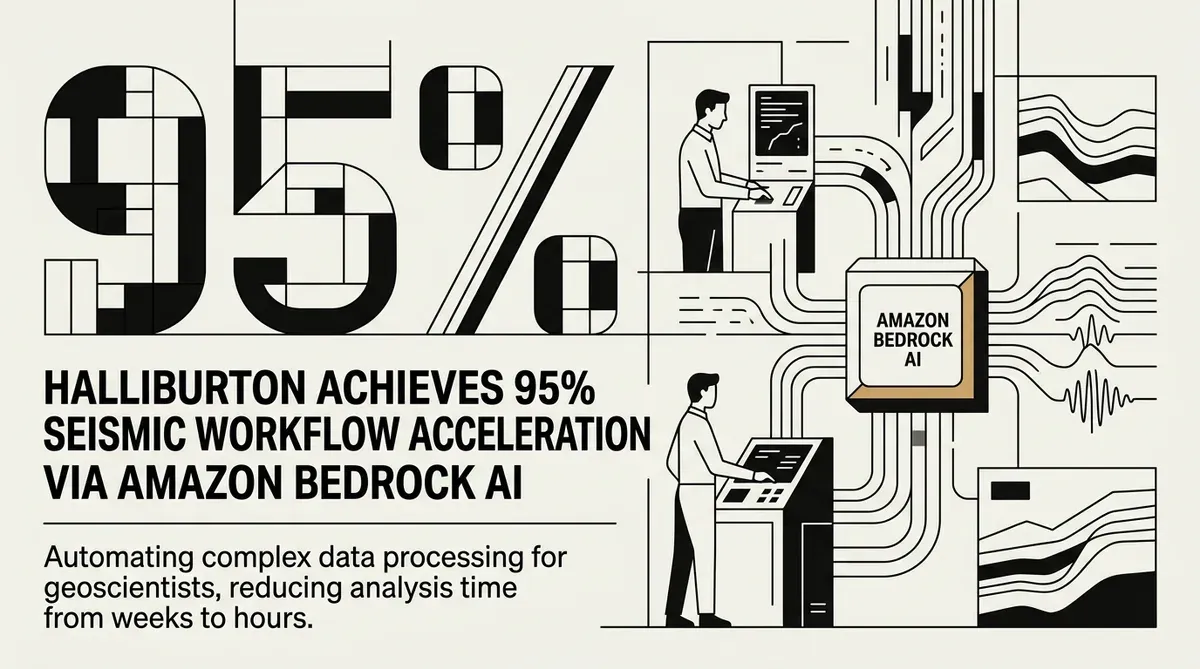
Halliburton has integrated generative artificial intelligence into its seismic data processing operations, achieving a 95% reduction in the time required to build complex exploration workflows. The energy services giant collaborated with the AWS Generative AI Innovation Center to develop an automated assistant that replaces manual configuration with natural language processing. This deployment, announced this week, utilizes Amazon Bedrock and the Amazon Nova model family to streamline the technical requirements of oil and gas exploration.
The seismic workflow acceleration addresses a long-standing bottleneck in the energy sector. Traditionally, geoscientists using the Halliburton Seismic Engine had to manually configure approximately 100 specialized tools to process subsurface data. This task required deep domain expertise and significant time to ensure each tool in the sequence was correctly calibrated. By leveraging Amazon DynamoDB alongside generative models, the new system allows users to describe their desired output in plain language, which the AI then converts into an executable technical workflow.
Strategic Impact of Seismic Workflow Acceleration
The shift from manual tool selection to AI-driven automation is a change in how energy companies manage technical debt and expertise. By reducing the configuration time by 95%, Halliburton enables its technical teams to focus on data interpretation rather than software orchestration. The integration of Amazon Bedrock provides a managed environment for these models, ensuring that the heavy computational demands of seismic processing are met with scalable cloud infrastructure.
This implementation highlights a broader trend of industrial AI applications where natural language interfaces act as a layer over legacy technical stacks. The use of Amazon Nova suggests a focus on high-performance reasoning capable of handling the specific parameters of geophysical science. For decision-makers in the industrial sector, this move demonstrates that generative AI value often lies in the technical operations—automating the configuration of existing expert systems rather than replacing them entirely.
Halliburton is currently deploying this capability to its global geoscientist workforce. The system is designed to handle the high-volume data requirements typical of modern seismic surveys, which often reach petabyte scales. As of May 2026, the company continues to refine the assistant to cover a wider range of specialized processing tools within its cloud-native Seismic Engine.
While we strive for accuracy, bytevyte can make mistakes. Users are advised to verify all information independently. We accept no liability for errors or omissions.
AI-generated image.
Related Articles
- AWS Cuts AI Costs with Nova Model Distillation
- Amazon Bedrock Adds Metadata Filtering for AI Agent Long-Term Memory to Improve Retrieval Accuracy
- Amazon Enhances Deadline Cloud with AI-Driven Troubleshooting for Render Pipelines
✔Human Verified