
HD Hyundai Robotics Humanoid AI Expands to Cobot and Industrial Lines
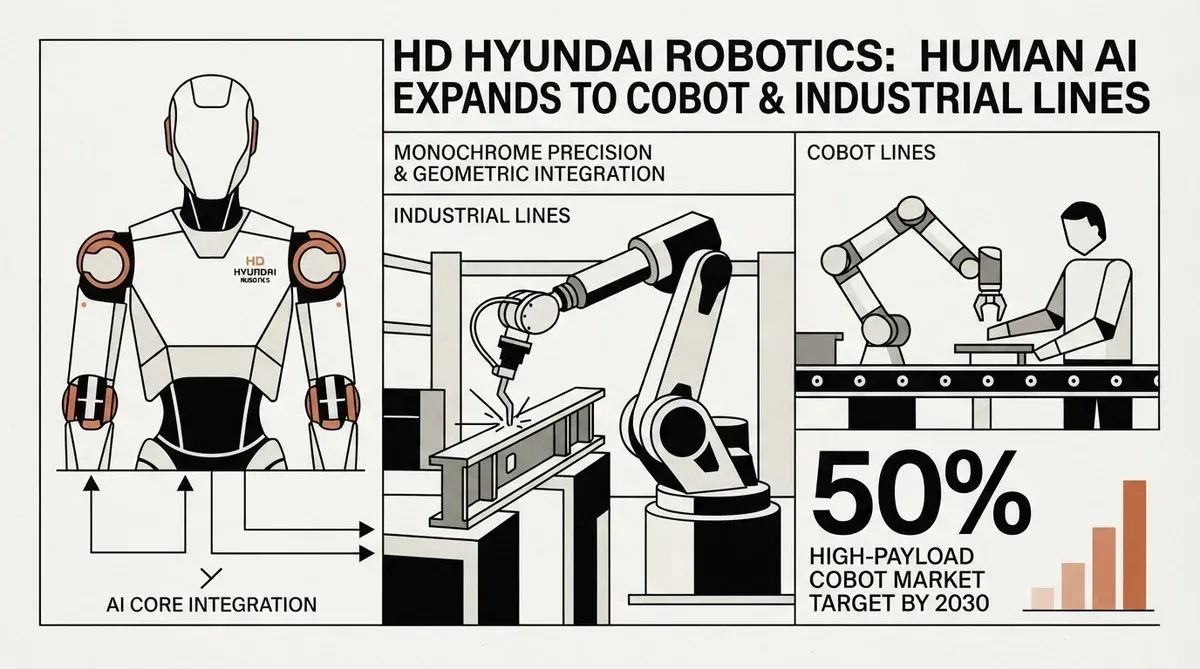
HD Hyundai Robotics plans to push its humanoid AI technology into the industrial and collaborative robots it already sells, turning a humanoid prototype into a shared intelligence layer for machines that ship today. According to the company, prototypes will train on its own controller assembly line to collect manipulation data in a live manufacturing setting. Physical-AI functions such as task recognition and precision manipulation are moving onto existing industrial machines, and the humanoid itself is being built as an open, scalable platform designed to host several robot types.
Hands are the deciding factor, according to HD Hyundai Robotics. The company says dexterous manipulation determines humanoid productivity, and it is securing robotic-hand technology that can handle a wide range of tasks with precision. That work sits alongside a 13 billion won investment, about $9.4 million, in Aidin Robotics, a South Korean developer of force and tactile sensors. Aidin Robotics has separately raised $12.1 million from HD Hyundai Robotics and Samsung Venture Investment.
The company says prototypes are in manipulation training and verification now. Running them on HD Hyundai Robotics' own controller assembly line gives it a feedback loop that laboratory testing cannot supply: real cycle times, part variation, and failure modes on equipment the company builds and services. The same data pipeline is meant to feed the industrial and collaborative lines rather than stay confined to the humanoid.
The cobot line carries the near-term business case
Collaborative robots are where the strategy meets revenue. The HDC series, launched in the second half of 2026, holds TÜV SÜD safety certification at performance level d, category 3, and cuts required factory floor space by 30% to 40%, by the company's own measurement. HD Hyundai Robotics says it is targeting half of South Korea's high-payload collaborative robot market, the segment rated 20 kilograms and above, by 2030. The company puts broader sales expansion at 2027.
The safety rating has a practical effect. Performance level d under a category 3 architecture sets how a robot must behave when a component fails, and it is the threshold that lets a collaborative machine work near people without full physical guarding. The 30% to 40% footprint reduction follows partly from removing fences rather than from shrinking the arm, which is why the certification and the floor-space figure arrive together.
The 20-kilogram threshold is not arbitrary. Collaborative arms rated at that payload and above can take over tasks that previously required caged industrial robots or manual lifting, so a cobot displaces two purchases at once: a traditional arm and the guarding around it. Contesting that segment requires payload capacity and safety certification in combination, and it is the segment HD Hyundai Robotics has chosen to enter first.
Those numbers set up a concrete commercial test. Half of a high-payload segment by 2030 requires the certified HDC line to convert industrial buyers over the next two years, well before the humanoid platform is ready for general deployment. Buyers placing orders in 2027 will judge the company on payload, certification, footprint, and integration cost rather than on humanoid demonstrations.
Framing the humanoid as an open platform has a second audience: systems integrators and robot software vendors. A single environment that runs industrial, collaborative, mobile, and humanoid machines lowers the cost of writing and maintaining task software across a mixed fleet, a point that matters to integrators weighing the HD Hyundai Robotics humanoid AI roadmap. Factories expect to run cobots and humanoids side by side for years, so software portability is a purchasing criterion now.
Labor supply is the other half of the equation. Factories that cannot staff repetitive, physically demanding roles have the strongest reason to adopt collaborative robots immediately, before humanoids clear reliability targets. That demand supports the HDC line during the years the humanoid program still needs to mature, and it builds a customer base already familiar with HD Hyundai Robotics controllers for the day humanoid units ship.
| Program | Form factor | Current status | Target |
|---|---|---|---|
| HDC collaborative robots | Cobot, 20 kg and above payload class | Launched second half of 2026; TÜV SÜD certification at PL d, category 3 | 50% of South Korea's high-payload cobot market by 2030 |
| HD Hyundai Robotics humanoid | Humanoid with five-fingered hands | Prototypes in manipulation training | Data collection on the company's own controller assembly line |
| Boston Dynamics Atlas | Humanoid | Training center open at Hyundai's Georgia EV plant since September 21, 2026 | Deployment from 2028; up to 25,000 units across Hyundai and Kia plants by 2030 |
Sensors and shipbuilding shape the hand
The robotic hand is a tailored component in this plan. HD Hyundai Robotics and Aidin Robotics are developing a five-fingered hand for shipbuilding and heavy industry, to be mounted on HD Hyundai Robotics' humanoids. Aidin Robotics will also extend its surface-finishing automation into shipbuilding, co-developing surface-treatment automation with HD Hyundai Robotics for on-site use before widening it to domestic manufacturing generally and to overseas markets including the United States.
Tactile and force sensing is the shared dependency. Manipulation without touch feedback stays blind, and sensor cost and durability set how many fingers a production hand can carry before unit economics fail. Shipbuilding gives the program a demanding first market: hull and block surface treatment involves irregular geometry, heavy components, and hazardous conditions, a harder test than picking and placing parts on a controlled assembly line. If the hand and sensor stack holds up there, the same parts carry into general manufacturing with a reference site behind them.
A group-wide robotics push, from Georgia to Korea
HD Hyundai Robotics is one node in a larger Hyundai effort. Hyundai Motor Group bought an 80% stake in Boston Dynamics for about $880 million in 2020, with SoftBank holding the remaining 20%, and the automaker has since taken full ownership. Boston Dynamics opened a robotics training center inside Hyundai's electric vehicle plant outside Savannah, Georgia, on September 21, 2026, after pilot work that began in June 2026. Hyundai Motor Group says it will start deploying Atlas humanoids in 2028 and targets up to 25,000 units across Hyundai and Kia plants worldwide by 2030.
Boston Dynamics plans to relocate operations to a facility ten times larger in 2027 and to expand testing beyond automotive. Hyundai expects Atlas to reach component assembly lines within the decade. Other manufacturers are running similar trials: BMW, Mercedes-Benz and several Chinese companies have started factory tests or in-house humanoid programs, and Toyota has said its plan for 400,000 robots will not replace workers even as it asks employees to train the machines.
Technical limits remain the main brake on the category. Hyundai's own schedule places Atlas on component assembly lines only within the decade, and the 25,000-unit figure is a 2030 target rather than a current deployment. The distance between a training center running pilot tasks and a plant that depends on humanoids for output is where most programs will be judged.
The contrast with the Korean timetable is sharp, and the two answer to different clocks. Atlas is a flagship humanoid with a 2028 deployment start, while HDC cobots ship in 2026 with certification already in hand. HD Hyundai Robotics is betting that revenue from certified collaborative robots funds the manipulation research that eventually makes humanoid labor practical, and that its controller assembly line produces training data no external customer would hand over.
Why this matters
For manufacturers weighing automation, the useful question is what can be bought, certified, and installed in the next budget cycle. HD Hyundai Robotics is pairing a shipping cobot line with a humanoid research program, so certified hardware reaches buyers in 2027 while the dexterity work matures behind it. For competitors, a target of half the domestic high-payload cobot market by 2030 shows where price pressure lands first. Hyundai's group-level effort, spanning Georgia and Korea, puts humanoid AI research and industrial robot sales inside one structure.
AI-generated image.
Related Articles
- How the Hyundai Boston Dynamics Acquisition Reshapes Physical AI Strategy
- Hyundai's Atlas Humanoid Robots: The Unit Economics of a 25,000-Unit Factory Fleet
- Inside the Georgia Plant Where Atlas Humanoid Robot Training Begins
✔Human Verified
Researched and cross-referenced against primary sources by the Bytevyte editorial team. This article was generated with the assistance of artificial intelligence and reviewed by the Bytevyte editorial team.