
How the Hyundai Boston Dynamics Acquisition Reshapes Physical AI Strategy
Hyundai's Boston Dynamics acquisition for $335 million gives full control of the robotics pioneer, accelerating physical AI and humanoid robot deployment in manufacturing.
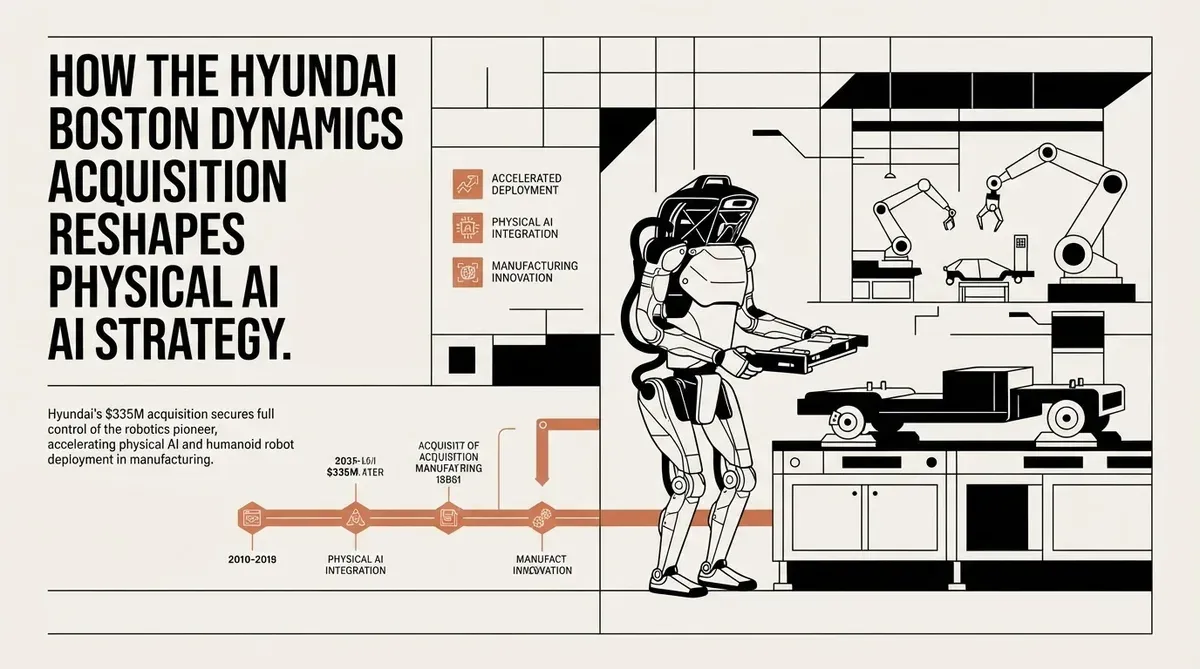
Hyundai Motor Group has moved to acquire the remaining stake in Boston Dynamics from SoftBank, making the US robotics company a fully owned subsidiary of the Korean automotive conglomerate. The Hyundai Boston Dynamics acquisition, valued at roughly $335 million (500 billion won), will give Hyundai complete control over the robot maker whose humanoid Atlas and four-legged Spot platforms are central to the group's physical artificial intelligence strategy.
SoftBank exercised a put option this month on the Boston Dynamics equity it had held under the original sale agreement signed in 2020, according to Hyundai Motor Group's announcement on July 16. The put option gave SoftBank the right to sell its remaining shares back to Hyundai under terms set six years ago. Hyundai board approval is expected to finalize the purchase.
The Ownership Structure
Before this acquisition, Hyundai Motor Group and its affiliates already held more than 90 percent of Boston Dynamics. HMG Global, an investment corporation whose primary shareholders are Hyundai Motor, Kia, and Hyundai Mobis, controlled about 56 percent of equity. Group Executive Chair Chung Eui-sun personally held roughly 23 percent, while logistics affiliate Hyundai Glovis owned approximately 11 percent. SoftBank's stake, now being acquired, was the final piece of outside ownership at roughly 9.65 percent.
The 2020 deal that first brought Boston Dynamics under Hyundai's umbrella had left SoftBank as a minority holder with certain exit rights. This month's exercise of the put option converts that residual position into full consolidation for Hyundai. SoftBank had originally acquired Boston Dynamics from Google's parent company Alphabet in 2017, making the Japanese firm's total involvement with the robotics company span nearly a decade.
Strategic Rationale Behind the Hyundai Boston Dynamics Acquisition
The Hyundai Boston Dynamics acquisition fits into a broader corporate push toward physical AI, the integration of artificial intelligence with machines that can move and act in the real world. Full ownership removes potential friction in decision-making around product roadmaps, investment allocation, and commercialization timelines.
Hyundai has stated that the acquisition will accelerate decision-making and business execution, giving the group more freedom to integrate Boston Dynamics' technology across its operations. The company plans to begin deploying Atlas humanoid robots in manufacturing environments, bringing a tangible use case to what has primarily been a research-focused platform. The manufacturing sector is one of the largest addressable markets for humanoid robotics, with automotive plants offering repetitive, structured tasks that legged robots can perform alongside human workers.
Placing Boston Dynamics under complete control also simplifies the governance structure. Rather than managing a consortium of shareholders with different time horizons and strategic priorities, Hyundai can now treat the robotics unit as a fully integrated division, streamlining capital allocation and operational planning. The shift from a joint-ownership model to a wholly owned subsidiary structure is expected to shorten the feedback loop between Hyundai's manufacturing divisions and Boston Dynamics' engineering teams.
Boston Dynamics' Technology Portfolio
Boston Dynamics has built a reputation over three decades for some of the most advanced legged robotics in the world. The company's Spot quadruped has found commercial traction in industrial inspection, security patrol, and data collection, while the humanoid Atlas platform has demonstrated increasingly sophisticated locomotion and manipulation capabilities in research settings.
Atlas is the longer-term bet. The humanoid form factor, standing roughly 5 feet 9 inches and weighing around 190 pounds, has been shown performing parkour, lifting heavy objects, and navigating complex terrain. Hyundai's plans to deploy Atlas in manufacturing signal a shift from research demonstrations toward production-grade applications. The deployment timeline, while not specified in detail, is expected to accelerate under full ownership as internal resource allocation becomes easier.
Spot, meanwhile, has already generated recurring revenue through sales and leasing to industrial customers. The combination of an existing commercial product with a high-potential humanoid pipeline gives Hyundai a dual-track robotics strategy that few other automotive companies can match. This product portfolio spans the gap between immediate commercial viability and longer-term transformational potential.
Industry Context: The Race for Humanoid Robotics
Hyundai's consolidation of Boston Dynamics arrives as competition in humanoid robotics intensifies. Tesla has been developing Optimus, its own bipedal robot, with ambitions to deploy thousands of units in its factories. Figure AI, backed by Microsoft and OpenAI, has raised significant funding for its humanoid platform. Agility Robotics and Apptronik have also announced commercial timelines for their respective robots.
What sets Hyundai apart is its existing manufacturing infrastructure and automotive supply chain. The group has deep experience in mass production, precision manufacturing, and battery and motor technology, all of which are directly applicable to scaling humanoid robots. The Hyundai Boston Dynamics acquisition gives the company a technology lead in locomotion and manipulation that competitors are still working to replicate.
Automotive manufacturers are increasingly viewing humanoid robots as a natural extension of their capabilities. The same engineering disciplines that go into vehicle production, such as electric motors, sensors, batteries, and control systems, translate directly to legged robotics. Hyundai's move signals that the group sees physical AI not as a distant research project but as a near-term industrial tool.
Financial and Operational Implications
The $335 million price tag for the remaining stake values Boston Dynamics at roughly $3.5 billion on a fully diluted basis. That figure is a premium over the valuation implied by the original 2020 transaction, reflecting the progress the company has made in product development and commercial traction over the past six years.
For SoftBank, the exit closes a chapter that began in 2017 when it acquired Boston Dynamics from Alphabet's Google. The Japanese conglomerate's investment thesis, that robotics would become a major growth vector, remains intact, but the decision to exercise the put option suggests a preference to redeploy capital elsewhere in its portfolio rather than waiting for a Boston Dynamics public listing or third-party sale. SoftBank's Vision Fund has been rotating toward AI infrastructure investments, making the divestiture consistent with its broader portfolio strategy.
For Hyundai, full ownership eliminates the possibility of third-party interference in strategic decisions and allows the group to integrate Boston Dynamics' accounting and financial reporting fully into its consolidated statements. The move also sends a signal to investors and partners that physical AI is a core pillar of Hyundai's long-term strategy, not a passive minority bet. The consolidation comes at a time when automotive margins are under pressure from electric vehicle transition costs, making diversification into robotics a strategic hedge.
Deployment Timeline and Manufacturing Focus
Hyundai has indicated that deployment of humanoid robots will begin in its manufacturing operations, though the company has not specified a date or volume target. Initial use cases are expected to focus on repetitive, physically demanding tasks where robots can improve safety and consistency. Welding, material handling, and assembly line support are among the applications being evaluated.
The manufacturing setting provides a controlled environment for validation before any potential expansion into broader commercial or consumer applications. By starting in its own factories, Hyundai can iterate on reliability, cost, and integration without the pressure of external customer expectations. The company's existing automotive plants in South Korea, the United States, and other markets offer multiple testbeds for phased deployment.
This approach mirrors Tesla's strategy with Optimus, which the company has said will first work in Tesla factories before being offered to other customers. The parallel suggests a growing consensus in the automotive industry that humanoid robots will prove their value first in internal manufacturing operations before addressing broader markets. Boston Dynamics' existing relationships with industrial customers through Spot also provide a channel for future commercial expansion beyond Hyundai's own facilities.
Why this matters
The full consolidation of Boston Dynamics under Hyundai Motor Group transforms the robotics company from a shared investment into a core operating asset. For the robotics industry, it provides a case study in how a major manufacturer can absorb and deploy advanced legged robots at scale. For competitors in the humanoid space, it raises the stakes by pairing Boston Dynamics' technology lead with Hyundai's manufacturing muscle and balance sheet. The success or failure of this integration will inform how other industrial conglomerates approach physical AI acquisitions in the coming years.
AI-generated image.
Related Articles
- VinDynamics Launches Dyno Humanoid Robot for Service and Security Markets
- Agility Robotics SPAC Merger: First Public Humanoid at $2.5B
- Siemens Deploys HMND 01 Alpha Humanoid Robots with NVIDIA
✔Human Verified
Researched and cross-referenced against primary sources by the Bytevyte editorial team.