
Higgsfield Series B valuation quadruples to $5.4B as enterprise marketing takes over
The Higgsfield Series B valuation quadrupled to $5.4B on $700M annualized revenue from enterprise marketing budgets. We assess whether the multiple holds.
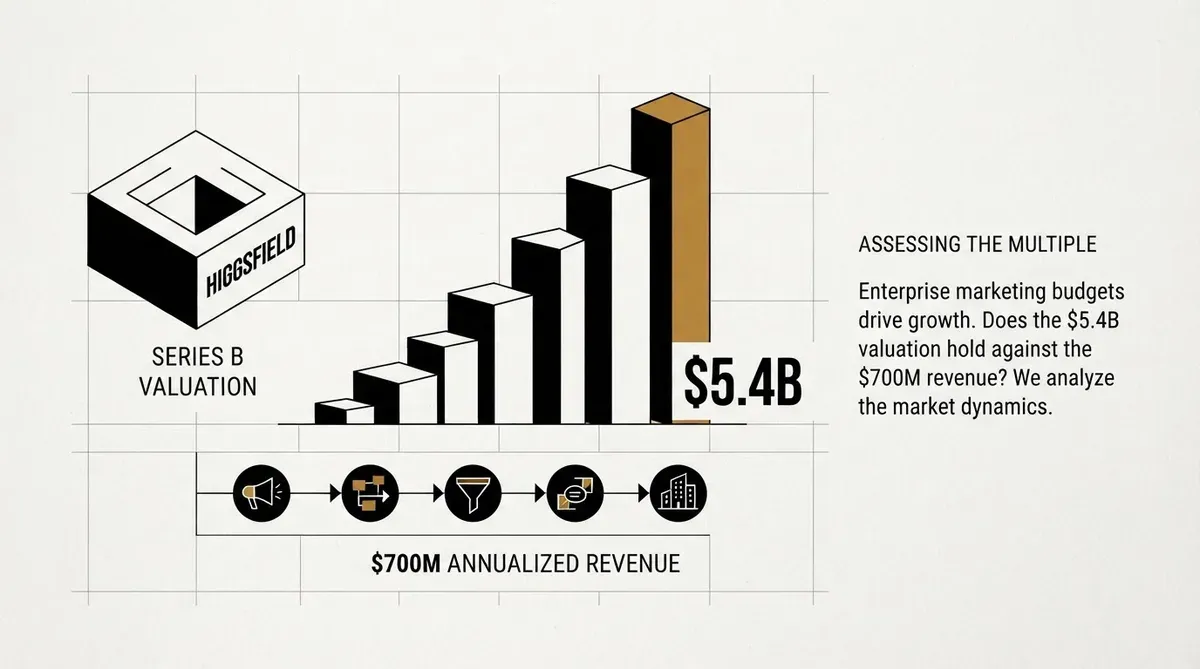
Higgsfield's Series B valuation now stands at $5.4 billion after a $400 million round announced on August 17, 2026, led by DST Global with Goldman Sachs and Intel among the new investors. The financing quadruples what the San Francisco-based AI video startup was worth in January and lands on the strength of roughly $700 million in annualized revenue, a figure that sat near $20 million a year earlier.
Eight months separate the two valuations. In January the company reached unicorn status through a Series A that raised more than $130 million at a mark near $1.3 billion. By August, annualized revenue had climbed roughly 35-fold, and the investor roster had widened from venture backers to include Goldman Sachs and Intel, a mix that reads as institutional validation of the category as much as of the company. The trade underneath those numbers is direct: Higgsfield swapped a broad consumer base for a smaller set of corporate contracts, and revenue followed.
The driver behind those numbers is who is buying. Enterprise contracts now account for the majority of Higgsfield's revenue, a share that sat below 25% at the start of the year, and the company counts 390 of the Fortune 500 among its customers for visual content creation. Marketing departments at that tier reportedly pay up to $1.8 million a year for the platform.
The underlying use case is marketing and advertising content produced at campaign scale and on deadline. That workload suits annual contracts rather than per-generation purchases, which is a structural reason the revenue mix flipped so quickly once enterprise teams began buying.
Investors are now pricing generative video on a different basis. A year ago the pitch rested on creative potential and engagement; the Series B rests on a revenue line that grew roughly 35-fold and a customer list drawn from the Fortune 500. The change in underwriting is a statement that paid marketing production is where the money in AI video is being made.
The consumer side remains large in raw terms: more than 30 million users across 238 countries generate over 20 million pieces of content per month. That base contributes reach rather than the bulk of revenue, and the divergence between user count and revenue mix is the practical definition of the pivot. The monthly generation volume shows real usage beyond the enterprise tier, even if the revenue is concentrated there.
Enterprise Marketing Is Now the Core Business
The product line points the same way. Cinema Studio is aimed at filmmakers directing AI films, and Marketing Studio is built for marketing and advertising teams. The company's positioning puts brands, agencies, and studios at the center of the platform. Founded by former Snap executive Alex Mashrabov two years ago, Higgsfield moved from film-festival showcases to enterprise procurement within a year, and the new capital is earmarked for research and development, computing capacity, and international expansion.
The international piece matters given the footprint. With users spread across 238 countries, expansion will run through localization and regional sales capacity as much as through new product work; Higgsfield For Good, an education-focused program, is one example of that localization push. Growth beyond the current base will have to come from mid-market agencies and regional brand teams, since the seven-figure accounts that anchor today's run rate are finite.
Two initiatives support that transition. Higgsfield Academy is a training program for AI video production, and Higgsfield For Good is focused on educational localization. Training matters commercially because it lowers the skill barrier for marketing teams that have never run generative video pipelines, reducing the implementation friction on the accounts that carry the largest contracts.
The trajectory is easiest to read as a before-and-after comparison.
| Metric | January 2026 | August 2026 |
|---|---|---|
| Valuation | ~$1.3 billion | $5.4 billion |
| Annualized revenue | ~$20 million | ~$700 million |
| Business share of revenue | Under 25% | Majority |
What the Higgsfield Series B valuation assumes
At $5.4 billion against $700 million in annualized revenue, the Higgsfield Series B valuation implies a multiple of roughly 7.7 times run rate. The same company was valued near $1.3 billion in January on a fraction of today's revenue, so the new price is a bet that the last twelve months of revenue growth are the better guide to the next twelve.
Put the January number next to it and the picture sharpens: $1.3 billion against roughly $20 million in annualized revenue was a multiple above 60 times run rate, while the August figure of 7.7 times looks conservative in comparison. The valuation quadrupled and revenue grew roughly 35-fold in the same window, which means the multiple compressed even as the price tag rose.
Two pressures will test that bet. The first is price competition from video generators shipped by larger AI labs, including OpenAI's Sora and Google's Veo line, which target the same marketing budgets and can be bundled into existing cloud and distribution relationships. The second is cost: enterprise output volume pushes compute spend up with every frame rendered, so gross margin rather than demand becomes the operating constraint. The round's earmarking of capital for computing power signals that Higgsfield is investing against that constraint now rather than waiting for model efficiency to close the gap.
The capital also buys options. With $400 million in hand, Higgsfield can respond to price pressure, carry higher compute spend while margins mature, and extend its runway through a competitive cycle without compromising growth targets. That flexibility is part of what a 7.7 times revenue multiple pays for.
Concentration is the third consideration. A run rate carried by a few hundred Fortune 500 contracts, some reportedly worth up to $1.8 million a year, puts renewal risk into a small number of cycles. The offset is that each embedded marketing team becomes harder to displace as campaign workflows and training investments build around the platform.
Verdict: What to Watch
The round is the clearest signal in months that investors see paying demand in generative video. It also sets a benchmark for the category: 390 Fortune 500 logos, a majority-enterprise revenue mix, and $700 million in run rate are the numbers competitors must match to command a comparable valuation, and the presence of Goldman Sachs and Intel raises the bar for institutional backing.
For marketing leaders, the practical read is to compare the bundled price against raw generation costs per finished asset, since that gap is where the premium lives or dies. The $1.8 million top tier only makes sense if it buys measurable throughput: more campaigns, faster iterations, and fewer outsourced production hours.
For buyers, AI video procurement now resembles enterprise SaaS more than an app-store product, with named accounts, annual contracts, and training programs attached. For the company, the next milestones are renewal rates on high-value marketing contracts and the gross margin behind them. The Higgsfield Series B valuation is a bet that the enterprise shift is durable. It gets tested as price competition arrives and compute bills scale with output volume.
Why this matters
Higgsfield's round shows where AI video revenue actually lives: enterprise marketing production, not consumer creation. That repositioning is what moved the company from $1.3 billion to $5.4 billion, and it will hold only if the run rate survives the pricing and compute pressures already visible in the market.
AI-generated image.
Related Articles
- Multiverse Raises $70 Million to Scale as an AI Adoption Platform
- Moonshot AI Funding Round Doubles to $3.5B at $35B Valuation
- Hadrian Series D: Defense AI Capital Goes Physical
✔Human Verified
Researched and cross-referenced against primary sources by the Bytevyte editorial team. This article was generated with the assistance of artificial intelligence and reviewed by the Bytevyte editorial team.