
Indian IT Leaders Deploy Microsoft 365 Copilot to 300,000 Staff members
Infosys, TCS, and Wipro deploy Microsoft 365 Copilot to 300,000 staff, achieving 25% productivity gains and saving 250,000 employee days per quarter.
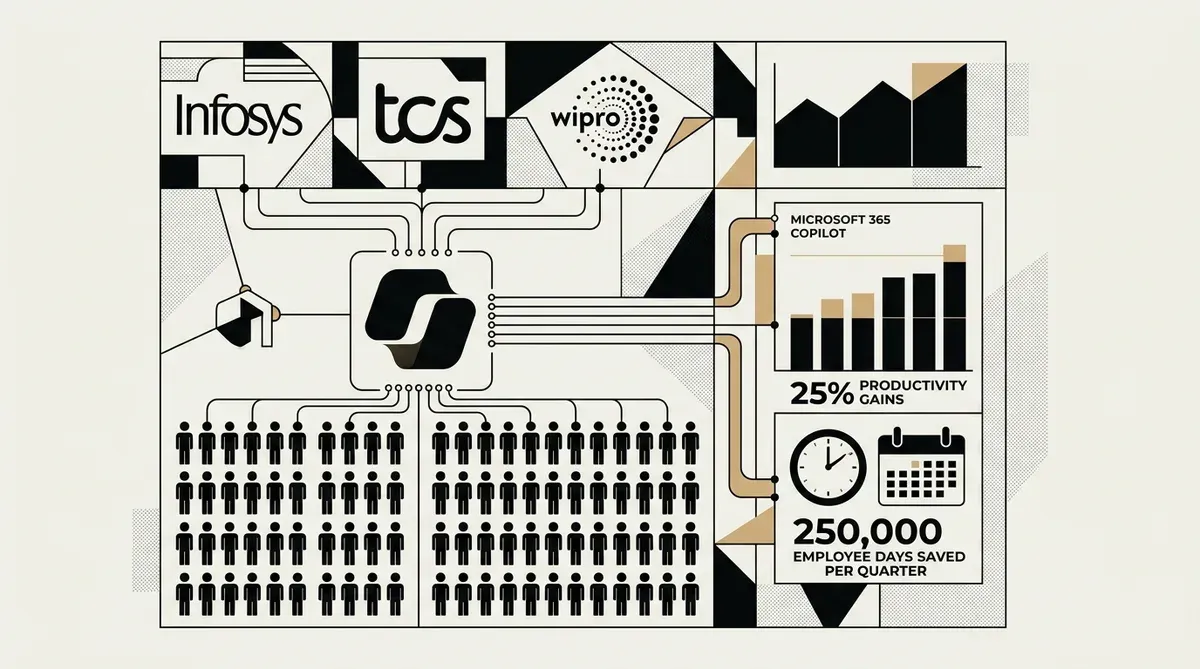
Infosys, Tata Consultancy Services (TCS), and Wipro have collectively deployed Microsoft 365 Copilot to more than 300,000 employees, signaling a massive shift in enterprise AI adoption within the Indian IT sector. Each of these three service giants has integrated the AI assistant for over 100,000 staff members in less than six months. This rapid scaling highlights how the world’s largest technology service providers are moving beyond experimental pilots to full-scale operational integration of generative AI tools.
The deployment of Microsoft 365 Copilot is already yielding measurable efficiency gains across various business functions. TCS has reported that its workforce is seeing productivity improvements of 20% to 25% specifically in research and content generation tasks. The company also noted a 25-35% reduction in total work-cycle times, allowing teams to complete projects faster. These metrics suggest that generative AI is successfully addressing the high-volume, repetitive cognitive tasks that define much of the modern IT services workflow.
Operational Impact and Usage Metrics
Usage data from Wipro and Infosys further illustrates the depth of this integration. Wipro employees are currently generating approximately 7.5 million AI prompts every month. This level of activity translates to an estimated saving of 250,000 employee days per quarter, providing the company with significant additional capacity without increasing headcount. Meanwhile, Infosys has achieved a monthly active usage rate of 91%, indicating that the tool has become a standard part of the daily employee experience rather than a niche utility.
This surge in India is part of a broader global momentum for Microsoft's AI platform. The company recently confirmed that global paid deployments for the assistant reached 20 million seats, representing a 250% increase over the previous quarter. The concentration of 300,000 users within just three Indian firms demonstrates the critical role that the Indian IT corridor plays in Microsoft's global enterprise strategy. By serving as the primary testing ground for large-scale deployment, these companies are setting the benchmark for how global corporations manage AI rollouts.
Strategic Implications for the IT Sector
For the broader technology industry, these figures represent a transition from the "hype" phase of generative AI to a "utility" phase. When firms of this scale commit to 100,000-seat deployments, it forces a shift in the competitive environment. Competitors must now match these productivity gains or risk losing margin in a market where speed and efficiency are primary differentiators. The high active usage rates also suggest that the learning curve for these tools is manageable for large, diverse workforces.
The focus for these IT leaders is now shifting toward optimizing the output of these 300,000 users. As the initial deployment phase concludes, the next milestone involves integrating these AI capabilities deeper into proprietary client workflows and software development lifecycles. With 20 million paid seats globally and a significant portion concentrated in India's top firms, the infrastructure for AI-augmented professional services is now firmly in place.
While we strive for accuracy, bytevyte can make mistakes. Users are advised to verify all information independently. We accept no liability for errors or omissions.
AI-generated image.
Related Articles
- Accenture Scales Microsoft 365 Copilot to Global Workforce of 743,000
- Microsoft 365 Copilot Redesign Cuts Loading Times in Half and Adds Work IQ
- Microsoft Debuts Copilot Cowork with Mobile Apps and Automated Skills
✔Human Verified