
Investors Propose 9 GW Stratos AI Data Center Campus in Utah Amid Grid Concerns
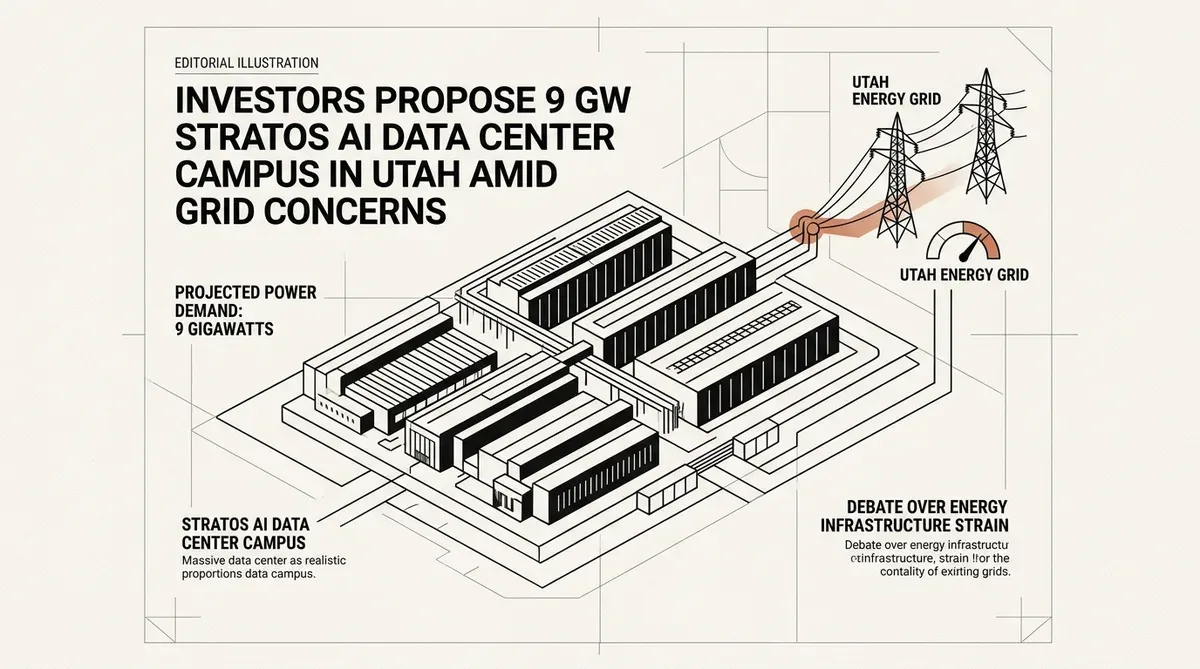
Stratos, a massive 9 GW artificial intelligence data center campus proposed for Utah, is one of the most ambitious infrastructure projects in the global technology sector. Backed by a group of investors including Kevin O’Leary, the development aims to provide the immense computing capacity required for next-generation AI workloads. The scale of the proposal, however, has sparked significant debate regarding its potential impact on regional resources and energy infrastructure.
The Stratos AI data center campus is a significant leap in infrastructure planning, with a 9 GW capacity that dwarfs most existing facilities. For context, typical large-scale data centers operate in the range of 100 to 500 MW. A 9 GW site would require power equivalent to the output of several nuclear reactors or massive renewable energy arrays. This extreme energy demand is the primary driver of the current controversy, as industry experts and local stakeholders evaluate the strain such a facility would place on the regional power grid.
Infrastructure Challenges and Resource Consumption
The proposal for the Stratos AI data center campus comes at a time when the technology industry is grappling with the physical limits of AI expansion. As models grow in complexity, the need for specialized hardware and the electricity to run it has surged. Utah has become a focal point for this development due to its available land and existing energy corridors, but the sheer volume of 9 GW presents unprecedented logistical hurdles. Beyond electricity, the cooling requirements for a campus of this magnitude would necessitate vast water resources, further complicating the environmental assessment.
Investors like Kevin O’Leary are positioning the project as a necessary step to maintain competitive parity in the global AI race. The argument centers on the idea that without massive, centralized computing hubs, the development of advanced foundation models will be throttled by infrastructure bottlenecks. However, critics within the utility and environmental sectors warn that the rapid integration of such a large load could destabilize local energy markets and lead to increased costs for other consumers.
Strategic Implications for the AI Market
The Stratos AI data center campus highlights a shift toward "gigascale" thinking in AI strategy. If successful, the project could set a new benchmark for how private equity and technology firms collaborate on physical assets. It also signals a move away from fragmented data center deployments toward hyper-concentrated hubs designed specifically for the power-hungry nature of generative AI training and inference.
As of June 3, 2026, the project remains in the early development and review phases. The outcome of the Stratos proposal will likely serve as a bellwether for future large-scale AI infrastructure projects in the United States. Decision-makers are closely watching how Utah regulators balance the economic promise of a multi-billion dollar investment against the long-term sustainability of the state's power and water networks.
While we strive for accuracy, bytevyte can make mistakes. Users are advised to verify all information independently. We accept no liability for errors or omissions.
AI-generated image.
Related Articles
- Hut 8 Secures $9.8 Billion Lease for Beacon Point AI Data Center Campus in Texas
- Pure DC Secures $2.7 Billion to Expand AI Infrastructure Across EMEA
- Nscale Secures $790 Million for Sovereign AI Infrastructure in Norway
✔Human Verified