
Mercedes-Benz Korea AI Data Strategy: Building Trusted Intelligence with Databricks
The Mercedes-Benz Korea AI data strategy uses Databricks to create a unified semantic layer, ensuring 100% accuracy for natural language data queries.
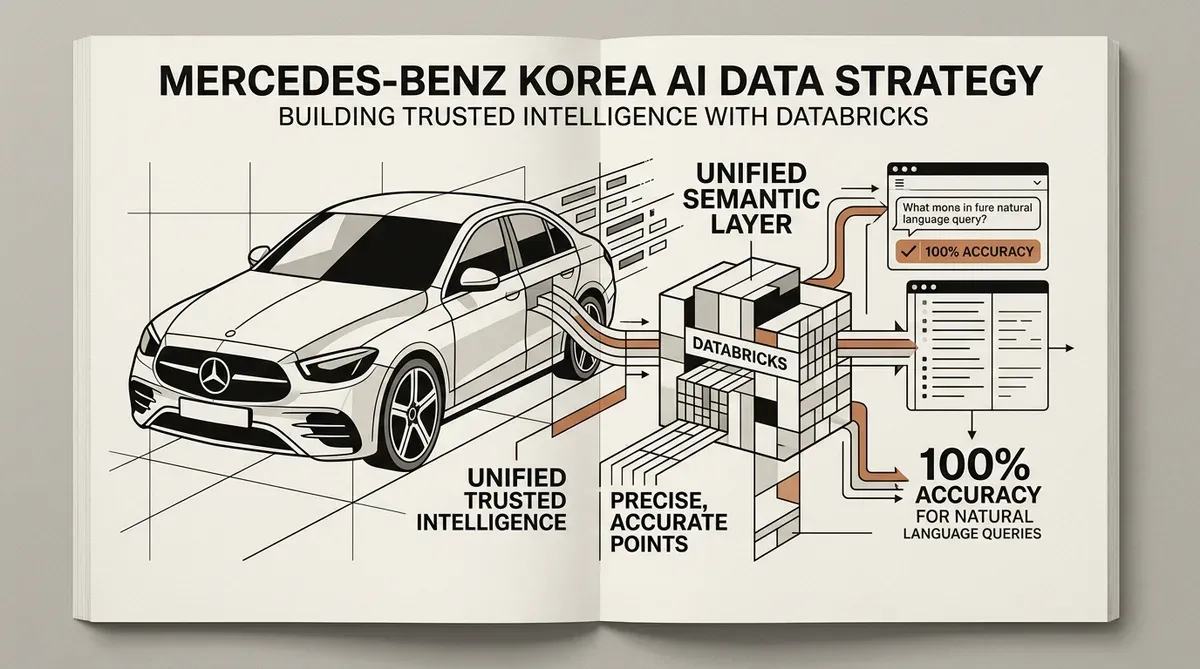
The Mercedes-Benz Korea AI data strategy has reached a new milestone with the deployment of an enterprise system for natural language data queries. Using Databricks technology, the automotive company built a "Talk to Data" platform that aligns AI responses with existing business intelligence reports. This unified semantic layer prevents AI hallucinations and ensures that metrics remain consistent across all corporate dashboards.
The implementation uses Unity Catalog to host the semantic layer. This repository acts as the single source of truth for key performance indicators (KPIs) used by both reporting tools and AI agents. To migrate existing logic, engineers built a tool that translates DAX code from Power BI into Databricks metric views, covering more than 500 distinct KPI definitions.
Architecture of the Mercedes-Benz Korea AI Data Strategy
The platform uses a multi-agent design to process business questions. When a user submits a query, a primary coordinator agent analyzes the request and assigns it to a specialized sub-agent with expertise in that specific data category. These agents function within Genie spaces and use the validated logic stored in the semantic layer. This ensures that sales and inventory figures match official financial records exactly.
Mercedes-Benz Korea used a five-phase validation process to verify the system. Technical teams compared AI outputs against historical reports until the system reached 100% accuracy. The tool is now available through Databricks Apps, which provides the interface and memory management needed for users to conduct deep data investigations without losing context.
Strategic Results and Engineering
The Mercedes-Benz Korea AI data strategy relies on governed semantic intelligence. The company uses Lakeflow and Spark Declarative Pipelines to automate the data engineering tasks that update the semantic layer. This architecture indicates that corporate generative AI success depends on data governance rather than the specific large language model used.
This deployment provides a method for scaling AI while maintaining data integrity. The shift from static dashboards to agent-based exploration changes how the organization accesses internal knowledge. As of June 2026, the platform is the primary tool for data-driven decisions within the Korean division of the automaker.
While we strive for accuracy, bytevyte can make mistakes. Users are advised to verify all information independently. We accept no liability for errors or omissions.
Sources
Unlocking semantics for AI: How Mercedes-Benz Korea built trusted “Talk to Data” at scale
AI-generated image.
Related Articles
- Mercedes-Benz Cloud Egress Costs Cut 66% via Data Mesh
- Databricks Launches Genie Agent Mode for Data Analysis
- Databricks Launches Context Engineer Associate Certification to Standardize AI Agent Reliability
✔Human Verified