
Mirendil Funding Round Nears $5 Billion as Investors Bet on Self-Improving AI
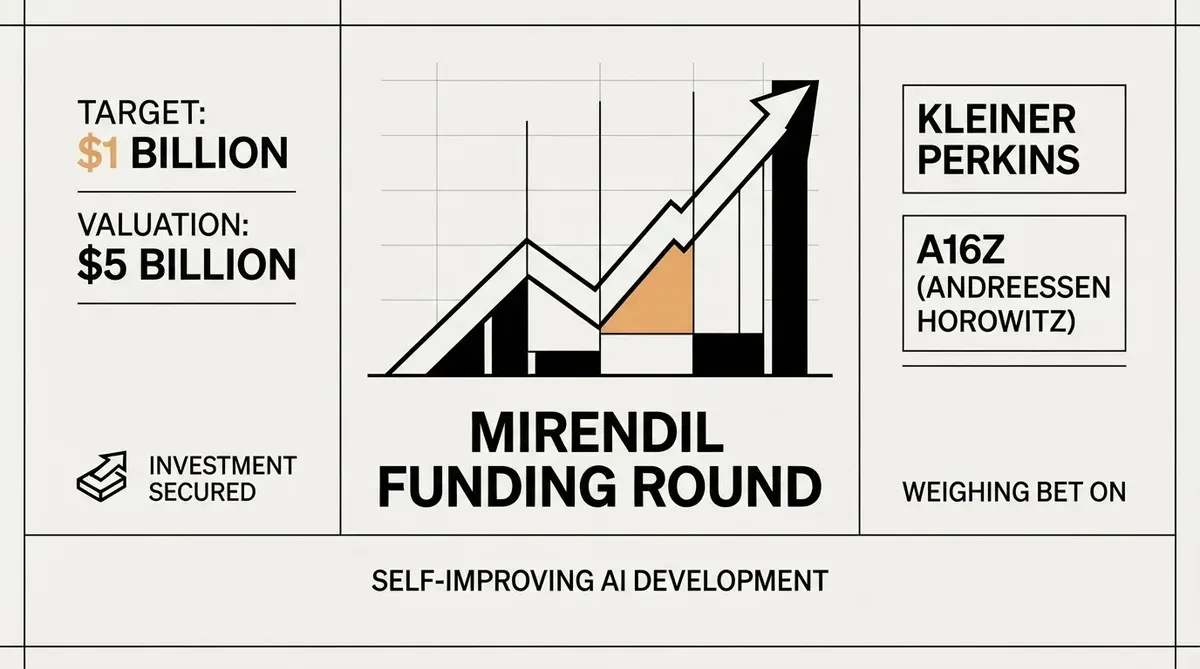
Mirendil, the artificial intelligence startup founded by former Anthropic researchers, is negotiating a new raise that would value the company at about $5 billion, roughly five times the mark it set a single quarter ago. The Mirendil funding round could reach $1 billion, with Kleiner Perkins and Andreessen Horowitz in discussions to lead or take part. The talks surfaced this week and remain incomplete, and no terms have been confirmed.
The company's technical bet is recursive self-improvement: AI models that raise their own capability with limited human intervention. Mirendil, which employs a little more than 20 people, has set a target of releasing a frontier model for research and engineering work by early 2027.
What the Mirendil Funding Round Reveals
The company emerged from stealth in June 2026 with a $200 million seed round at a $1 billion valuation. That financing ranked among the largest seed rounds of 2026 for an AI company that had not yet shipped a model, and the step to roughly $5 billion would arrive before Mirendil has published results demonstrating its central claim.
| Milestone | Timing | Valuation | Capital raised |
|---|---|---|---|
| Seed round (from stealth) | June 2026 | $1 billion | $200 million |
| New round in negotiation | September 2026 | About $5 billion post-money | Up to $1 billion |
Set against headcount, the reported terms imply a valuation of about $250 million for each employee. That ratio prices expected capability rather than current revenue, since Mirendil has no disclosed sales, customers, or published model releases.
Mirendil is not the only company being priced this way. Factory, which builds AI agents for software work, raised $200 million at a $5 billion valuation, more than tripling the $1.5 billion figure it carried five months earlier. Both cases reflect the same pattern: a small set of early-stage AI companies is absorbing capital at round sizes that outpace headcount, product maturity, and disclosed financials.
Step-ups of this scale are unusual even by the standards of the current AI cycle. Software companies have historically repriced on annual fundraising cycles, and a fivefold move inside one quarter compresses that schedule into months. For Mirendil, the practical effect is that hiring, compute, and partnership decisions taken now are being made against a valuation that has not been finalized and may not survive diligence.
Why Self-Improvement Commands a Premium
Recursive self-improvement is the mechanism Mirendil is selling, and it is also the capability that frontier labs treat with the most caution. Anthropic, the lab Mirendil's founders left, has argued publicly that the industry should measure and publish progress toward models able to build their own successors, warning that systems which accelerate their own development could become harder for humans to understand or control. Anthropic has also said that its Claude models are being used to help develop the next version of Claude.
That makes the line between assisted engineering and genuine self-improvement a live question, and it accounts for part of the premium attached to Mirendil. If a model can improve itself, the returns accrue to whoever gets there first. If it cannot, a $5 billion mark for a team of 20 looks expensive.
Anthropic's own trajectory supplies the comparison. The Claude developer has filed to go public at a $965 billion valuation, a figure that has multiplied more than 1,500 times since 2021. The gap between that number and Mirendil's is the point: backers are not paying for current output but for a position in the argument that a small team organized around one research goal can reach frontier-adjacent capability.
The choice of first market is deliberate. Research and engineering work is where capability gains feed back into model development itself, which makes the recursive self-improvement thesis self-reinforcing rather than aspirational. A model that writes better training code or designs better evaluations shortens the cycle for the next model, and that compounding effect is what investors are underwriting.
Compute is the other half of the thesis. Training a frontier model requires contracted capacity from cloud providers or clusters of accelerators, and those commitments are booked months ahead of a training run. A company with 20 employees and a 2027 delivery date is buying capacity on the strength of its valuation, which ties the funding round and the technical plan together financially.
Backers, Hiring, and Open Risks
The identity of the prospective backers carries weight beyond the amount. Kleiner Perkins and Andreessen Horowitz are in discussions to lead or join, and either name on a term sheet affects how Mirendil recruits and which enterprise customers take meetings. Whoever leads the Mirendil funding round also sets its structure, including whether the capital arrives in one tranche or in milestones tied to technical results.
Hiring is the immediate constraint. A company that has promised a frontier model by early 2027 must compete for research and infrastructure engineers against labs that can pay in liquid stock. A higher valuation lets Mirendil offer larger dollar-denominated grants while issuing fewer shares per hire, which protects existing holders from dilution. Provenance helps as well: the founding team came out of Anthropic, and investors have repeatedly paid premiums for founders from a short list of frontier labs, where publication records and lab affiliations substitute for a record of commercial execution.
Anthropic's own path toward the public markets shapes that talent flow. A listing at the $965 billion figure would create liquid wealth for early employees at the lab, and that money tends to push researchers toward founding or joining small teams of their own. The pipeline of Anthropic alumni into startups is unlikely to slow while that event is pending.
The round is still in negotiation. Talks at this stage can be repriced, restructured, or abandoned, and nothing reported makes the $5 billion figure binding. Mirendil's delivery target of a frontier model by early 2027 sits less than a year after the seed close, and building that model requires compute that must be paid for in cash. A raise of up to $1 billion is roughly the scale needed for a serious training run plus the staff to support it.
Measurement is the longer-term issue. Anthropic's position is that labs should publish metrics showing how close they are to models that autonomously build their successors. A company whose pitch rests on that capability will face pressure to produce evidence rather than projections, and disclosure requirements would reveal how far Mirendil's models have actually progressed.
Valuation practice has shifted underneath all of this. Early-stage AI companies are now priced on expected capability and the compute budgets their backers will underwrite, rather than on revenue multiples. That convention favors founders with credible research credentials and puts teams without a frontier-lab pedigree at a disadvantage, whatever the quality of their product.
Enterprise buyers watching the segment have four things to track: whether Mirendil publishes model evaluations rather than claims, how access is granted, what the licensing terms look like, and whether the model is positioned as a general-purpose system or a narrow engineering tool. Each choice determines whether the technology reaches a procurement budget in 2027 or stays inside a research lab.
Why this matters
The Mirendil funding round tests how far valuation multiples can run ahead of delivery in AI. For enterprise buyers, it points to a wider set of vendors selling frontier-grade research and engineering models within roughly two years, which changes how procurement teams plan. For investors, the question is whether a 20-person team can turn a $200 million seed and a possible $1 billion follow-on into a model that stands alongside what the incumbent labs ship.
The next hard data point is the frontier model Mirendil has promised for early 2027. Until it lands, the $5 billion figure is a bet on a thesis rather than a record of delivery.
AI-generated image.
Related Articles
- Menlo Ventures $3 Billion AI Fund Hits 50-Year Milestone
- Kevin Weil's AI Science Startup Seeks $150M Round
- Menlo Ventures AI Investments Hit $3 Billion
✔Human Verified
Researched and cross-referenced against primary sources by the Bytevyte editorial team. This article was generated with the assistance of artificial intelligence and reviewed by the Bytevyte editorial team.