
Nano Banana Google Earth Tool Lets Anyone Plant Fake Scenes on Real Maps
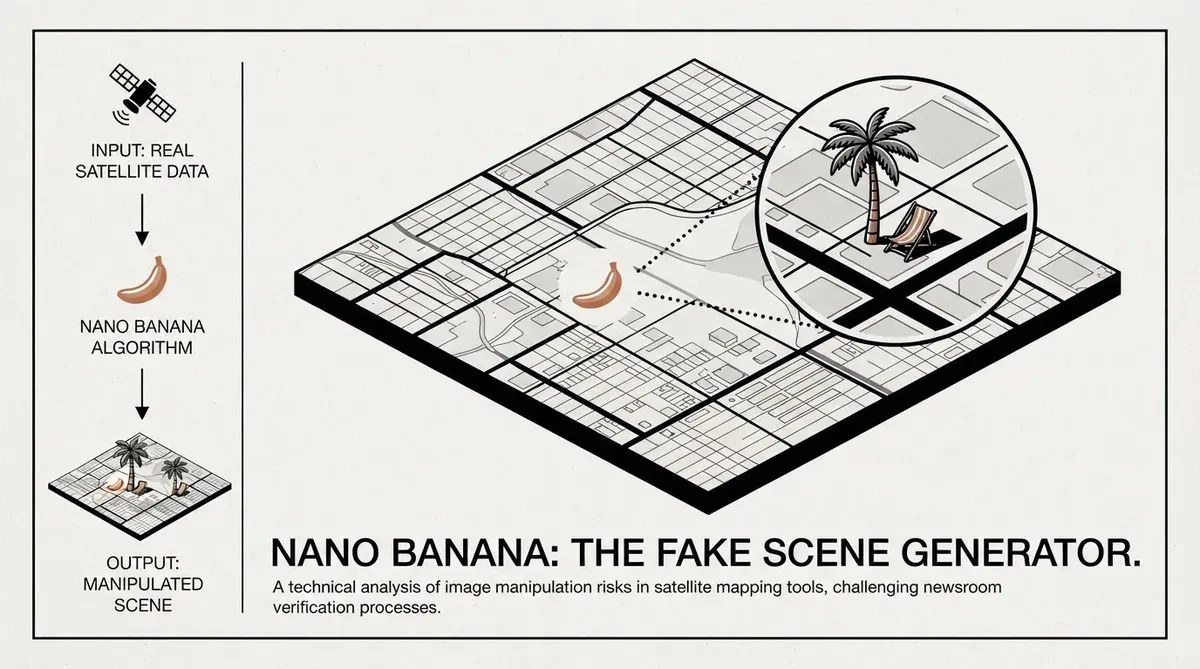
Google's new Nano Banana Google Earth image generation tool is facing an immediate trust backlash over its ability to place fabricated scenes on real maps. One day after the global launch on July 30, open-source intelligence researcher Henk van Ess demonstrated the feature by planting a fake nuclear plant in Iran, a bomb crater in Gaza, refugees near the Mexican border, and a fatal crash in Amsterdam on Google's own imagery within seconds.
The tool, which arrived in Google Earth for the web as we previously reported, lets anyone zoom into a location, tap the Create Image button, and type a prompt. The model receives the actual map viewport as input, so the output is anchored to real satellite, aerial, and 3D terrain data for that exact spot, rather than generated from a generic description of a place.
Google pitches the feature for historical reconstructions such as Pompeii in 78 A.D., landmark infographics, real estate plans, and pre-construction visualization. A Refine Image option lets users adjust the result before saving it into a project. Users cannot reposition the map while a prompt is being written, and the Create Image button does not appear in Street View.
Nano Banana Google Earth images raise trust concerns
Van Ess's demonstrations, published on Digital Digging, point to an asymmetry: removing a real building from the imagery requires a government request, while adding a fake one takes a single sentence. Because the images are grounded in real coordinates, the fakes inherit the credibility of the map, which threatens the satellite imagery that newsrooms and open-source investigators rely on for verification. The Nano Banana Google Earth rollout is web-only at launch and absent from the iOS and Android apps, even though Android alone has passed 500 million downloads.
Why this matters
The Nano Banana Google Earth tool is free, globally available, and open to anyone without a waitlist, so the only barrier between a prompt and a convincing fake is the user's intent. Verification workflows that treat satellite imagery as ground truth must now account for a new class of AI-generated content, and a web-only launch does not limit where finished images can spread.
Sources
Transform any place with Nano Banana in Google Earth
Nano Banana Image Generation in Google Earth
AI-generated image.
Related Articles
- Chrome Users in Asia-Pacific Gain Access to Advanced Gemini AI Tools
- YouTube Deploys Automated Labels for Photorealistic AI-Generated Content
- YouTube and Meta Deploy New Labels as Synthetic Influencers Proliferate
✔Human Verified
Researched and cross-referenced against primary sources by the Bytevyte editorial team. This article was generated with the assistance of artificial intelligence and reviewed by the Bytevyte editorial team.