
NVIDIA JetPack 7.2 Brings Agentic AI and Performance Gains to Robotics
NVIDIA JetPack 7.2 introduces agentic AI and a 20% performance boost for Jetson Orin, enabling advanced autonomous robotics for industrial use.
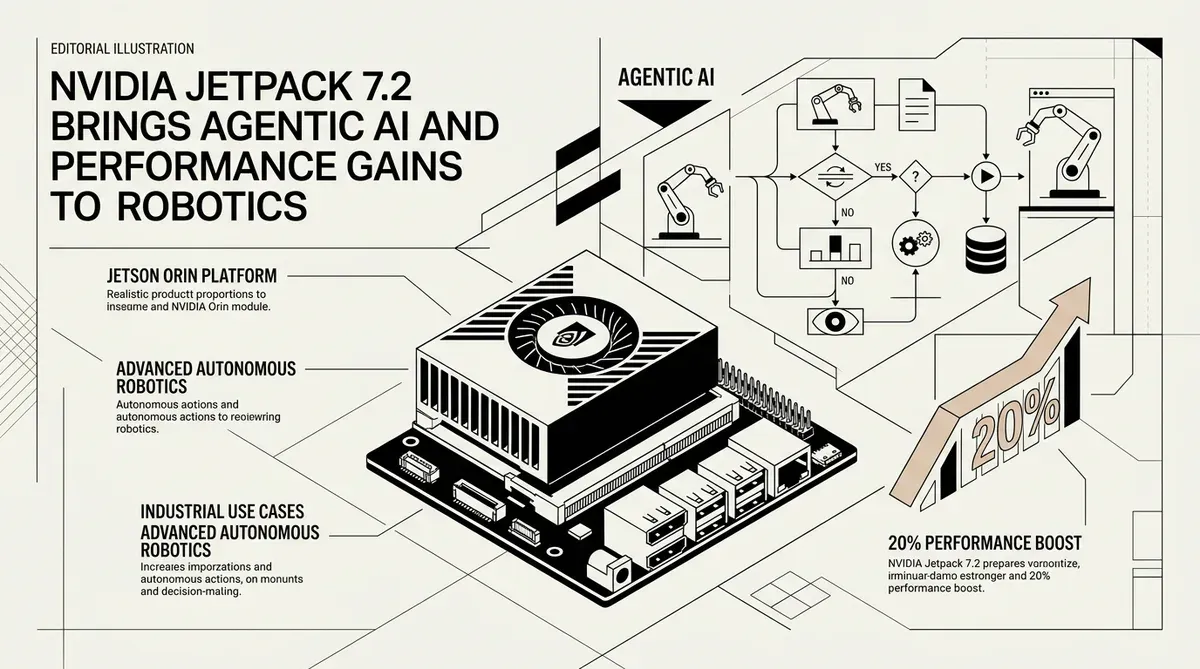
NVIDIA has launched NVIDIA JetPack 7.2, a software update that integrates agentic AI capabilities into its edge computing hardware. Announced at COMPUTEX on June 2, 2026, the release brings the NVIDIA NemoClaw framework to the Jetson platform, allowing physical robots to operate with higher levels of autonomy and reasoning. This development is a shift from traditional robotics, which relies on rigid programming, toward systems that can perceive, plan, and execute complex tasks independently.
The update provides a significant performance boost for existing hardware. The NVIDIA Jetson AGX Orin 32GB module now reaches 241 TOPS (Tera Operations Per Second), representing a 20% increase over its original technical specifications. By optimizing the software stack and introducing NVIDIA CUDA 13 support, the company is extending the lifecycle and utility of its current silicon for industrial and commercial robotics applications.
Advanced Capabilities in NVIDIA JetPack 7.2
A key addition in NVIDIA JetPack 7.2 is the support for the Yocto Project. This integration allows industrial developers to build highly customized, lightweight Linux distributions tailored for specific hardware requirements. For enterprise users, this means greater control over the operating system environment, which is essential for maintaining security and stability in factory or warehouse deployments.
The software also introduces agentic AI skills designed to automate common developer workflows. These tools can handle complex tasks such as memory optimization and performance tuning without manual intervention. By reducing the technical overhead required to deploy sophisticated models, the platform lowers the barrier for companies looking to integrate autonomous agents into their physical operations.
For high-end applications, the update enables Multi-Instance GPU (MIG) support on NVIDIA Jetson Thor. This feature allows a single GPU to be partitioned into multiple isolated instances, each with its own dedicated memory and compute resources. This capability is particularly useful for robots that must run several distinct AI models simultaneously, such as one for computer vision and another for natural language processing, without the processes interfering with one another.
NVIDIA is positioning these updates to support a broader ecosystem of autonomous machines. By combining the NVIDIA NemoClaw framework with the increased throughput of the Orin modules, the company provides the infrastructure necessary for robots to move beyond simple automation. These systems can now leverage generative AI to understand environmental context and adapt to changing conditions in real time.
While we strive for accuracy, bytevyte can make mistakes. Users are advised to verify all information independently. We accept no liability for errors or omissions.
Sources
NVIDIA Jetson Brings Agentic AI to the Physical World
AI-generated image.
Related Articles
- NVIDIA Revenue Surges to $81.6B as New Vera Rubin NVL72 Architecture Targets Agentic AI Efficiency
- NVIDIA Unveils AI Factories to Power the Next Generation of Autonomous Agents
- Lenovo AI Library Debuts to Speed Up Enterprise Agentic AI Deployment
✔Human Verified