
OpenAI, Anthropic Invest $350M in AI Labor Impact Research
OpenAI and Anthropic launch multi-million dollar AI labor impact research programs to study how generative AI reshapes jobs, hiring, and workforce policy.
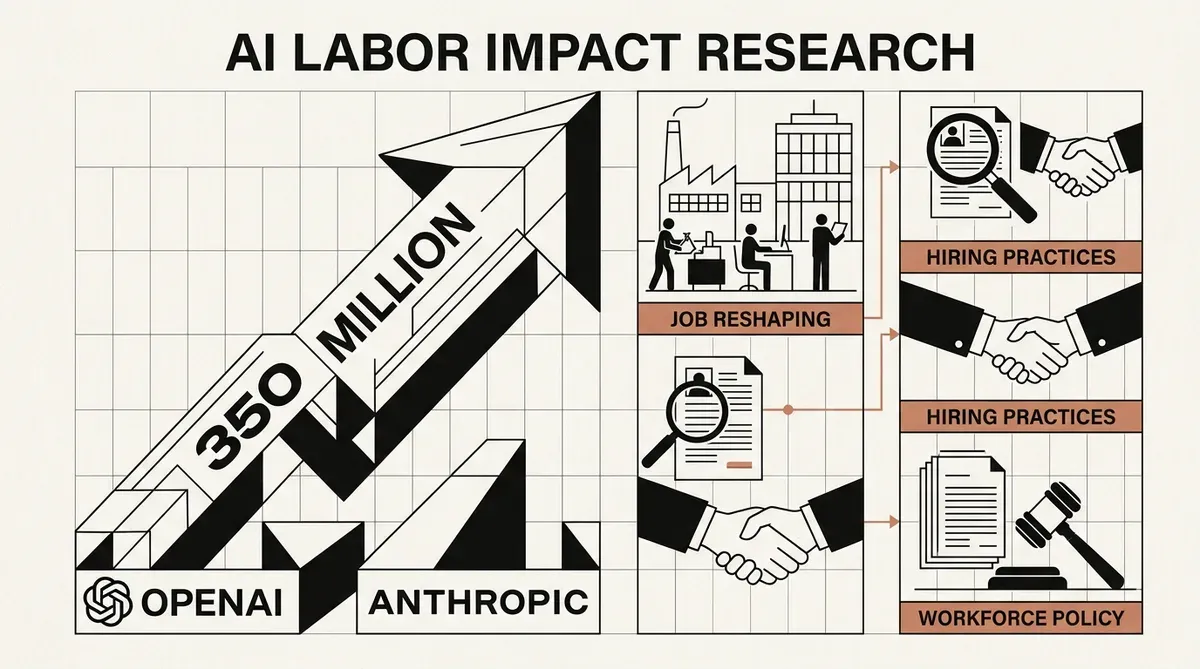
The economic consequences of generative artificial intelligence are moving from theoretical debate to structured investigation. OpenAI and Anthropic are launching significant research programs to measure how automation reshapes businesses and employment. OpenAI unveiled its Economic Research Exchange on June 12, 2026, a program that connects independent economists and social scientists with policymakers to produce evidence-based analysis of AI's effects across healthcare, manufacturing, and software development. Anthropic is spending $350 million on its own parallel initiative, split between a $200 million Research Fund for academic studies and a $150 million Claude Corps fellowship that will employ 1,000 paid researchers to examine workforce transformation. Together, these initiatives represent the largest coordinated push by AI developers to understand how their own technology affects the labor market, marking a significant escalation in AI labor impact research at a time when adoption rates are accelerating faster than most forecasters predicted. These programs are the first time AI developers have funded large-scale independent research on their own technology's labor effects while the technology is still evolving, a departure from historical patterns where economic impact studies lagged years behind deployment.
OpenAI's Economic Research Exchange is designed to move the conversation beyond broad automation fears and toward concrete, verifiable data. The lab is calling on economists and social scientists to join the initiative, which aims to generate findings that can inform governance decisions as generative AI adoption accelerates across multiple industries. The structure deliberately links independent researchers with policymakers, creating a direct pipeline from academic study to regulatory action. OpenAI has stated that it wants to analyze productivity gains alongside displacement risks, treating both sides of the ledger as equally important for sound policy formation. The program covers three initial focus sectors: healthcare, where AI tools handle transcription and image analysis; manufacturing, where computer vision systems monitor production lines; and software development, where large language models now generate and debug code at scale.
Anthropic's $350 Million Bet on Workforce Research
Anthropic's commitment is the larger of the two by investment size, and its structure reflects a more expansive view of the problem. The $200 million Research Fund will support academic and institutional studies of AI-driven labor market changes, while the Claude Corps fellowship adds a direct research capacity by funding 1,000 individuals to study workforce transformation over a defined period. The total $350 million outlay suggests Anthropic is treating labor impact as a long-term strategic question rather than a short-term public relations concern. The scale of the investment is comparable to what a mid-sized university might spend on a major research center, but focused entirely on a single policy domain.
The urgency behind both programs has a real-world basis that extends beyond speculation. According to Anthropic's internal data, entry-level workers aged 22 to 25 in AI-exposed fields such as software development have seen a 14 percent decline in hiring rates. Aggregate unemployment figures remain low across most developed economies, but this broad stability masks a more uneven distribution of AI's effects across different segments of the workforce. Younger workers entering fields where AI tools can automate significant portions of entry-level tasks are bearing the early brunt of the transition, and the trend appears to be accelerating as newer model capabilities emerge.
Anthropic's policy framework goes further than OpenAI's in its willingness to contemplate worst-case scenarios. The company has outlined a tiered intervention system in which the highest level, Tier 3, includes proposals such as Universal Basic Income if future automation triggers job losses at a scale that existing safety net programs cannot handle. This is not a policy recommendation that the company is actively advocating. It is a preparatory framework that signals Anthropic views deep labor disruption as a plausible outcome, not merely a hypothetical risk that can be dismissed. The tiered approach gives policymakers a vocabulary for discussing interventions before a crisis arrives, rather than scrambling to design them under pressure.
What the Labor Data Shows About AI and Employment So Far
The available labor data paints a mixed picture that both research programs will need to explain. Overall employment rates in most developed economies have not collapsed, which has led some observers to argue that fears of mass AI-driven unemployment are overblown. But the 14 percent decline in entry-level hiring in AI-exposed roles suggests that the impact is concentrated and real. Software development, a field that was once considered relatively immune to automation because of its complexity, is now among the most affected. Large language models can generate code, debug routines, write documentation, and handle testing tasks that previously required junior developers to perform. Companies still hire developers, but they need fewer entry-level hires to produce the same output.
Healthcare and manufacturing are also in scope for both research programs, and the dynamics in these sectors differ from software. In healthcare, generative AI tools are being deployed for medical transcription, preliminary image analysis, and administrative workflow automation. These tasks were previously performed by medical scribes, radiologists assistants, and administrative staff. The displacement in healthcare is more likely to affect support roles rather than core clinical positions, at least in the near term. In manufacturing, computer vision and predictive maintenance systems reduce the need for certain inspection and monitoring roles, but create demand for workers who can manage and maintain AI systems. The question that both OpenAI and Anthropic will need to answer through their AI labor impact research is whether the net employment effect is neutral, as with previous automation waves, or structurally negative.
A further complication is timing. Previous technological shifts, from the steam engine to the internet, played out over decades, giving labor markets and education systems time to adjust. Generative AI has achieved significant adoption in under three years. The compressed timeline means that workers displaced today may not have the same opportunity to retrain into new roles before those roles are also affected. This is the core uncertainty that the research programs are designed to address.
Strategic Implications for Business Leaders and Investors
For CTOs, founders, and investors, these research initiatives carry a clear signal about the direction of the industry. The companies building the most advanced AI systems are investing millions to study workforce disruption because they believe the disruption is coming. That does not mean every enterprise should expect immediate labor reductions, but it does mean that the strategic timeline for workforce planning has shortened considerably. Companies that rely heavily on entry-level talent in software development, content production, data analysis, and customer support should expect the hiring environment to continue shifting in ways that favor experience over volume.
The 14 percent drop in junior developer hiring is not a one-time correction. It is a structural change that may deepen as AI capabilities improve and as enterprises gain confidence in delegating more complex tasks to automated systems. Organizations that invest in reskilling programs, internal AI tools that augment employee capabilities, and human-AI collaboration models will be better positioned than those that treat automation purely as a cost-cutting lever. The strategic advantage will go to companies that can redeploy talent into higher-value work rather than simply reducing headcount.
The involvement of policymakers through OpenAI's Economic Research Exchange also signals that regulatory attention will intensify over the next several years. Evidence produced by these programs will likely inform legislation on AI training transparency, workforce adjustment assistance, and potentially tax or benefit policies tied to automation rates. Business leaders who track the findings emerging from both OpenAI's and Anthropic's AI labor impact research will have a significant advantage in anticipating regulatory shifts before they become binding. Early engagement with the data can inform corporate strategy, risk assessment, and public positioning on AI policy.
Competitive Positioning and the Broader Industry Context
Both initiatives place OpenAI and Anthropic ahead of other major AI developers in publicly engaging with labor market questions. Google DeepMind has published research on AI and labor productivity effects, and Microsoft has commissioned external studies on AI's economic contribution, but neither has launched a dedicated multi-million dollar research program with the explicit goal of informing policy at scale. The gap may be strategic. By funding research that anticipates both positive and negative outcomes, Anthropic and OpenAI can shape the narrative and the evidence base before regulators act on assumptions developed without their input.
The Claude Corps fellowship model is particularly interesting from a strategic perspective. Funding 1,000 researchers to study workforce transformation creates a cohort of independent experts whose findings will carry academic and policy credibility that company-commissioned studies might lack. This is a different approach from commissioning a single white paper or think tank report. It builds a distributed network of investigators who can produce granular, sector-specific analysis rather than broad macroeconomic projections. The findings will be harder for critics to dismiss as biased because the researchers are not Anthropic employees.
OpenAI's model of connecting researchers directly with policymakers gives its program a governance pathway that Anthropic's lacks in formal structure. The Economic Research Exchange has two goals: produce findings and deliver them to those who can act on them. That makes it a de facto policy engagement operation, even though it is framed as an academic research initiative. The two approaches are complementary rather than competitive, and together they cover more ground than either would alone.
What Policymakers and Enterprises Should Watch For
Both programs are in their early operational stages. OpenAI has issued its call for researchers to join the Economic Research Exchange and is accepting applications from qualified economists and social scientists. Anthropic is rolling out the Claude Corps fellowship and Research Fund over the course of 2026, with the first cohort of fellows expected to begin work in the second half of the year. The first wave of published findings will likely emerge within 12 to 18 months, covering baseline measurements of AI adoption rates across key sectors, productivity effects at the firm level, and early displacement patterns among specific job categories.
The data these programs generate will be closely watched by multiple audiences. Governments preparing AI regulations will use it to calibrate the scope and timing of intervention. Enterprises planning workforce strategy will use it to model staffing needs and skill requirements. Investors evaluating AI companies will use it to assess which products carry higher disruption risk from a regulatory perspective. For decision-makers across all these groups, the core message is straightforward: the AI labor impact research being funded today will produce the evidence base that shapes both policy and corporate strategy for the remainder of the decade. Engaging with it early is not optional for anyone with exposure to AI-driven labor shifts.
Anthropic and OpenAI have made their strategic bets on the importance of this question. The next phase will reveal whether the evidence supports the more measured view that AI is a normal productivity tool or the more urgent view that it is a structural break in how labor markets function. Either outcome will have direct consequences for technology strategy, workforce planning, and regulatory compliance across every sector that AI touches.
While we strive for accuracy, bytevyte can make mistakes. Users are advised to verify all information independently. We accept no liability for errors or omissions.
AI-generated image.
Related Articles
- AI Revenue Growth Hits New Heights as OpenAI and Anthropic Reach Q1 Milestones
- Anthropic Valuation Hits $900 Billion as Firm Surpasses OpenAI in New Funding Round
- Anthropic and Gates Foundation Launch $200 Million Claude AI Initiative for Global Development
✔Human Verified