
OpenAI Smart Speaker Brings ChatGPT Off the Screen and Into Your Living Room
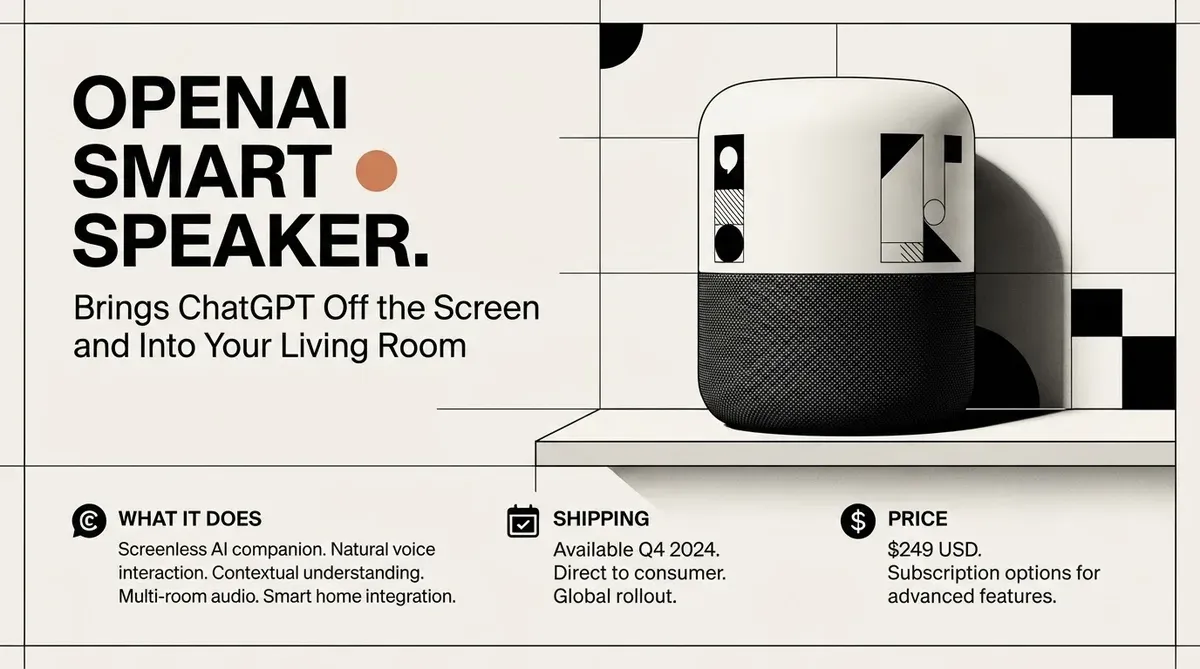
The OpenAI smart speaker has no screen, no keyboard, and no touch interface. The company's first self-branded hardware product is a portable speaker equipped with a camera, multiple sensors, and mechanical components that allow it to move autonomously through a home. Designed as an always-present AI companion rather than a device users actively operate, it is a deliberate departure from the smartphone-and-tablet paradigm that has dominated personal technology for nearly two decades.
Bloomberg reports that the device, developed by the io Products team OpenAI acquired for roughly $6.5 billion, is a screenless, voice-first speaker that integrates deeply with ChatGPT. The internal pitch describes it as a humanlike AI companion that lives in the home, proactively learning about its owner over time rather than waiting for commands. Mechanical elements give the speaker the ability to shift and move on its own, a design choice meant to make interactions feel more natural and present.
What the OpenAI Smart Speaker Does
The OpenAI smart speaker is built around a next-generation GPT-Live voice mode that enables real-time, natural conversation. Users can control smart home devices, play media, ask questions, and manage messages, all through voice interaction without needing to look at a display. A built-in camera and other sensors let the device see the room, recognize faces, and understand context, pushing the assistant beyond a simple tool-you-invoke model toward something closer to a presence in the room.
One internal presentation, cited in reporting, describes the device suggesting to a user that they go to bed earlier because it knows they have a morning meeting. That level of proactive, context-aware behavior is the core differentiator OpenAI is betting on. Where Amazon Alexa and Google Nest respond to commands, it is designed to observe, learn, and act on its own initiative.
The device is positioned internally as a third core device alongside the laptop and phone, an ambitious framing that signals OpenAI sees this as more than a niche accessory. If successful, it would slot into users' lives as a persistent, ambient AI layer that spans the home.
Pricing, Manufacturing, and Timeline
The target price for the device sits between $200 and $300, according to Bloomberg's reporting. That puts it in direct competition with Amazon's Echo Show lineup and Apple's HomePod, though the screenless design and autonomous movement are features neither competitor currently offers.
Foxconn has been contracted for manufacturing, with production planned for facilities in Vietnam or the United States. The initial run is sizable: reports indicate Foxconn has been lined up for 40 million to 50 million units, a volume that suggests OpenAI expects significant consumer demand out of the gate.
OpenAI still plans to announce the OpenAI smart speaker in the second half of 2026 and begin shipping in 2027, according to a person familiar with the matter. That timeline has held firm even after Apple filed a trade-secret lawsuit related to OpenAI's hardware ambitions. OpenAI executives have told reporters the company is on track for a late-2026 unveiling, and Sam Altman confirmed the existence of working prototypes as early as November 2025.
Legal Clouds and Competitive Stakes
Apple's trade-secret lawsuit, filed in mid-2026, targets the hardware chief who joined OpenAI from Apple and alleges the theft of proprietary information. The case adds risk to an already ambitious hardware launch for a company whose core expertise is software and cloud AI. OpenAI has not commented publicly on the lawsuit's details, but Bloomberg reports that internally the company still believes its timeline is achievable.
The competitive picture is equally high-stakes. Amazon, Google, and Apple have each spent years building smart home ecosystems with voice assistants, but none has brought a device to market that moves autonomously or proactively learns user behavior in the way OpenAI's design describes. Amazon's Alexa has struggled to find a profitable hardware model, and Google's Nest lineup has focused on smart home control rather than emotional companionship. Apple's HomePod has strong audio but limited AI capabilities compared to what the OpenAI smart speaker promises.
The positioning as a companion rather than a utility device is a genuine strategic bet. If consumers embrace a screenless, always-on AI presence in their homes, it could reshape the smart home category around agentic behavior rather than voice-triggered commands. If they do not, the investment in mechanical movement and proactive intelligence may struggle to justify its production volume.
Why this matters
The OpenAI smart speaker is the first time a major AI company has stepped directly into consumer hardware with a device designed around agentic, proactive behavior rather than reactive command-following. If OpenAI can execute on the vision, it could force Amazon, Google, and Apple to rethink what a smart home assistant should be, moving from tools users invoke to entities that observe, learn, and participate in daily life. For consumers, the device promises a fundamentally different relationship with AI: not a search bar you speak to, but something that lives alongside you.
AI-generated image.
Related Articles
- Google Home Speaker Unveiled with Integrated Gemini AI Features
- OpenAI and Jony Ive's 'Sweetpea' AI Wearable Set for 2026 Release
- OpenAI's Jalapeño Inference Chip Cuts Costs 50%
✔Human Verified
Researched and cross-referenced against primary sources by the Bytevyte editorial team.