
Palantir Secure AI Air-Gapped Environments Get NVIDIA Nemotron Model Integration
Palantir launches secure AI for air-gapped environments with NVIDIA Nemotron open models, giving US agencies sovereign control over data and model deployment.
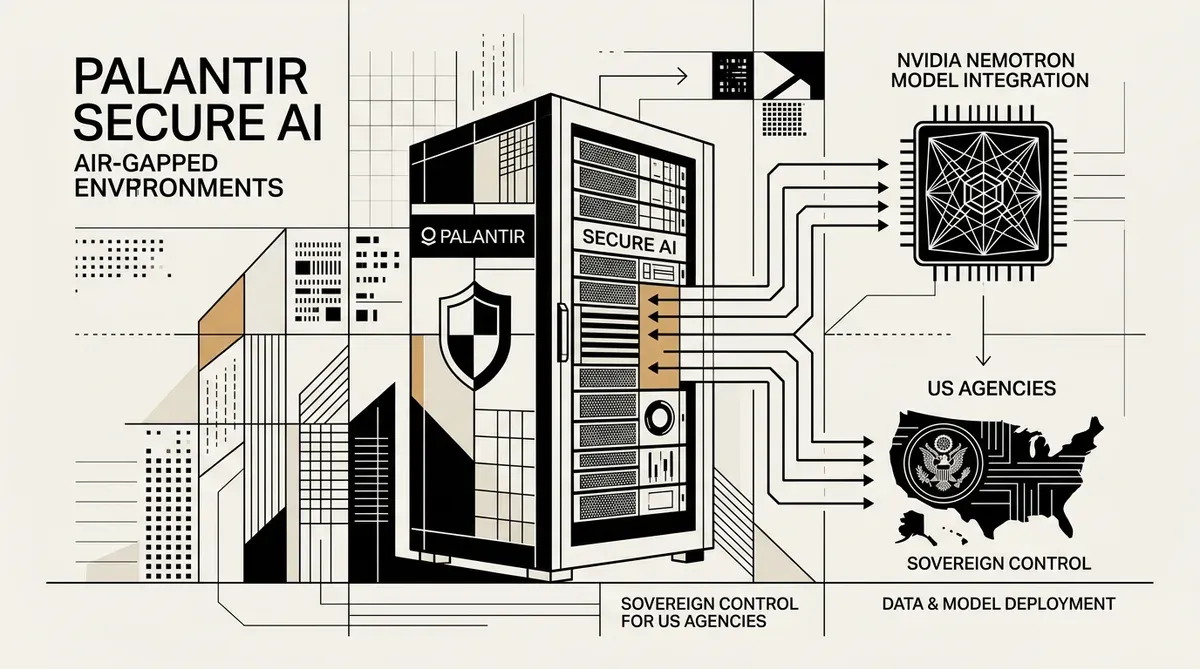
Palantir Technologies has introduced a new intelligent engine that delivers Palantir secure AI for air-gapped environments by integrating NVIDIA Nemotron open models for U.S. government agencies. The solution, announced this week, is built on Palantir's Sovereign AI Operating System and runs on NVIDIA accelerated computing infrastructure, giving federal agencies access to frontier-quality AI models while maintaining complete isolation from unsecured networks.
The offering targets a persistent challenge in government AI adoption: how to deploy advanced large language models in environments that are physically or logically disconnected from the internet. Air-gapped setups are standard across defense, intelligence, and critical infrastructure operations, where data security requirements prevent cloud-based AI services from being used.
Palantir Secure AI for Air-Gapped Environments: What the Partnership Delivers
Under the arrangement, Palantir will use the NVIDIA Nemotron family of open models to build custom models tailored to specific government missions. The Nemotron models, which NVIDIA has released under permissive open licenses, can be inspected, modified, and fine-tuned by agency teams without the restrictions that come with proprietary AI platforms. This openness is important for government use cases where supply chain security and algorithmic transparency are mandatory requirements rather than nice-to-have features.
The solution draws on four components of Palantir's Sovereign AI OS: AIP (Artificial Intelligence Platform), Foundry (data integration and analytics), Ontology (knowledge representation), and Apollo (continuous delivery and management). Together, these create a pipeline that lets agencies ingest classified or sensitive data, train or fine-tune models on that data, and deploy the resulting AI services — all within the boundaries of the air-gapped environment. No data, model weights, or deployment configurations leave the agency's control at any stage.
NVIDIA AI Enterprise provides enterprise-grade support and runtime optimization for the Nemotron models running on NVIDIA accelerated computing hardware, which includes GPUs designed for both training and inference in data-center and edge configurations.
Why Open Models Matter for National Security
The decision to use open models rather than proprietary alternatives carries strategic weight. Closed AI systems typically require agencies to share data or inference requests with the model provider, creating security and compliance concerns. Open models, by contrast, can be fully audited by government security teams, customized for domain-specific tasks, and deployed without external dependencies.
Palantir's approach positions open-source AI as a pillar of American technology leadership in national security. The company argues that the ability to independently review model weights and training pipelines is essential when AI systems are used for mission-critical decisions in defense, intelligence, and infrastructure protection. NVIDIA has positioned the Nemotron family as a platform for sovereign AI — the concept that nations and institutions should retain control over their AI infrastructure rather than relying on foreign or commercial providers.
This emphasis on sovereignty aligns with broader trends in government AI procurement. Multiple allied nations have signaled that future AI systems for defense and critical infrastructure must support on-premises deployment, independent verification, and full data ownership. The Palantir-NVIDIA solution is one of the first integrated offerings to meet all three criteria in a production-ready package. The Palantir secure AI for air-gapped environments model also allows agencies to conduct independent security audits, a requirement that proprietary platforms often cannot fulfill.
Target Sectors and Use Cases
Palantir has identified healthcare, energy, and transportation as priority sectors within government operations. In healthcare, AI models could assist with medical logistics, epidemiological analysis, and supply chain management for agencies such as the Department of Veterans Affairs or military medical commands. In energy, the models could be applied to grid management, threat detection for critical infrastructure, and optimization of resource allocation. In transportation, use cases include logistics routing, infrastructure monitoring, and security screening at ports and border crossings.
Each of these sectors handles sensitive data that cannot be processed by commercial AI services running in public clouds. The air-gapped deployment model ensures that patient records, grid configuration data, and transportation security information remain under government control throughout the AI lifecycle.
Competitive Position and Market Implications
The announcement places Palantir and NVIDIA in a strong position within the growing market for secure government AI. Rivals including Amazon Web Services, Microsoft, and Google have each developed air-gapped and classified-cloud AI offerings, but those solutions typically rely on proprietary models that limit transparency and customization. By combining open models with a sovereign deployment framework, Palantir and NVIDIA are offering an alternative that addresses the transparency requirements proprietary platforms cannot meet.
For Palantir, the partnership deepens the company's already extensive relationship with U.S. government customers. The company's platforms are widely used across the Department of Defense, the intelligence community, and federal civilian agencies. Adding NVIDIA's AI capabilities to that installed base gives Palantir a differentiated offering at a time when demand for secure AI is accelerating across the federal government.
For NVIDIA, the deal extends its reach beyond the commercial AI market and into a government vertical where accelerated computing and AI are becoming mission priorities. The collaboration also reinforces NVIDIA's strategy of positioning its open models as platforms for sovereign AI deployment, a theme the company has emphasized in recent announcements.
The broader implication for the AI industry is that open models are increasingly viewed as security advantages rather than simply cost-saving alternatives. In highly regulated environments, the ability to audit, customize, and fully control AI systems may outweigh the convenience of proprietary platforms that handle more of the complexity but leave agencies dependent on external providers.
Enterprise Support and Deployment Path
Agencies adopting the Palantir-NVIDIA solution have access to enterprise support through NVIDIA AI Enterprise, which provides runtime optimization, security patches, and technical assistance for the Nemotron models. This support layer is designed to give government customers the reliability guarantees of enterprise software while maintaining the flexibility of open models.
The deployment path begins with Palantir's AIP, which is the orchestration layer for AI workflows. Data from agency systems is integrated through Foundry, modeled in Ontology, and delivered via Apollo's continuous deployment pipeline. The NVIDIA Nemotron models are loaded onto NVIDIA accelerated computing hardware within the air-gapped environment, where they can be fine-tuned or used for inference without any external network connectivity.
Palantir has structured the solution so that agencies retain full ownership of all data, model weights, and deployment configurations. There are no data-sharing requirements, no third-party access to model outputs, and no dependency on external APIs once the initial software and model artifacts have been loaded into the environment.
Strategic Significance for Government AI
The Palantir-NVIDIA announcement is a concrete step toward the vision of sovereign AI that has been discussed extensively in policy circles but has seen relatively few production deployments. By combining open models with a deployment framework that respects the operational constraints of government environments, the two companies are providing a template that other vendors may follow.
For government decision-makers evaluating AI adoption, the key takeaway is that secure AI deployment in air-gapped environments is now achievable with frontier-quality open models. The partnership addresses the three barriers that have historically slowed government AI adoption: security concerns around data handling, transparency requirements for algorithmic decision-making, and the operational need for full control over deployed systems.
As agencies across defense, intelligence, healthcare, energy, and transportation begin to explore AI deployment at scale, the availability of solutions built on open models with sovereign deployment guarantees is likely to accelerate adoption timelines. The Palantir-NVIDIA intelligent engine, shipping with enterprise support from NVIDIA AI Enterprise, is positioned to serve as one of the primary on-ramps for that transition.
Sources
Palantir Brings Secure AI to US Agencies With NVIDIA Nemotron | NVIDIA Blog
AI-generated image.
Related Articles
- NVIDIA Secures Multi-Billion Dollar Pentagon Contract to Deploy Nemotron AI on Classified Networks
- Amazon Bedrock Integrates OpenAI GPT OSS and NVIDIA Nemotron to Diversify Enterprise AI Options
- NVIDIA Unveils Nemotron 3 Nano Omni to Streamline Multimodal AI Workflows
✔Human Verified
Researched and cross-referenced against primary sources by the Bytevyte editorial team.