
Physical Intelligence Acquisition Rumors Draw a Denial as a $1B Series C Looms
Physical Intelligence acquisition rumors persist after the CEO's denial, as the $11B robotics startup seeks a $1B round with OpenAI holding a stake.
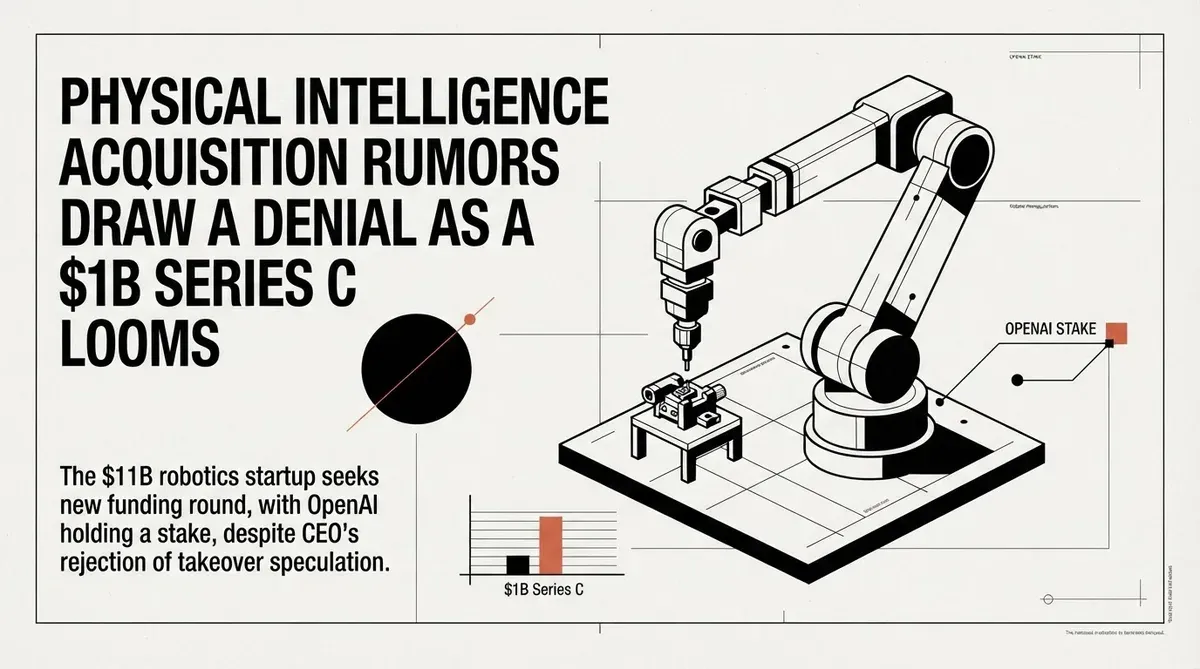
Physical Intelligence has told employees that reports of an acquisition by Anthropic are false, and the robotics AI startup is now reported to be raising another $1 billion. Chief executive Karol Hausman delivered the denial after a weekend post on X ignited takeover speculation this summer, and it has since emerged that the two companies held acquisition discussions in early 2026 that ended without a deal. The Physical Intelligence acquisition rumors have not slowed the company's fundraising, which reportedly targets a Series C round at the same $11 billion valuation the startup already commands.
The speculation began with tech blogger Robert Scoble, who said an unnamed investor had told him Anthropic was buying the robot AI developer. Anthropic has completed four known acquisitions this year and has shown almost no public robotics work, so the claim spread quickly through the AI community even though neither company confirmed it. A pure-software robotics company with a leading model is a rare acquisition target, which made the story credible on its face.
The denial was brief rather than emphatic. Hausman told staff the reports were not true in a Slack message that included a GIF from the TV series The Office, and the story kept moving because it was not invented from nothing: the two companies did hold acquisition talks in early 2026, and those talks ended without an agreement. When a target and a suitor have already sat down once, a denial reads as a status report rather than a closing statement.
OpenAI's position on the cap table is what makes the situation delicate. OpenAI is an existing shareholder in Physical Intelligence, and its information and refusal rights could complicate any sale to a competitor. Information rights keep a shareholder apprised of sale discussions, while refusal rights can block a transaction under the terms of an investment agreement. Because OpenAI is also one of Anthropic's main rivals, that stake may end up dictating who Anthropic can or cannot acquire. The situation puts OpenAI in a double role: it is both a rival to Anthropic in AI models and a gatekeeper for one of the most attractive robotics assets on the market.
The fundraising picture explains why the company is being circled. Physical Intelligence has raised more than $1 billion to date at an $11 billion valuation and is reportedly in the market for roughly another $1 billion in a Series C at that same price, which would bring cumulative funding to about $2 billion. At an unchanged valuation, a $1 billion round would transfer roughly nine percent of the company to new investors. A flat round at the previous price is a signal that backers are holding the valuation steady rather than marking the company up, an unusual discipline for a sector where capital is flowing freely.
Why the Physical Intelligence Acquisition Rumors Persist
The Physical Intelligence acquisition rumors kept traction for a structural reason: the company occupies a rare position in the robotics stack. It focuses entirely on the AI layer, building a generalist robot policy that can control many different robot bodies instead of being tuned to a single machine. Its pi0.5 model is among the most prominent foundation models in robotics research, a position few companies hold, and the $11 billion valuation makes it one of the most richly valued pure-software robotics companies in the market. Physical Intelligence, co-founded by Lachy Groom, has built its name entirely on that software layer rather than on robot hardware.
The competitive field around that position is filling in. Google DeepMind has been actively developing Gemini Robotics, and OpenAI has spent more than a year quietly assembling a dedicated robotics team. Anthropic has shown few public signs of robotics work of its own, which helps explain why it would look at acquiring its way into the market rather than building from scratch. A quiet bidding contest for the robotics foundation-model layer is now visible across the industry, with Physical Intelligence near the center of it and OpenAI positioned to influence the outcome through its shares.
Robots Move From Pilots to Shift Schedules
The commercial demand for that layer is arriving faster than expected. BMW described the Figure 02 pilot at its Spartanburg plant as a success, and in February 2026 the automaker announced plans to deploy AEON, a wheeled humanoid from Hexagon Robotics, at Plant Leipzig in Germany. The two decisions, taken months apart, show an automaker moving from piloting one humanoid to planning another, and both point the same way: factory automation is becoming a software problem as much as a hardware one.
The transition is not frictionless. Workers are pushing back as humanoid robots take on production roles, and that labor pressure is part of the reason the software layer carries so much of the value: factories can change robot bodies, but the generalist policy that controls them is harder to replace. Labor responses and public perception affect how fast pilots become shift schedules, and that uncertainty is part of the environment in which the flat Series C is being raised. For Physical Intelligence, the timing of the reported round matters because its model is already a fixture in robotics research, and production deployments are building the market the company is raising to serve.
What the Reported Series C Signals
The round also clarifies the strategic direction. A company preparing to sell to Anthropic would have little reason to raise new capital at a flat valuation, so the reported Series C reads as a signal that Physical Intelligence intends to stay independent while demand for robot foundation models grows. Anthropic's path to a robot brain would then run through other targets or internal development, while OpenAI holds a lever on the outcome through its existing shares. For early investors, a flat round delays a mark-up but keeps the company funded without a down round, and for new capital it offers entry at the same price the previous backers paid.
For decision-makers, the practical question is who ends up controlling the software that future fleets of humanoid robots will run on. The Physical Intelligence acquisition rumors, the flat Series C, and the OpenAI stake are three views of the same question: who will control the robot brain market. Physical Intelligence is one of a small number of companies with a credible generalist policy, its $11 billion valuation sets the price of entry for the layer, and the OpenAI stake constrains every other bidder. The next milestones are the close of the Series C and any further movement on the Anthropic front, since both will determine whether the robot brain market consolidates or stays fragmented.
Why This Matters
The robotics AI layer is becoming a contested asset class, and the fate of Physical Intelligence will set the precedent for the rest of it. If the company closes a flat $11 billion round and keeps its independence, the generalist robot policy market stays open to multiple acquirers; if the OpenAI stake eventually steers the company toward a particular buyer, the shape of the humanoid robotics industry changes along with it.
AI-generated image.
Related Articles
- Generalist AI Funding Round Secures $400 Million to Advance Physical AGI
- How the Hyundai Boston Dynamics Acquisition Reshapes Physical AI Strategy
- Bezos Secures $10B for Project Prometheus Physical AI
✔Human Verified
Researched and cross-referenced against primary sources by the Bytevyte editorial team. This article was generated with the assistance of artificial intelligence and reviewed by the Bytevyte editorial team.