
ROHM Launches Miniature NFC Wireless Charging Solution for Smart Rings
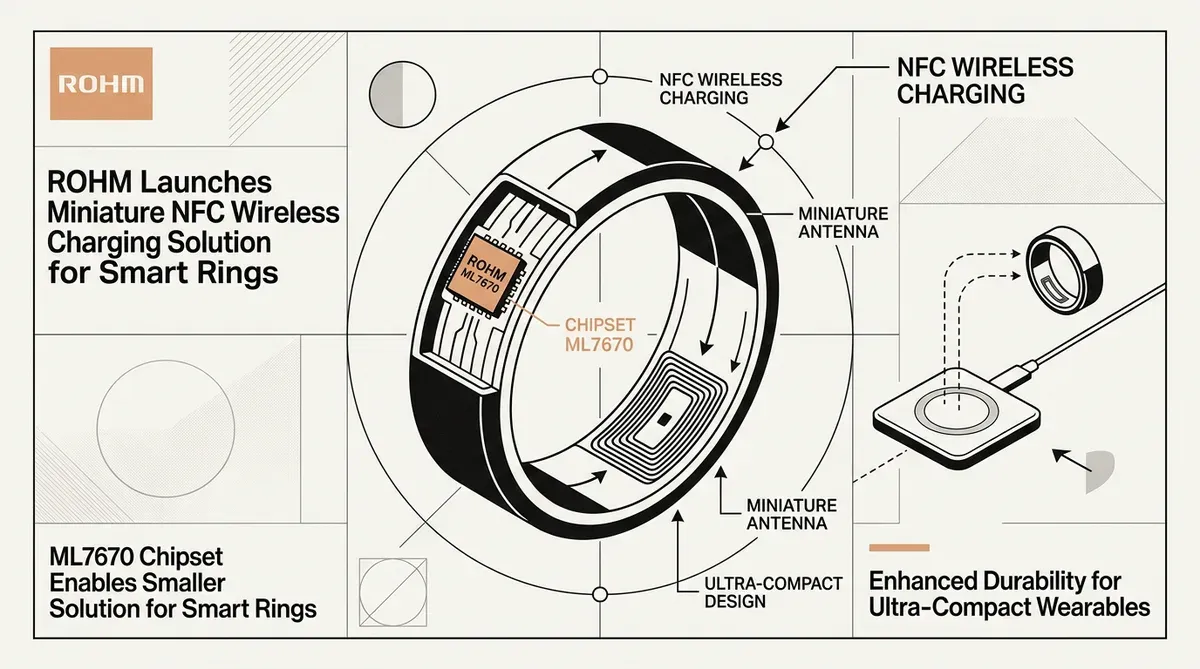
ROHM has introduced a specialized wireless power supply chipset designed specifically for the growing smart ring market. The new solution, consisting of the ML7670 receiver and ML7671 transmitter, utilizes 13.56 MHz Near Field Communication (NFC) technology to deliver power to ultra-compact wearables. By using this frequency instead of standard Qi protocols, the NFC wireless charging system allows for significantly smaller antenna designs that fit within the narrow constraints of a finger-worn device.
The ML7670 receiver IC is particularly notable for its miniature footprint, measuring just 2.28mm by 2.56mm with a thickness of 0.48mm. This compact size enables manufacturers to integrate wireless charging without sacrificing battery space or increasing the bulk of the ring. The chipset supports a maximum power delivery of 250 mW and adheres to the NFC Forum Wireless Charging (WLC 2.0) specifications, ensuring compatibility with standardized charging infrastructure.
Integrated Design for Smaller Wearables
One of the primary advantages of this NFC wireless charging solution is the reduction in external components. ROHM has embedded the necessary firmware directly into the chipset, which eliminates the requirement for a separate microcontroller (MCU) to manage the charging process. This integration further saves internal space and simplifies the circuit design for hardware engineers working on miniature electronics. By removing the MCU, the overall power consumption of the charging circuit itself is reduced, which is a critical factor for devices with limited battery capacities.
The technology is already reaching consumers through the SOXAI RING 2, a Japanese health-tracking wearable that utilizes this specific chipset. Because the system handles both power and data transmission over the same 13.56 MHz band, it can facilitate basic communication between the charger and the ring while the battery refills. This dual-functionality allows the device to report battery health or firmware status during a charge cycle without needing additional Bluetooth connectivity.
As of May 2026, the chipset is in mass production, providing a standardized path for other wearable brands to adopt NFC wireless charging in future product cycles. The shift toward NFC-based power delivery is a significant change for the industry, as it moves away from proprietary contact-based pins that are prone to corrosion and wear. By using a sealed wireless approach, manufacturers can improve the water resistance and long-term durability of smart rings and other small biometric sensors.
While we strive for accuracy, bytevyte can make mistakes. Users are advised to verify all information independently. We accept no liability for errors or omissions.
AI-generated image.
Related Articles
✔Human Verified