
RUM Group GPU Lease: $13.7B Bet on Renting AI Compute
The RUM Group GPU lease, worth up to $13.7B over six years, turns a Tether-backed video platform into an AI compute landlord.
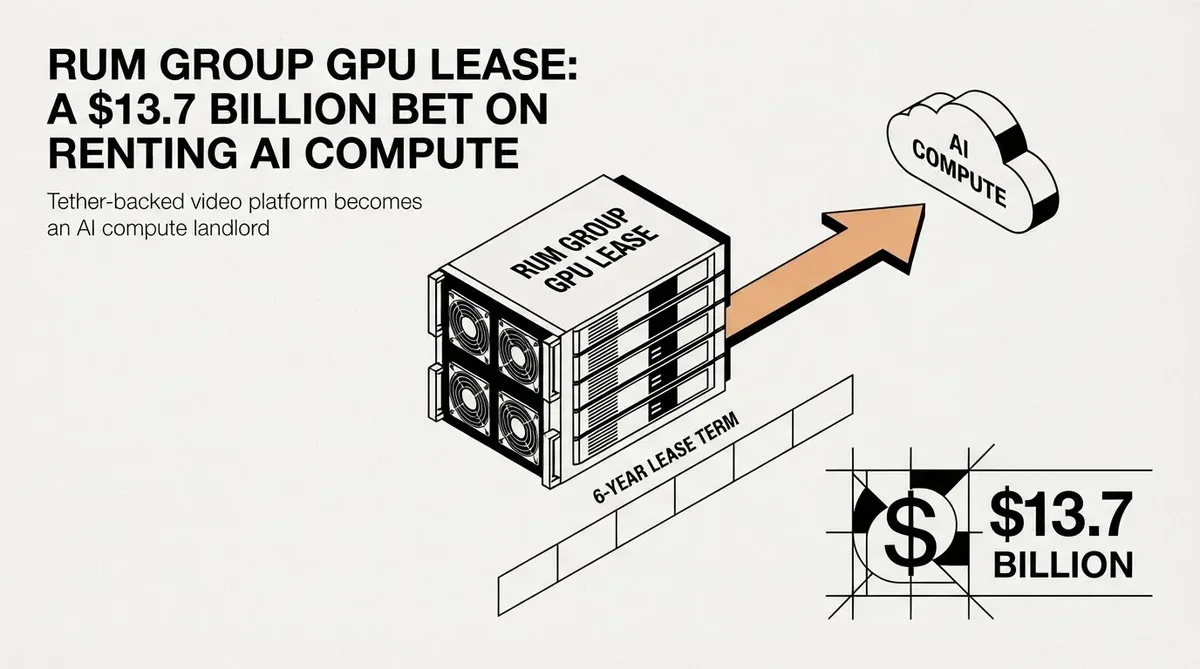
RUM Group, the rebranded holding company behind the Rumble video platform that hosts Truth Social, has signed a six-year contract worth up to $13.7 billion to supply GPU services to an unnamed U.S. cloud customer. The deal puts the company among the larger AI compute landlords in the market. The RUM Group GPU lease was dated August 23 and disclosed in an SEC filing the next day. It covers GPUs and related infrastructure at the company's Maysville, Georgia data center campus, which is still being built. At roughly 100 times trailing twelve-month revenue of about $117 million, the order anchors a pivot away from a video business that currently operates at negative gross margins.
Under the terms of the RUM Group GPU lease, the $13.7 billion order value is split into three roughly equal tranches of about $4.6 billion each. The third tranche becomes binding only if the customer approves the proposed delivery date, which gives the buyer a standing exit if construction at Maysville slips. RUM Group describes the customer only as an unaffiliated U.S.-based cloud provider and has not identified it by name.
Anatomy of the RUM Group GPU lease
The most unusual element is the equity kicker attached to the commercial terms. The cloud customer holds warrants for more than 50.8 million Class A shares at an exercise price of $0.01, with vesting tied to capacity purchases. Each tranche of compute purchased moves new equity closer to issuance, so the buyer's consumption is directly tied to shareholder dilution: the more GPUs the customer rents, the more shares exist to absorb the revenue.
That warrant design is what separates the RUM Group GPU lease from a conventional capacity lease. Standard cloud contracts pay cash for compute; this one delivers part of the customer's economics in near-free equity that scales with usage. For RUM Group, the warrants are both a retention mechanism and a substitute for the cash incentives a less established vendor might otherwise offer. For existing shareholders, they are a cost of the contract that grows in step with its revenue.
RUM Group is the holding company for two businesses: Rumble, the independent video platform, and Quake AI, the full-stack GPU and cloud computing operation built from the assets of Northern Data and Rumble Cloud. The company hosts Truth Social, the platform associated with President Donald Trump, and carries a market capitalization near $4.09 billion. Tether, the stablecoin issuer, owns about half of RUM Group and provides the capital support behind the AI push.
The assets behind the pivot
The infrastructure backing the RUM Group GPU lease was already on its balance sheet. RUM Group owns 22,000 Hopper-generation GPUs, and management says they are in use more than 80% of the time. The company has also confirmed 250 megawatts of grid-connected power capacity, expected to come online by 2027. That power currently produces no revenue; the lease is the mechanism that turns it into contracted income. The Maysville campus, where the leased GPUs will be housed, is under development and will absorb the new capacity as it arrives.
| Metric | Figure |
|---|---|
| Contract value | Up to $13.7 billion over six years |
| Structure | Three tranches of about $4.6 billion each |
| GPU fleet | 22,000 Hopper-generation GPUs |
| Fleet utilization | Above 80% |
| Power capacity | 250 MW grid-connected, online by 2027 |
| Tether ownership | Roughly 50% of RUM Group |
| Q3 2026 revenue guidance | $87 million to $93 million |
| Market capitalization | About $4.09 billion |
Power is the scarce input in the current AI buildout, and the 250 MW RUM Group controls is already grid-connected, which means the company has cleared a step that often takes years of utility negotiation. The lease converts that asset from a balance-sheet line into contracted revenue, and it helps explain why the customer would commit to a campus that does not exist yet: secured power at a buildable site is the constrained resource in this market.
The company's own guidance shows how far the current business sits from the contract's scale. RUM Group targets third-quarter 2026 revenue of $87 million to $93 million, nearly double its second-quarter result and above prior consensus, yet still a small fraction of the $13.7 billion order book. The arithmetic of the pivot is simple on paper: Rumble's video business operates at negative gross margins, so each incremental advertising dollar costs more to serve than it brings in, while leased compute turns idle silicon and stranded power into infrastructure revenue without the content-cost drag.
Where the risk sits
The clearest risk sits in RUM Group's own disclosure: the company states it does not currently have the financing required to fulfill the agreement. Tether's roughly 50% stake is the implied backstop, but the funding gap, the construction timeline, and the single unnamed customer mean the RUM Group GPU lease concentrates execution risk in three places at once. The conditional third tranche compounds that exposure, because the customer can decline the delivery date and leave RUM Group with two-thirds of the order value and a partially contracted campus.
The competitive frame matters too. RUM Group has positioned Quake AI as a direct challenger to CoreWeave and Nebius, the GPU cloud specialists that grew by securing anchor commitments from AI labs before building out capacity. The difference is sequencing: CoreWeave and Nebius signed contracts after their platforms were proven, while RUM Group signed its anchor contract before the facility that will serve it exists, and before the financing is in place.
Market reaction has been strong without being complete conviction. RUM shares jumped as much as 26.3% on the announcement, then settled into a lower range over subsequent sessions. Against a market cap near $4.09 billion, the $13.7 billion order book implies investors are pricing in a substantial chance that some tranches never bind or that the delivery schedule slips.
The verdict depends on execution rather than demand. If Maysville comes online, the customer approves the third tranche, and Tether's backing closes the funding gap, RUM Group converts 250 MW of idle power and 22,000 Hopper GPUs into a compute-rental business with an anchor tenant, moving from negative gross margins toward the high-margin model that CoreWeave and Nebius operate. If financing stalls or the customer walks away, the warrant structure leaves holders with diluted equity and a partially built campus. The milestones to watch are the financing announcement, construction progress at Maysville, and the customer's approval of the tranche-three delivery date.
Why this matters
The RUM Group GPU lease tests whether stranded power and idle GPUs can be converted into compute-rental revenue faster than traditional cloud providers can build capacity, and whether equity-linked incentives can lock in demand ahead of construction. For buyers of AI compute, it signals that capacity is now being financed through more aggressive structures; for investors, it shows the AI infrastructure trade has moved beyond chipmakers into companies that own grid connections and leased silicon.
AI-generated image.
Related Articles
- Riot-Anthropic Deal: A $9.1B Lease Turns a Texas Bitcoin Mine Into an AI Landlord
- Google's $150B Anthropic Chip Financing Machine Beats Nvidia on Borrowing Costs
- The Meta BlackRock Data Center Venture: How a $14 Billion Deal Reshapes AI Infrastructure Finance
✔Human Verified
Researched and cross-referenced against primary sources by the Bytevyte editorial team. This article was generated with the assistance of artificial intelligence and reviewed by the Bytevyte editorial team.