
Shanghai Begins Commercial Operations of Subsea AI Data Center Powered by Wind Energy
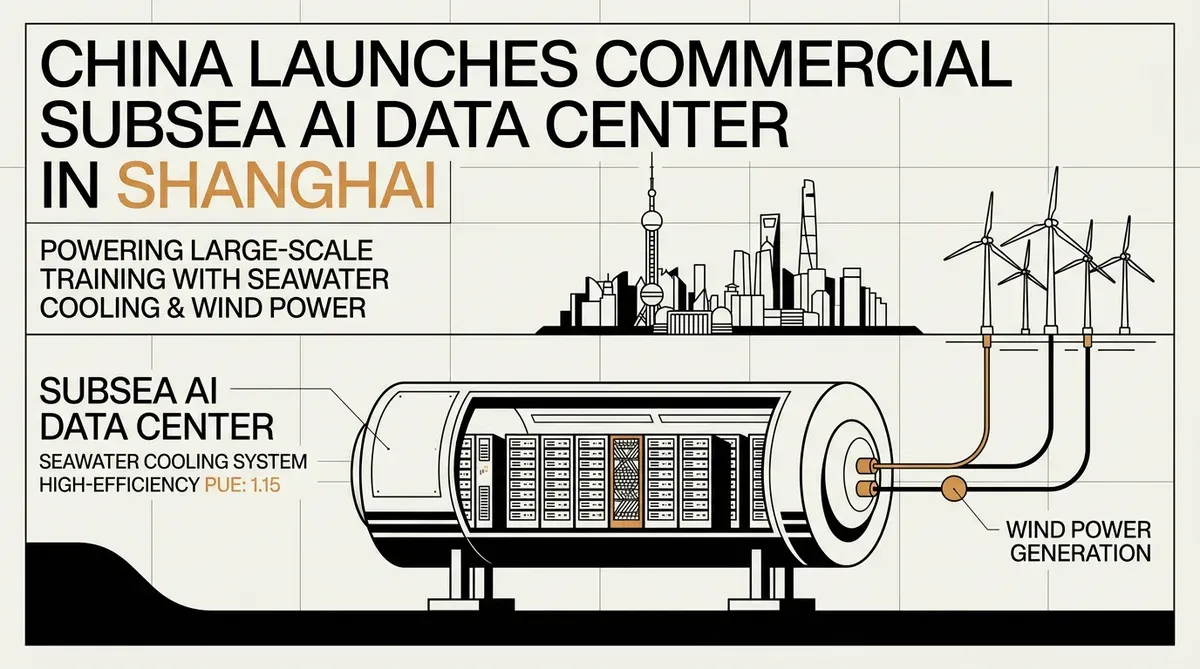
China has started commercial operations at a subsea AI data center off the coast of the Lingang Special Area in Shanghai. The facility uses natural seawater to cool approximately 2,000 servers contained in sealed underwater capsules. This design removes the need for traditional air conditioning and freshwater, resulting in a Power Usage Effectiveness (PUE) of 1.15. This rating is lower than the global average for land-based facilities.
The site is configured for AI model training and big data analytics. Electricity comes from nearby offshore wind farms to create a renewable energy supply for high-density computing. This configuration solves the high energy costs of cooling and the lack of available land in Shanghai. According to project specifications, the underwater environment acts as a constant heat sink for hardware that produces extreme heat during processing.
Operational Benefits of Underwater Infrastructure
The Shanghai facility maintains stable temperatures by using the surrounding water. This method supports higher rack density because it prevents thermal throttling. Terrestrial AI clusters often face performance limits due to heat, but subsea placement allows hardware to run at peak capacity. Operators can place these centers near coastal urban hubs where data demand is highest, which reduces latency for local enterprise clients.
Moving hardware offshore also bypasses land-use restrictions. In metropolitan areas, finding large plots with high power capacity is difficult. The subsea model allows for infrastructure expansion without competing for urban real estate. The sealed capsules protect the server racks from the marine environment while maintaining high efficiency.
Global Context for AI Infrastructure
The deployment of this commercial facility provides a template for sustainable AI scaling. Global demand for AI model training has increased the environmental footprint of data centers. Combining offshore wind power with seawater cooling offers a method for carbon-neutral computing. This approach is applicable to other coastal regions facing similar energy and land constraints.
The Shanghai project confirms that underwater deployment is a functional commercial reality. The 1.15 PUE demonstrates an efficiency level that is difficult for land-based centers to achieve. The facility currently supports large-scale artificial intelligence workloads for the regional market.
While we strive for accuracy, bytevyte can make mistakes. Users are advised to verify all information independently. We accept no liability for errors or omissions.
AI-generated image.
Related Articles
- Google Initiates Construction of First Swedish Data Center to Support AI Growth
- Pure DC Secures $2.7 Billion to Expand AI Infrastructure Across EMEA
- TCS and Siemens Energy Expand Alliance to Tackle AI Data Center Energy Challenges
✔Human Verified