
SoftBank Launches Domestic Manufacturing to Support SoftBank AI Infrastructure
SoftBank expands its SoftBank AI infrastructure with domestic battery and server manufacturing in Japan to secure power and compute supply chains.
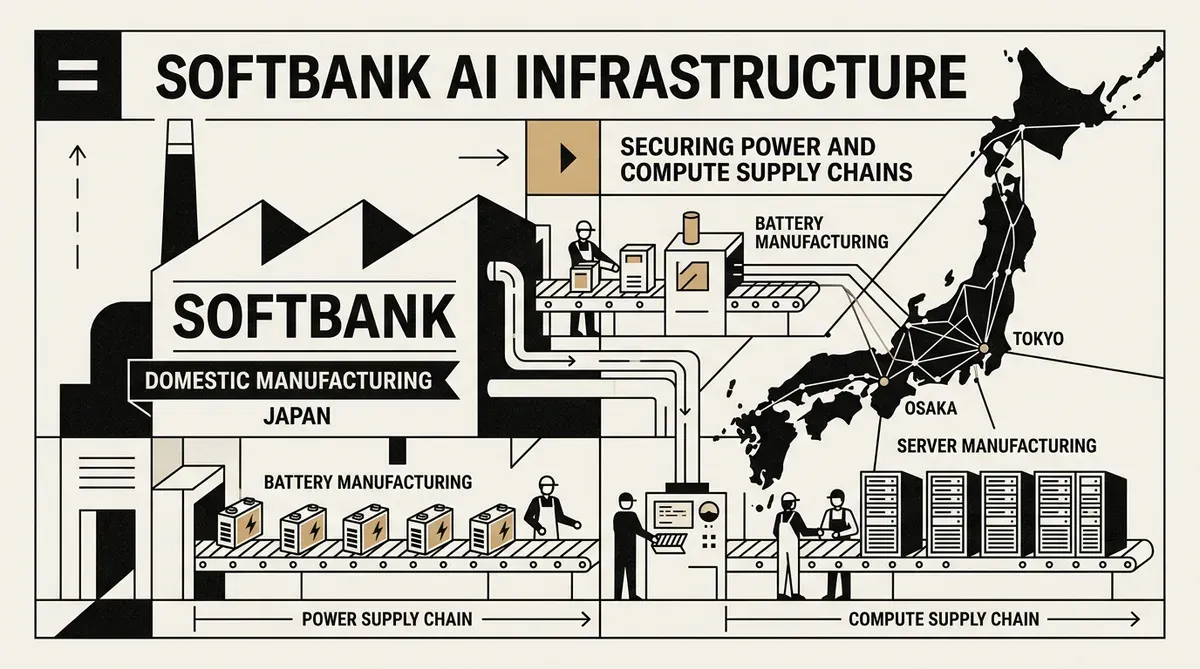
SoftBank has initiated a major expansion into industrial manufacturing to secure the energy and hardware requirements of its SoftBank AI infrastructure. The company confirmed this week that it will repurpose a portion of its Sakai City facility in Osaka to produce advanced batteries. These power storage units will utilize technology that avoids the use of lithium and cobalt, addressing both supply chain risks and environmental concerns. SoftBank intends to reach mass production for these batteries by fiscal 2027.
This manufacturing push is part of a broader strategy to vertically integrate the AI compute stack within Japan. By producing its own energy storage solutions in partnership with DeltaX Co., SoftBank aims to provide sustainable power for its growing network of data centers. The move reflects a growing trend among technology giants to control the physical components that sustain high-performance computing, rather than relying solely on external vendors.
Domestic Production for SoftBank AI Infrastructure
The strategy extends beyond energy storage to include the hardware that processes AI workloads. SoftBank is currently in discussions with Nvidia and Foxconn to establish domestic manufacturing for high-performance AI servers. This collaboration would allow the company to build the specialized hardware necessary for modern machine learning tasks while ensuring data sovereignty. Producing these servers within Japan reduces dependence on international logistics and strengthens the local technology ecosystem.
The decision to move into hardware manufacturing is a shift for SoftBank, which has traditionally focused on telecommunications and investment. By controlling both the power supply and the server hardware, the company can optimize its infrastructure for the specific demands of its AI services. This integrated approach is designed to improve efficiency and lower the long-term operational costs of running massive data models.
Strategic Implications for the AI Market
SoftBank's investment in lithium-free battery technology and local server production addresses two of the most significant bottlenecks in the AI industry: power availability and hardware scarcity. The use of alternative battery chemistries could provide a competitive advantage if traditional battery materials face price volatility or export restrictions. The partnership with Nvidia ensures that the domestic servers will be compatible with the industry-standard software and hardware architectures used by developers globally.
As of 2026-05-11, the conversion of the Sakai City plant is a key milestone in Japan's efforts to reclaim a leading position in high-tech manufacturing. The project aligns with national interests regarding economic security and the development of a resilient digital economy. SoftBank expects the first units from the new production lines to support its internal data center expansion before potentially offering these solutions to the broader enterprise market.
While we strive for accuracy, bytevyte can make mistakes. Users are advised to verify all information independently. We accept no liability for errors or omissions.
AI-generated image.
Related Articles
- SoftBank, Sony, and Honda Form ¥1 Trillion Alliance to Build Sovereign Physical AI
- ASE and WUS Invest NT$35 Billion in Taiwan AI Chip Packaging Plant
- SUSE and NVIDIA Partner to Deliver Sovereign AI Infrastructure for High-Security Enterprises
✔Human Verified