
The Compliance Cliff: Navigating the EU AI Act Enforcement Gap and Tiered Compliance
Analysis of the EU AI Act enforcement gap and tiered compliance. Explore the friction between GPAI transparency rules and global AI supply chain realities.
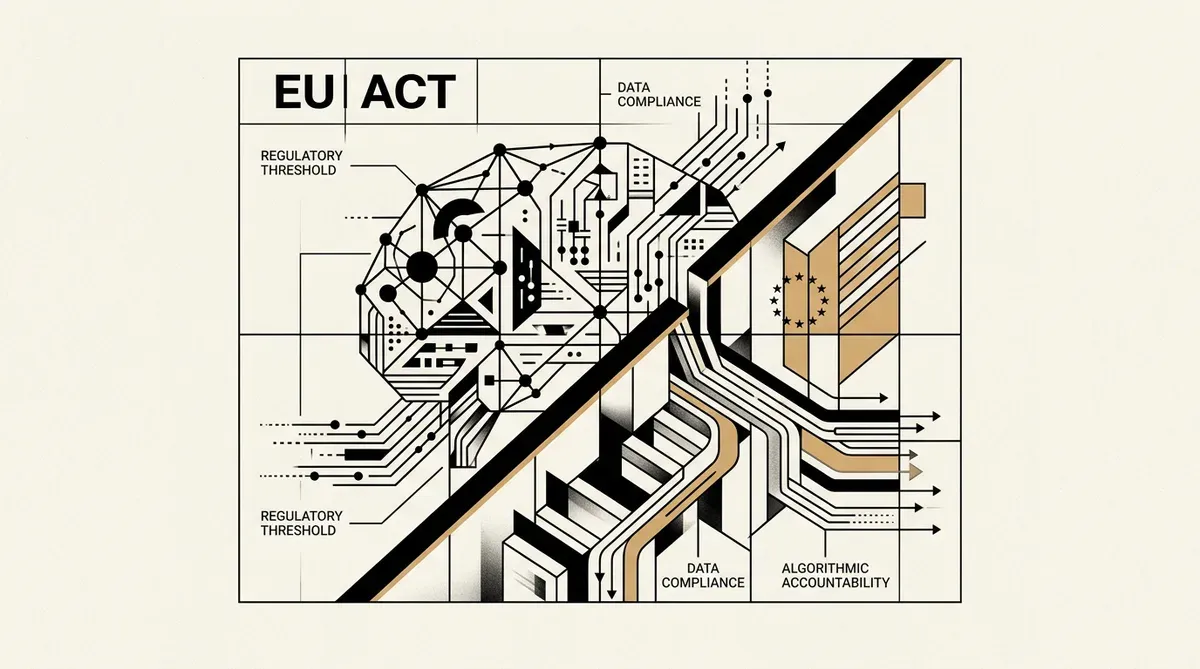
The Great Decoupling: Legislative Intent vs. Technical Reality
The European Union’s Artificial Intelligence Act is moving toward its full operational phase, yet the transition from a theoretical landmark to a functional framework is proving difficult. While the "Brussels Effect" was intended to harmonize global AI safety, current developments have instead exposed a widening enforcement gap. This gap exists between the tiered compliance obligations mandated by the European AI Office and the technical friction of auditing opaque models within global software supply chains.
With the critical milestone for high-risk AI enforcement set for August 2, 2026, the industry is currently preparing for what regulators call the "Compliance Cliff." Since the rules for General-Purpose AI (GPAI) models became applicable on August 2, 2025, the market has seen a surge in legal disputes over model classification, particularly regarding the distinction between standard GPAI and those posing systemic risk.
The Tiered Trap: The 10^25 FLOPs Game
The EU AI Act’s tiered structure was designed to be surgical: light-touch transparency for most models and stringent oversight for those with systemic risk. According to Article 51, the primary metric for this distinction is a compute threshold where models trained with more than 10^25 floating-point operations (FLOPs) are automatically categorized as systemic risks. However, early implementation suggests this compute-counting approach has triggered a technical game of cat-and-mouse.
Major AI labs are exploring "student-teacher" distillation and "Mixture of Agents" (MoA) architectures to manage this threshold. By training a massive teacher model outside the EU and then distilling its capabilities into a student model trained with just under 10^25 FLOPs, providers can place highly capable models on the European market while avoiding the more onerous obligations of Article 55, such as adversarial testing and incident reporting.
- The Systemic Risk Paradox: Only a handful of models, including OpenAI’s GPT-4 and Google’s Gemini 1.5 Pro, were initially flagged as systemic risks based on known compute data.
- The Student Loophole: Smaller, highly optimized models like Mistral’s latest iterations often rival the performance of systemic-risk models but fall below the compute threshold, creating a regulatory blind spot.
- The 30% Margin: The AI Office’s October 2025 guidelines allow for a 30% error margin in compute estimation, a buffer that critics argue is being used to under-report training intensity.
Technical Friction: The "Summary of Training Data" Battle
The most significant point of friction in the current enforcement landscape is Article 53, which requires GPAI providers to provide a sufficiently detailed summary of the content used for training. This has become a point of contention between the EU AI Office and major technology firms.
Regulators intended these summaries to facilitate copyright enforcement and safety audits. However, the General-Purpose AI Code of Practice, finalized on July 10, 2025, remains a living document that many providers claim is technically incompatible with proprietary data protection. Compliance officers at major US-based AI firms have indicated that technical documentation often arrives at the AI Office heavily redacted, citing trade secret protections under the EU Trade Secrets Directive.
Engineers at leading LLM providers have noted that the level of granularity requested often does not exist in automated scraping logs. The legislative intent assumes a clean, cataloged library of data, but the technical reality involves petabytes of unstructured web data where summarization becomes a subjective exercise rather than a technical report.
Supply Chain Chaos: The Downstream Dilemma
The enforcement gap is most visible in the global software supply chain. Under the Act, a developer in Berlin building a high-risk recruitment tool, categorized under Annex III, is legally responsible for the entire system's compliance. If that tool is built on top of a GPAI model provided by a third party, the developer must obtain technical documentation from the model provider to satisfy EU auditors.
This has created a liability crisis. In late 2025, the European Commission introduced the Digital Omnibus Package in an attempt to reduce this administrative burden, but the technical friction remains. Many GPAI providers are refusing to share the deep-level weights, biases, or specific data provenance required for a high-risk Conformity Assessment.
The Role of the AI Office and the "Digital Omnibus" Retreat
The European AI Office, established to be the central nervous system of enforcement, is currently facing a resource crisis. Tasked with monitoring the most powerful models, the Office has struggled to keep pace with rapid release cycles. The Digital Omnibus Package, presented on November 19, 2025, was widely seen as a pragmatic retreat. It proposed linking the enforcement of high-risk requirements to the availability of harmonized standards, many of which are still in draft form at CEN/CENELEC.
This delay has created a gray market of AI systems. Companies are deploying systems that technically fall under high-risk categories but are operating in a state of regulatory uncertainty because the specific technical benchmarks for accuracy and robustness have not been finalized. This lack of clarity has led to a 40% increase in compliance spending for EU startups, according to a March 2026 report by the European Digital SME Alliance, while larger firms with deep legal pockets are self-certifying and awaiting potential litigation.
Auditing the Black Box: The Failure of Model Transparency
The core of the investigative challenge lies in the auditing gap. The AI Act mandates that systemic-risk models undergo model evaluation and adversarial testing. However, there is currently no standardized, legally binding framework for what constitutes a successful audit of a non-deterministic model.
Independent auditors have noted that the presumption of conformity granted to signatories of the Code of Practice is being used as a shield. Companies like Meta and Google, who were early signatories, can claim compliance by following the Code’s voluntary measures, even if their models exhibit the same biases or safety failures as non-signatories. This has led to a situation where documentation is plentiful, but actual model behavior remains opaque.
The Road to August 2026: A Fragmented Future?
As the full application of the Act in August 2026 approaches, the industry is at a crossroads. The enforcement gap has created two distinct tiers of AI in Europe. Large providers who can afford the regulatory costs are negotiating bespoke transparency agreements with the AI Office. Meanwhile, smaller providers and open-source projects are either withdrawing from the EU market or operating in a state of permanent beta to avoid classification as a finished product.
The technical friction of meeting transparency requirements within complex supply chains is a fundamental mismatch between traditional regulatory structures and modern software architecture. The AI Office must move beyond FLOPs-counting and toward a more dynamic form of oversight to ensure the EU AI Act creates a safe market without stifling innovation. The next six months will determine if the Act becomes a global gold standard or a cautionary tale of regulatory overreach as the gap between legal demands and technical capabilities remains wide.
While we strive for accuracy, bytevyte can make mistakes. Users are advised to verify all information independently. We accept no liability for errors or omissions.
AI-generated image.
Related Articles
- Stanford 2026 AI Index: Adoption Surges, Transparency Falls
- Lenovo Study Finds Unregulated Enterprise Shadow AI Risks Corporate Security and ROI
- Australian Regulator Mandates Stricter AI Governance for Financial Institutions
✔Human Verified