
Valar Atomics $1B Raise Fuels Nuclear Factory Push
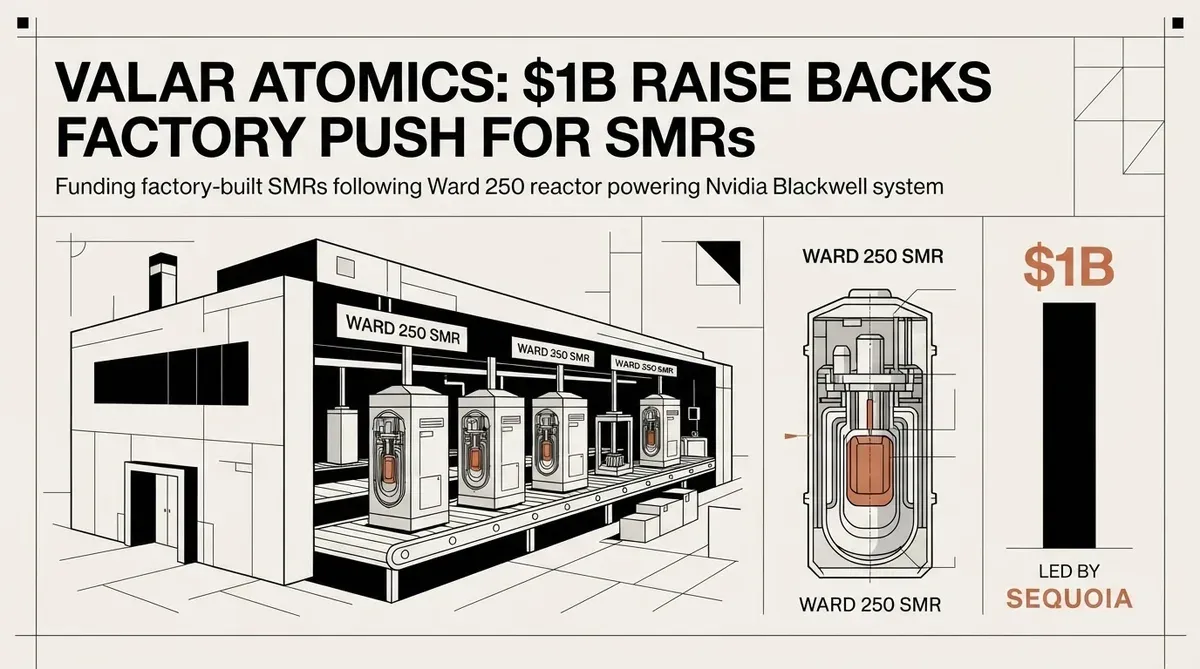
Valar Atomics has closed a $1 billion Series B led by Sequoia Capital, giving the three-year-old El Segundo startup the money to move from demonstrating small reactors in the Utah desert to building them on a production line. The Valar Atomics $1B raise, confirmed this week, lands at a reported valuation of roughly $6 billion, about three times the company's mark from four months ago.
Inside the Valar Atomics $1B raise
The equity round is paired with a $200 million line of credit arranged by Erebor and other banks, and Sequoia partner Shaun Maguire is joining the board. The investor group spans venture firms, hedge funds and family offices: Apandion Capital, Conviction, Dream Ventures, HOF Capital, Point72, Riot Ventures and Snowpoint Ventures are in, with Atreides Management and Valor Equity Partners also participating.
The valuation jump shows how quickly investor sentiment has shifted. Four months ago Valar was marked at $2 billion; the new round values it near $6 billion. For a company that has demonstrated one reactor, that multiple is priced into the manufacturing plan rather than into any installed capacity.
The Valar Atomics $1B raise also shows nuclear power repositioning from a contested energy source to critical infrastructure for AI. The flow of capital into reactor developers this year reflects that shift, and Valar is the newest example of it.
The credit facility reads as a separate signal. Debt of this kind is uncommon for a reactor developer at Valar's stage, so the $200 million line from Erebor and other banks suggests lenders see the factory plan as bankable alongside the equity backers.
Valar is three years old, which is short by nuclear standards and long by venture standards. In that window it has gone from a design on paper to a critical reactor to a $6 billion valuation, a trajectory that helps explain why the round closed at all.
From one reactor to a production line
Valar builds small modular reactors, or SMRs, designed to be manufactured in factories and deployed like equipment at data centers or industrial sites, rather than assembled on location the way conventional nuclear plants are. The company says the Ward 250 is the first reactor outside a national laboratory to be taken critical.
The company's milestones are built around cycle time. Valar reports that the NOVA core took two years to complete and that Ward 250 reached criticality seven months later. The stated roadmap is to shrink that interval with each reactor built until output reaches tens, then hundreds, then thousands of units a year.
The figures matter because time is the industry's core problem. Traditional reactors are expensive partly because they take years to build, and Valar's argument is that factory production turns a long construction project into a repeatable manufacturing step.
The manufacturing thesis is the heart of the strategy. Conventional reactors are built one at a time on site, with project-specific engineering, permitting delays and labor costs that compound. Valar treats the reactor as a product, shipped to customers the way data center operators receive racks of servers, and that product logic is what separates the factory model from project construction.
The Valar Atomics $1B raise is aimed at that factory expansion. The company has described the financing as accelerating manufacturing for the AI industry and for national security. In practice the capital has to stand up production capacity before signed orders require it, the same capital-intensive pattern used by chip fabs and battery plants.
Nvidia is the strategic anchor. In June, Valar demonstrated the Ward 250 powering an Nvidia Blackwell system, and the two companies agreed to develop a waterless 30 MW AI factory in Utah, a facility sized for AI workloads without the cooling water that conventional plants draw from rivers and reservoirs.
The 30 MW AI factory in Utah is the concrete expression of the model: a single site, co-developed with Nvidia, that pairs the reactor with compute. It also gives both companies a reference installation to show data center customers, extending the June demonstration into a deployable product.
The waterless design matters for where these plants can go. Utah's desert site is the proof point: dry cooling removes a constraint that has historically limited nuclear siting in arid regions, which is exactly where cheap land and cheap power are most available for data centers.
The demonstration closes the loop between reactor and compute. A reactor that has powered an Nvidia Blackwell system gives data center operators a verifiable reference point, which is more than most SMR developers can offer at this stage of the market.
The leap from one demonstrated reactor to thousands a year remains the open question. It is the same promise the nuclear industry has struggled to keep for decades: cheaper power through repetition, delivered at industrial scale. Valar's answer is a roadmap with shrinking cycle times, but the manufacturing ramp will also depend on licensing, component supply chains and a steady stream of orders.
Valar's public statements describe the sequence without pinning down the calendar. The first orders will be the real test of the model: a production line pays for itself only if customers commit to repeat purchases, a contract pattern data center operators already use with hardware vendors.
The nuclear money race
Valar is raising into a crowded field. Antares has pulled in $470 million for its own reactor push, and X-energy completed a $1 billion IPO, both signs that venture and public-market money is now flowing to reactor developers at a pace the industry has not seen in decades.
| Developer | Latest financing | What it is building |
|---|---|---|
| Valar Atomics | $1B Series B plus $200M credit line | Factory-built SMRs for AI data centers |
| Antares | $470M raised | Small modular reactors |
| X-energy | $1B IPO | Small modular reactors |
Taken together, the three raises put close to $2.5 billion into the SMR segment in a short window, and the Valar Atomics $1B raise is paired with a $200 million credit facility. That money will test whether factory-built reactors can actually deliver on the manufacturing promise.
The size of these rounds reflects how capital-hungry the path is. A demonstrated reactor is one thing, but a factory producing hundreds of units a year needs tooling, licensing and a supplier base, all of which must be paid for before revenue arrives. That is why the financing is front-loaded rather than milestone-based.
Among the three, Valar is the one with a demonstrated reactor, and that is the point of differentiation. The Ward 250 has run an Nvidia Blackwell system and sits under a partnership for a specific 30 MW facility, proof points the paper designs in the rest of the field cannot match.
The cap table adds context. Early backers include Palmer Luckey and Palantir's Shyam Sankar, and the Valar Atomics $1B raise brings Sequoia's Shaun Maguire onto the board, giving the company a direct link to investors who fund AI infrastructure at scale.
For Sequoia, the round extends an AI infrastructure thesis into power generation itself. Shaun Maguire's board seat gives the firm a direct hand in a company whose product is electricity for the same data centers Sequoia-backed startups sell into, a position few venture firms hold.
Why this matters
The Valar Atomics $1B raise is a wager that the AI power crunch can be met with factory-built reactors sold like hardware. If the production roadmap holds, it changes how data center operators procure power; if it slips, it joins a long history of nuclear projects that promised scale and delivered cost overruns. Either way, the capital moving to Valar, Antares and X-energy makes clear that investors now treat nuclear capacity as part of the AI buildout.
AI-generated image.
Related Articles
- Anthropic Volta Compute Deal: $10 Billion, a Week-Old Startup and a Bitcoin Miner
- NVIDIA Blackwell Ultra Drives Shift Toward Industrial AI Factories
- Nvidia SSI Investment: $5B for Safe Superintelligence
✔Human Verified
Researched and cross-referenced against primary sources by the Bytevyte editorial team. This article was generated with the assistance of artificial intelligence and reviewed by the Bytevyte editorial team.