
Why the AI Data Center Backlash in San Jose Is the Whole Industry's Problem
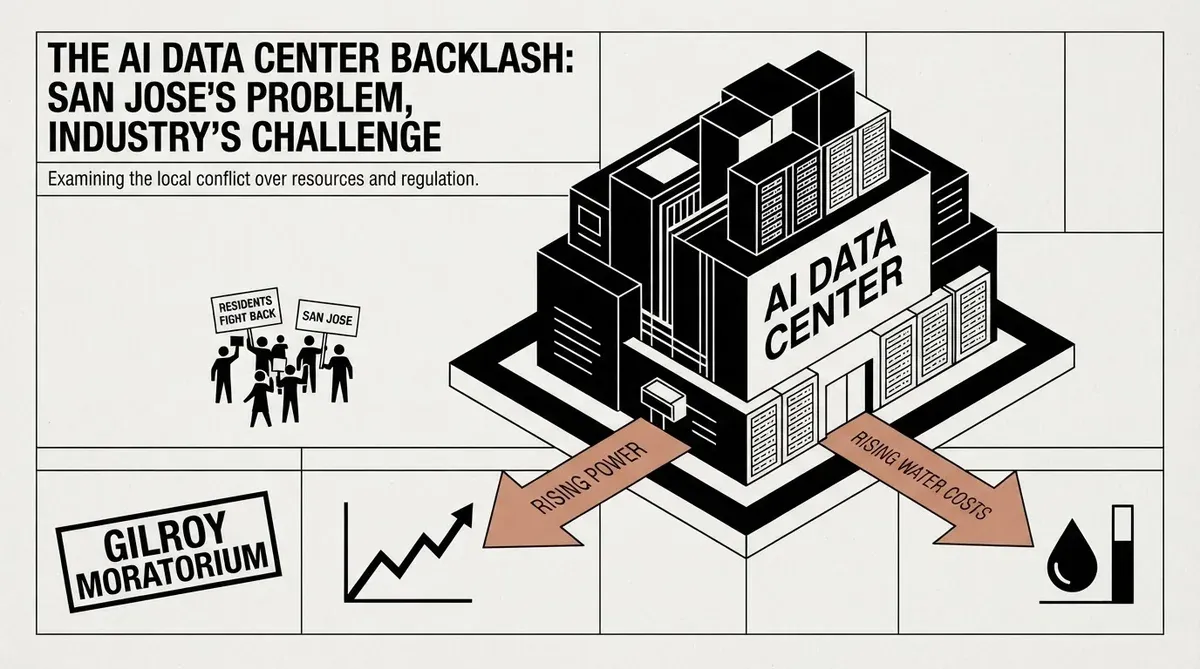
San Jose has spent years courting the data center business, and it is now learning what that courtship costs. Neighborhood groups and environmental advocates in California's third-largest city are pressing officials over electricity prices, water consumption and air quality as they organize against a growing list of proposed projects. The AI data center backlash has moved from a national talking point to a municipal planning fight.
I have covered enterprise infrastructure long enough to know how this usually goes. The industry treats the hard problem as silicon, cooling or interconnect, then finds that the real gate is a city council agenda item on a Tuesday night. San Jose, with roughly a million residents, actively recruited these projects as an economic anchor. The people pushing back are ratepayers and neighbors who suspect that hosting compute raises the cost of running a household.
San Jose Mayor Matt Mahan has staked out a narrower position than either camp. He argues the city should not halt data center construction while insisting that projects meet responsible standards. His summary of the public's questions is the useful part: whether the facilities raise household energy bills, whether they draw down drinking water, whether they degrade quality of life in the neighborhoods that host them.
Gilroy Chose the Freeze
South of San Jose, Gilroy's City Council voted to stop accepting new data center applications and instructed staff to draft development standards, according to San Jose Spotlight. Mayor Greg Bozzo described the pause as in step with steps taken by neighboring cities and by municipalities around California and the country. Opponents brought signs to the meeting.
The divergence between the two cities is the detail that matters for anyone underwriting capacity in Santa Clara County. San Jose is drafting uniform standards and has declined to pause approvals. Gilroy halted applications first and will define the rules afterward. Same pressure, opposite sequencing.
| Jurisdiction | Approach | Mechanism | Stated rationale |
|---|---|---|---|
| San Jose | Regulate without pausing | Uniform development standards in progress | Keep AI infrastructure investment and tax revenue while addressing cost and water concerns |
| Gilroy | Pause first | Temporary moratorium plus staff-drafted standards | Consistency with nearby cities and municipalities statewide |
For a developer comparing sites, those are not equivalent risks. A moratorium removes schedule certainty outright. A standards process removes it partially and leaves open the possibility that the rules eventually adopted make a site uneconomic.
San Jose's case for the buildout rests on the region's AI-driven economy and on the property and utility revenue the facilities generate. City officials make that revenue argument as the counterweight to every objection about cost, and it explains why San Jose has not joined the jurisdictions moving the other way.
Why the AI Data Center Backlash Landed Here
Three years of AI infrastructure coverage have been dominated by accelerator supply. That framing is now the least informative part of the story. The constraints that decide whether a facility gets built are electricity, water and local consent, and all three are administered by people who answer to voters rather than shareholders. San Jose's organizing drive is the clearest case yet of the AI data center backlash reaching a city that actively wants the investment.
Electricity is the first squeeze. Data centers are large, flat, always-on loads, and the objections in San Jose tie them directly to rising prices for everyone else on the same grid. That link turns every rate case into a referendum on the AI buildout, whether or not the operator intended one.
Water is the second. Evaporative cooling consumes potable supply, and in a state that has spent a decade managing drought restrictions, a facility's water draw is legible to residents in a way that a transformer upgrade is not.
Consent is the third, and the one the industry is least equipped to manage. Land use is a municipal power. A hyperscaler can negotiate interconnection with a utility and lobby a state regulator, then lose at a planning commission that meets twice a month in a room with fifty chairs.
That asymmetry is the substance of the San Jose story. Companies with nine-figure capital budgets hold almost no leverage over the body that decides whether a site is rezoned.
Nothing here is unique to California politics. The same arithmetic applies wherever a utility must add generation, transmission or treatment capacity to serve one large customer: the cost lands on a rate base that did not ask for the load, and the load's owner has no vote in the proceeding that sets the tariff.
The national dimension is easy to miss from inside one county. Gilroy's mayor framed the moratorium as consistent with cities across the state and the country, and the AI data center backlash is spreading as capacity demand accelerates. Each jurisdiction writes its own rules, so the industry faces a patchwork of approval regimes rather than one national permitting standard.
The Counter-Argument Worth Taking Seriously
The strongest case against my reading comes from officials trying to keep projects moving. Their argument runs roughly as follows: demand for AI capacity is not created by Gilroy, so a moratorium there does not reduce it. It relocates it, possibly to a jurisdiction with looser environmental rules and no community benefits at all. Better to approve projects under uniform standards and extract commitments on water, grid upgrades and local revenue while the developer still needs the permit.
That is a coherent position, and it explains why San Jose has not followed Gilroy. It has a weakness. Uniform standards set a floor; they do not settle whether a particular neighborhood absorbs the load. The organizing in San Jose is about cost allocation rather than prohibition: who pays for the substation upgrade, and where the property tax revenue lands.
My stance is that operators should stop treating municipal approval as a permitting formality and start treating it as a first-class capital risk. Water recycling designs, load-flexibility commitments and ratepayer protections belong in the first public meeting rather than the third. A site-selection model that prices interconnection but not a two-year approval slip is mispricing the asset.
The evidence sits in the sequencing. Gilroy's council acted before standards existed because the political cost of waiting exceeded the economic cost of pausing. San Jose's council is trying to keep construction moving while writing rules, which is harder than it sounds: a standards process invites every interested party to litigate the details, and the details include the numbers residents care about most.
Investors should note what the fight does to the regional pitch. Santa Clara County's advantage was supposed to be proximity to the engineers and the customers. When hosting compute becomes politically expensive inside the county, that advantage narrows, and capacity drifts toward places where land, power and permits are cheaper but latency and talent are worse. The trade-off is now a line item in the AI buildout.
What to watch next is concrete. Gilroy's staff will draft standards that determine whether its pause becomes a template or a temporary delay. San Jose's uniform standards will show how the city allocates grid upgrade costs and water obligations between developers and ratepayers. Those two documents will shape the region's capacity pipeline more than any accelerator roadmap published this quarter.
Why this matters
The AI buildout's cost curve now runs through city halls as much as through fabs and substations. For anyone planning capacity in Silicon Valley, local consent has become a schedule dependency as real as any equipment lead time, and it is the one input that money cannot shorten. The organizing in San Jose and the freeze in Gilroy are early signals of how that constraint gets priced. Operators who negotiate it late will pay in delays they cannot recover.
AI-generated image.
Related Articles
- AI data center backlash is Big Tech's costliest constraint
- Anti-Data-Center Protests Go National With 142 Demonstrations Across 42 States
- How the AI Data Center Backlash Became a Midterm Election Fight
✔Human Verified
Researched and cross-referenced against primary sources by the Bytevyte editorial team. This article was generated with the assistance of artificial intelligence and reviewed by the Bytevyte editorial team.