
Zoox robotaxi incidents in the paid launch's first month put NHTSA's exemption model to the test [Update]
Two Zoox robotaxi incidents in paid Las Vegas service echo failures behind July's 105-vehicle recall, testing NHTSA's exemption bet.
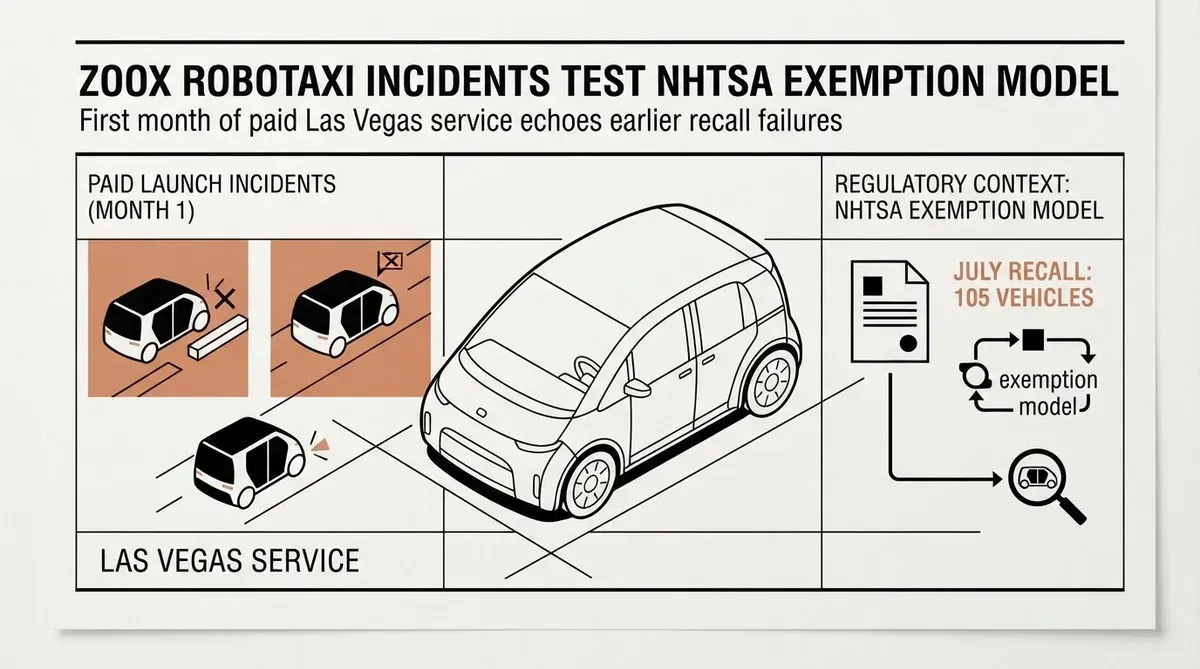
An Amazon-owned Zoox robotaxi passed a road-closed sign and traveled the wrong way down a barricaded street in Las Vegas' Arts District on September 4, weeks into the paid ride service that began August 10 under a federal safety exemption, as we previously reported when fares went live. Days later, another driverless Zoox vehicle was hit from behind after stopping for an oncoming emergency vehicle. The Zoox robotaxi incidents arrive barely a month into paid service and put the scene-reading failures behind Zoox's July recall of 105 robotaxis back under scrutiny.
The road-closure episode unfolded in the Arts District, a gallery- and nightlife-heavy quarter of Las Vegas where the company runs driverless operations. A widely shared video shows the vehicle steering around construction barricades and continuing along the closed stretch. The on-board systems appear to have treated the sign and barrier as a physical object to route around rather than a traffic command to obey, a reading consistent with the scene-interpretation weakness regulators flagged this summer. A Las Vegas rideshare driver who helped circulate the footage warned residents and visitors to exercise caution around the robotaxis.
The second incident came days after Zoox opened its first airport route, extending service to Harry Reid International Airport on September 3. At the Decatur Boulevard and Russell Road intersection, the driverless vehicle braked hard to yield to an approaching emergency vehicle and was struck from behind by the other driver, according to Zoox. Video of that crash also spread quickly online.
Why the Zoox robotaxi incidents echo July's recall
The Arts District breach is a close cousin of the June 20 event that forced the summer recall. On that date, an unoccupied Zoox robotaxi in Las Vegas entered an active fire scene hidden by heavy smoke before emergency crews had placed cones. Zoox reported the episode to the National Highway Traffic Safety Administration, discussed its severity, frequency and root causes with the agency, and on July 17 recalled 105 robotaxis for an over-the-air update designed to improve detection of heavy smoke and active emergency scenes.
By Zoox's own description, that fix targeted smoke and emergency scenes. The regulator's warning covered more ground. NHTSA characterized failures to detect active emergency scenes and construction work as a functional insufficiency rather than a rare edge case, and it pressed the industry for corrections by a July 31 deadline after Zoox and rival Waymo each recalled vehicles over the same pattern this summer. NHTSA Administrator Jonathan Morrison followed up with a directive telling autonomous vehicle developers that their vehicles must clear the way for first responders, a message aimed across the industry rather than at one company. Zoox chief executive Aicha Evans has since backed calls for stricter federal robotaxi rules.
What NHTSA flagged is a gap between two kinds of scenes. Robotaxis read fixed infrastructure such as lane lines, signals and posted signs with high reliability. They struggle far more with scenes assembled on the spot: smoke where there should be none, cones set out after an incident, a road closed for overnight work. The September 4 breach sits squarely in the second category, which is what makes it harder to dismiss than a simple sensor miss.
| Date | Event | Outcome |
|---|---|---|
| December 2025 | Software recall covering 332 test vehicles | Fix for improper lane crossings and stopping in front of traffic |
| June 20, 2026 | Unoccupied robotaxi enters smoky, uncordoned fire scene in Las Vegas | Episode reported to NHTSA |
| July 17, 2026 | Voluntary recall of 105 robotaxis | Over-the-air update for smoke and emergency-scene detection |
| August 10, 2026 | Paid commercial fares begin in Las Vegas | Exemption-based launch |
| September 3, 2026 | Service expands to Harry Reid International Airport | First airport route |
| September 4, 2026 | Robotaxi bypasses road-closed barrier in the Arts District | Viral video; rideshare safety warning |
| September 2026 | Robotaxi rear-ended after stopping for an emergency vehicle | Other driver at fault, per Zoox |
That timing makes the September breach awkward for Zoox. The July update shipped roughly seven weeks before the Arts District episode, and the construction half of the flagged problem was already on the record. If the vehicle that crossed the barricades was running the recall-era software, the episode suggests the update addressed smoke and emergency scenes without closing the wider gap around road closures. Zoox told NHTSA after the June event that it was the only occurrence of its kind in the company's history; a barricade breach in the same season makes that claim harder to sustain. Its recall history points the same way: the December 2025 action covered 332 test vehicles, and the July recall followed within seven months, so the September breach would be the third software correction in under a year if NHTSA pushes for another.
What the exemption regime has at stake
The commercial stakes sit inside the exemption itself. NHTSA granted Zoox a temporary pass on certain federal motor vehicle safety standards so its driverless vehicles could carry paying passengers, capping the fleet at 2,500 vehicles per year with the authorization running through July 31, 2028. Zoox had offered free demonstration rides in Las Vegas for roughly a year before converting to fares, and it still runs free rides in parts of San Francisco while testing in small zones in Miami and Austin and in six other U.S. cities. The airport corridor now gives the paid service a repeatable, high-demand route as Zoox builds toward the cap.
Because that arrangement rests on public and regulatory trust, incidents in the first month of revenue carry an outsized cost. There are two ways to read the record so far. The rear-end collision is the reassuring case: on Zoox's account the robotaxi performed the maneuver regulators demanded, stopping for the emergency vehicle, and the other driver caused the impact. The Arts District breach is the harder case because it shows a robotaxi failing at exactly the scene-reading task NHTSA put on notice. For regulators, the recall loop is operating as designed, with events reported, fixes pushed over the air and a direct line kept open with the company. For Zoox, that same loop converts each public failure into ammunition for critics of the exemption approach.
For riders and officials, the practical question is whether NHTSA treats the September breach as a closed matter or as evidence that the recall-era fixes stopped short of the full problem class. The service is expanding, the airport route is live, and the company has every incentive to keep scaling under its exemption cap. The Zoox robotaxi incidents of the past week will be judged against the regulator's July warning rather than against the industry's usual accident baseline, and another road-closure or emergency-scene event would put the exemption itself in a harder position.
Why this matters
Zoox's paid launch is the first sustained test of the idea that a federal exemption can bring driverless cars to market while regulators correct defects after the fact. A repeat of the flagged detection weakness inside the first month of fares shifts the burden of proof onto the exemption's beneficiaries: the next closed road, smoke plume or emergency scene will show whether the regime can scale before the software closes the gap.
AI-generated image.
Related Articles
- Zoox Paid Robotaxi Service Debuts in Las Vegas
- Zoox Robotaxi Exemption: Landmark U.S. Approval for Steering-Wheel-Free Rides
- Robotaxi safety operator injuries: hidden cost of scale-up
✔Human Verified
Researched and cross-referenced against primary sources by the Bytevyte editorial team. This article was generated with the assistance of artificial intelligence and reviewed by the Bytevyte editorial team.