
Apple's UK Encryption Challenge Reaches the Secret Tribunal
Apple's UK encryption challenge reaches the secret tribunal over a UK order for iCloud backdoor access. The ruling will decide encryption's future.
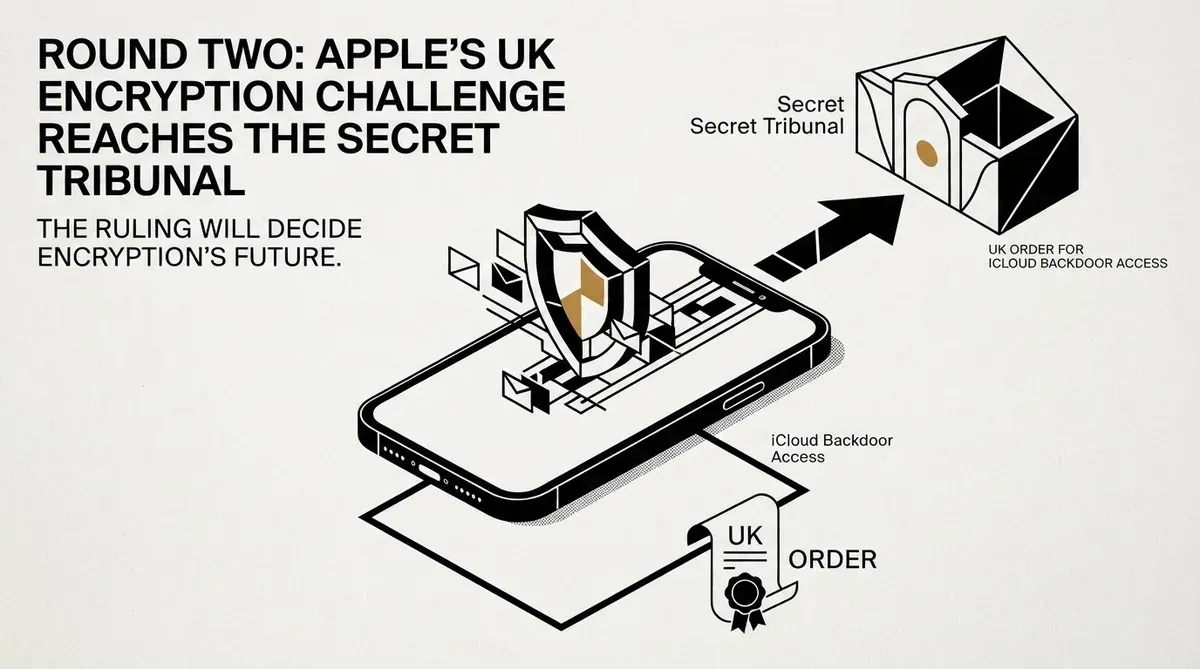
Apple has confirmed that it lodged a fresh complaint at the Investigatory Powers Tribunal, the UK's court for covert surveillance disputes, contesting a Home Office demand for access to encrypted iCloud backups belonging to British users. Apple's UK encryption challenge, filed last month and made public this week, arrives roughly a year after the government withdrew a broader version of the same order. This second round tests whether consumer end-to-end encryption can survive the Investigatory Powers Act's system of secret technical capability notices.
The dispute began in early 2025, when the Home Office issued a technical capability notice ordering Apple to create a way for officials to view fully encrypted material uploaded to iCloud. Apple refused to build that backdoor and instead pulled Advanced Data Protection from the UK, so British users could no longer enable the feature. ADP is a voluntary setting that encrypts iCloud backups, Drive storage, photos, and voice memos end to end, engineered so that not even Apple holds a key to the data. New British users therefore could not get the strongest protection Apple offers, a level of security that remains available to users elsewhere.
ADP exists precisely because standard iCloud protection is different. Ordinary iCloud data is encrypted, but Apple retains the ability to decrypt it when required by law; the end-to-end tier removes that ability entirely. That is why the Home Office demand targets backups specifically: encrypted cloud backups are the part of a user's data that a technical capability notice would otherwise leave out of reach.
The price of that refusal was paid by British consumers. The original order covered data belonging to UK and US customers, and the government abandoned it last year after pressure from Washington. A narrower replacement notice, submitted in October 2025, applies only to British users' encrypted cloud backups, and it is that order Apple now contests. The scope changed, but the demand did not: the Home Office still wants a way around encryption for data stored by iPhone users and other Apple customers in the UK.
The two rounds differ in scope, timing, and status.
| First notice | Current notice | |
|---|---|---|
| Issued | January 2025 | October 2025 |
| Scope | UK and US users | UK users only |
| Target | Fully encrypted iCloud data | Encrypted iCloud backups |
| Apple's response | Pulled ADP for UK users | IPT complaint filed July 2026 |
| Status | Withdrawn after US pushback | Hearing expected later this year |
What Apple's UK Encryption Challenge Really Tests
The mechanics of the case are as important as the outcome. Technical capability notices are secret orders, and the Home Office declines to confirm or deny that individual notices exist. The tribunal, an independent judicial body, exists to investigate claims that the UK intelligence services have acted unlawfully, and its proceedings are generally closed to the public. Apple has argued that complying with the current notice would force a redesign of iCloud and weaken encryption protections that extend well beyond British accounts.
The unusual part is the target. Technical capability notices are the mechanism the Investigatory Powers Act uses to compel communications providers to maintain interception capabilities, but they normally apply to services where access is technically possible. Here the notice aims at a security feature engineered so that the company itself cannot decrypt the data, which is why Apple treats compliance as equivalent to building a backdoor.
Because the notice is confidential, the public may never see the exact terms Apple is contesting, and the ruling could arrive without a detailed explanation of the reasoning. A hearing is expected later this year. It would be the first open look at how the UK's secret capability regime is applied to a major consumer platform. The tribunal gave public notice of Apple's filing at the start of this week, so at least the existence of the case is on the record.
The Trade-Offs Behind the Backdoor
Both sides have framed the dispute in familiar terms. The Home Office says it supports strong encryption and privacy protections but maintains that law enforcement must be able to access communications when necessary and proportionate. It cites terrorism, serious crime, and child sexual abuse as the justification and points to the safeguards built into the Investigatory Powers Act. Apple's position is that a capability notice of this kind functions as a backdoor: once a mechanism to decrypt user data exists, any government with the legal power to ask can demand it again.
The trade-offs at the center of Apple's UK encryption challenge are sharp for a consumer privacy dispute. For British users, the realistic choice was a weakened service or no service, and Apple picked the second option, leaving UK customers with less protection than users in the US and elsewhere. For the government, a ruling in its favor would establish that a secret notice can compel backdoor capability even after a company has publicly refused to build one. For Apple, a loss would mean running an iCloud service in the UK whose encryption the state can override on lawful authorization.
For consumers outside the UK, the practical stakes are indirect but real: Apple operates one iCloud service across markets, so a capability inserted for British users cannot be neatly contained. Other companies offering end-to-end encryption will watch the tribunal closely, because the ruling will define how far secret capability notices can reach under the Investigatory Powers Act.
Until the tribunal rules, UK users can still store data in iCloud under Apple's standard protections, but the end-to-end tier that ADP provided remains unavailable. The narrowing of the order removes the pressure that ended round one: the first demand was dropped after Washington objected, so the replacement was drawn to cover British users alone. That leaves the tribunal as the only check on the secret order, which is why Apple's UK encryption challenge carries so much weight for consumers. A win would keep ADP-style encryption viable in the UK and signal that secret orders cannot quietly hollow out consumer security features; a loss would give governments with comparable surveillance laws a ready-made template.
Why This Matters
Every iCloud user has a stake in the ruling because it sets the precedent for whether a democratic government can force a company to break its own end-to-end encryption through a secret order. The outcome decides whether the encryption tier removed from the UK a year ago can ever return, and it tells every other provider of encrypted cloud storage how far secret capability notices can reach. The hearing later this year is the moment to watch.
Sources
Apple battles it out again with the UK over encrypted ...
AI-generated image.
Related Articles
- The Apple OpenAI Trade Secrets Case: Injunction as a Weapon in the Hardware Race
- EU Rejects Apple Exemption Request, Forcing Siri AI Rollout Delay
✔Human Verified
Researched and cross-referenced against primary sources by the Bytevyte editorial team. This article was generated with the assistance of artificial intelligence and reviewed by the Bytevyte editorial team.