
EU Rejects Apple Exemption Request, Forcing Siri AI Rollout Delay
EU regulators have denied Apple's request for an 18-month DMA exemption, causing a significant Siri AI rollout delay across Europe due to privacy concerns.
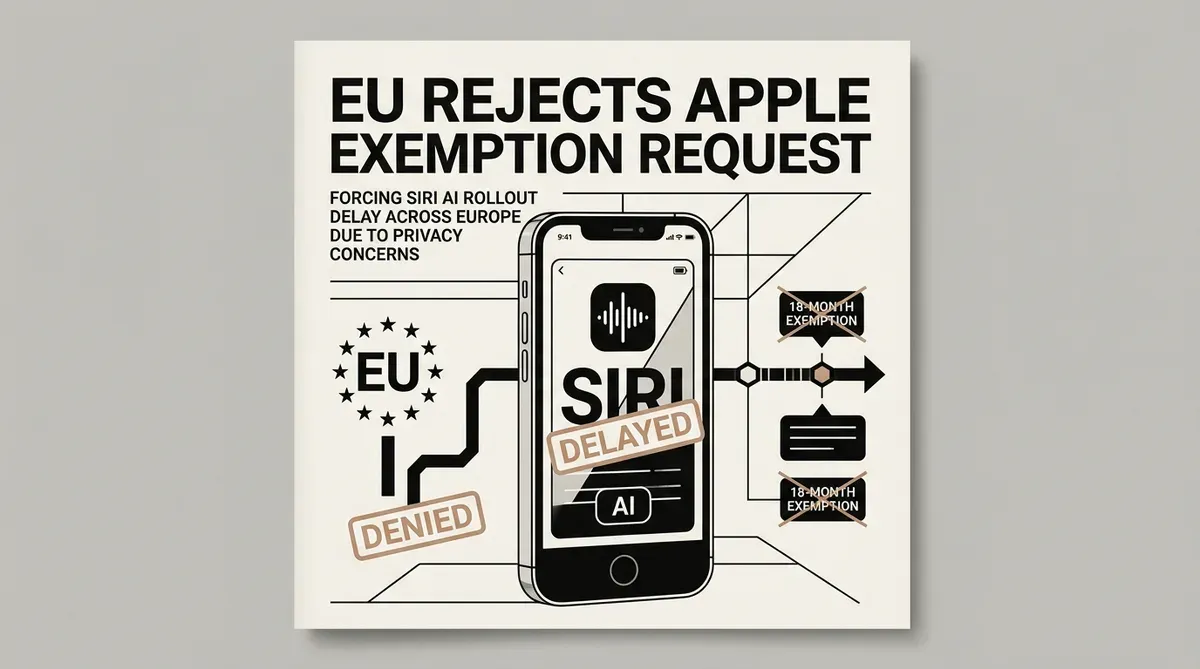
Apple has encountered a significant regulatory hurdle in its attempt to deploy advanced artificial intelligence features within the European Union. On June 10, 2026, European regulators officially denied the company's request for an 18-month exemption from the Digital Markets Act (DMA), a decision that effectively stalls the Siri AI rollout across the 27-nation bloc.
The conflict centers on the DMA's strict interoperability requirements, which mandate that dominant tech platforms allow third-party services to integrate with their core systems. Apple has expressed concerns that opening its ecosystem to external developers in this manner would compromise user data security and personal privacy. To address these issues, the company proposed a transition period to develop an intermediary system for managing data access, but the European Commission maintained that new features must follow existing legal standards immediately.
Strategic Impact of the Siri AI Rollout Delay
The regulatory standoff extends beyond virtual assistants. Apple confirmed that other highly anticipated features, including iPhone Mirroring and real-time translation for AirPods, will also be withheld from the European market for the time being. This delay creates a fragmented user experience, as customers in the EU will lack access to the generative AI capabilities available to users in other global regions.
From a business perspective, the stakes are high for the Cupertino-based firm. The European market is a key revenue driver, representing nearly 27% of the company's total sales in the previous fiscal year. By choosing to delay the Siri AI rollout rather than comply with the current interpretation of the DMA, Apple is prioritizing its integrated security model over immediate feature parity. However, the European Commission has clarified that the choice to withhold these products rests solely with the manufacturer, asserting that the DMA does not explicitly forbid the introduction of new technologies.
The financial risks of non-compliance are substantial. Under the DMA framework, companies found in violation of competition rules can face penalties of up to 10% of their total global annual turnover. For a company of Apple's scale, such a fine would reach tens of billions of dollars. The company now faces the complex task of re-engineering its AI architecture to meet European standards for third-party access without undermining the privacy protections that are central to its brand identity.
This development highlights the growing tension between global technology standards and regional digital sovereignty. As Apple continues to negotiate with European officials, the timeline for the Siri AI rollout in the EU remains uncertain. The outcome of this dispute will likely set a precedent for how other major AI providers handle the balance between proprietary security and open-market regulations in Europe.
While we strive for accuracy, bytevyte can make mistakes. Users are advised to verify all information independently. We accept no liability for errors or omissions.
AI-generated image.
Related Articles
- Apple Prepares Siri Revamp with Beta Launch and Enhanced Chat Privacy
- New Deadlines for EU AI Act Compliance: High-Risk System Requirements Delayed to 2027
- EU Digital Omnibus Updates Timelines for AI Act Compliance
✔Human Verified