
China AI Companion Crackdown: Beijing Orders ByteDance, Alibaba to Shut Down Chatbot Features by July 15
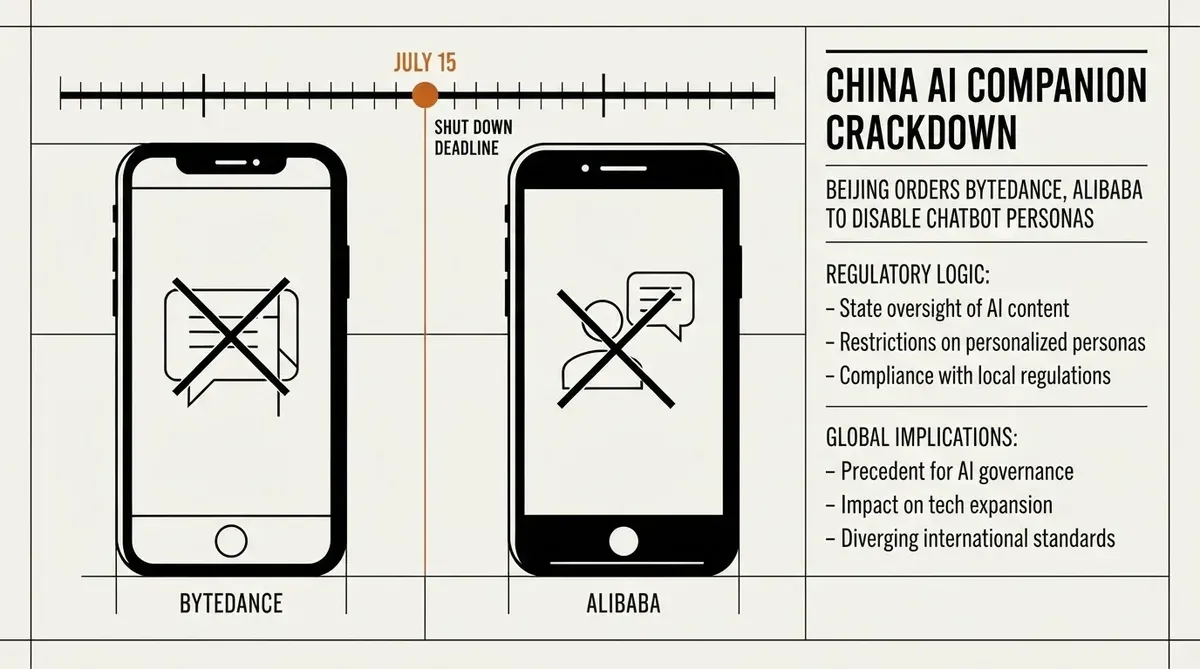
I see China's move against AI companion chatbots as the most consequential regulatory action in consumer AI this year, and not just for the companies directly affected. ByteDance and Alibaba have until mid-July to disable features that let users create custom chatbot personas. Alibaba must comply by July 10, ByteDance by July 15. Tencent already pulled similar capabilities from its Yuanbao app in June, making the China AI companion crackdown a coordinated action across the country's three largest consumer AI platforms.
The Cyberspace Administration of China issued the underlying rules in April 2026, targeting what it described as risks of AI addiction and emotional dependency. Providers are now banned from training models on sensitive conversational data or generating content that could trigger extreme emotions in minors. The regulations also require platforms to monitor for addictive usage patterns and issue warnings to users who spend excessive time interacting with AI personas.
What strikes me is how swiftly this has moved from rulemaking to enforcement. The CAC set hard deadlines, and companies are complying without public pushback. ByteDance's Doubao, one of China's most popular AI chatbot apps with tens of millions of users, will lose its signature persona customization feature on July 15. Alibaba's Qwen, which powers enterprise and consumer AI tools across the Alibaba ecosystem, is following suit by July 10. Tencent's Yuanbao, which already removed its companion personas last month, appears to have set the precedent that the rest must now follow. Both ByteDance and Alibaba have confirmed the shutdown dates, making the China AI companion crackdown one of the fastest-moving regulatory actions in the sector.
The Regulatory Logic Behind the China AI Companion Crackdown
The CAC's rationale is grounded in a growing body of evidence, much of it from outside China, that AI companions can cause genuine psychological harm. International incidents in which chatbot interactions were linked to self-harm among adolescents have drawn attention from regulators worldwide. China is acting on those concerns preemptively rather than waiting for domestic incidents to force its hand, a precautionary approach that is characteristic of its broader regulatory philosophy.
The specific prohibitions in the April rules go beyond general safety requirements. Training AI models on conversation data that includes sensitive interpersonal dynamics is restricted. Content that encourages users to treat AI as a substitute for human relationships is explicitly forbidden. The mandate to issue warnings about excessive use requires platforms to build detection systems that track user engagement patterns in real time, adding a technical compliance burden to the product changes. Research into human-AI attachment patterns, including studies on parasocial relationships with chatbots, has given regulators a framework for identifying the types of interactions most likely to cause harm.
For the companies involved, compliance carries real costs. ByteDance and Alibaba have invested heavily in their AI companion features as engagement drivers and data collection mechanisms. Doubao's persona system, which let users customize everything from appearance to conversation style, was a key differentiator in China's crowded consumer AI market. Removing it levels the playing field but also eliminates a feature that drove user retention and in-app activity metrics across both platforms. The financial impact extends beyond direct revenue loss to include reduced data for model training and personalization algorithms.
Where I Think the Critics Have a Point
The strongest argument against the CAC's approach is that it is overreaching. AI companions are not inherently harmful. Many users report positive experiences, including reduced loneliness and improved emotional wellbeing. Banning the feature entirely denies them that benefit. A more nuanced approach might have imposed age restrictions, usage limits, or mandatory disclosures about the artificial nature of the interaction rather than an outright prohibition on the feature category. This tension between protection and prohibition lies at the heart of the global debate on AI companion regulation.
But the CAC's position appears to be that the risks outweigh the benefits, especially for minors. The April rules explicitly cite the protection of minors as a primary concern. Given that younger users are both the most vulnerable to emotional manipulation and the most likely to form deep attachments to AI personas, the regulator is erring on the side of caution. The question is whether a more proportional approach would have achieved the same protective goals without removing the feature entirely. That question remains unanswered, but the July deadlines mean that for Chinese users, the decision is already made.
The broader context of how China regulates compared to other major economies also matters here. This crackdown reveals a fundamental divide in AI governance approaches. China's model prioritizes social stability and psychological welfare over commercial freedom, using direct mandates and hard deadlines. The European Union's AI Act relies on risk categorization and transparency requirements without banning specific features outright. The United States has no federal AI regulation at all, leaving companies largely self-regulated with only voluntary commitments from the White House. Each model has trade-offs, but China's is the only one producing this level of enforceable specificity on psychological harm.
What This Means for Global Markets
The immediate effect is contained to China, but the secondary effects matter for global AI companies. China's regulatory moves often influence other Asian markets. South Korea and Japan, both of which have active AI companion markets with services like Luda Lee in Korea and various LINE-integrated chatbots in Japan, are watching closely. If similar concerns emerge in those countries, the CAC's framework could serve as a template for their own rulemaking. The harmonization of regulatory standards across Asia would create compliance challenges for companies operating regionally.
For Western companies like OpenAI, Character.AI, and Replika, I believe the Chinese crackdown is a warning shot. These companies operate AI companion services in markets with far less regulatory oversight today. Character.AI, which allows users to create and chat with fictional personas, has already faced criticism for its influence on younger users. Replika, which markets itself as an AI friend, has seen users report both positive companionship and emotional distress. The psychological risks the CAC has identified are not unique to Chinese users or Chinese apps. They are inherent to the product category.
If incidents of AI-related self-harm or emotional dependency surface in the US or Europe, and I believe they likely will given the scale at which these services operate, regulators will look to China's response as one data point in their own policymaking. The April rules and July deadlines provide a concrete case study in how a government can enforce psychological safety standards on AI products. Not all regulators will adopt the same approach, but none will be able to ignore it.
The practical takeaway for decision-makers is straightforward. AI companion features carry regulatory risk that is only beginning to materialize. Companies building emotional-AI products should conduct psychological impact assessments, implement usage monitoring systems, and prepare for regulation that may arrive faster than current timelines suggest. The CAC's action demonstrates that governments are willing to intervene directly when they perceive harm, even at the cost of restricting popular products. For global AI firms, the Chinese approach is no longer hypothetical. It is operational, it is enforceable, and it is happening now.
Why this matters
This is not an isolated regulatory action. It is the first major government-ordered shutdown of an entire AI product category based on psychological harm concerns. The precedent matters because regulatory responses in one major economy tend to influence others over time. If China's approach proves durable and popular, other regulators will cite it as a reference point. Decision-makers building or investing in AI companion products should treat the July 15 deadline as a milestone to study, not just a Chinese compliance event. The rules being enforced in Beijing today could shape the regulatory playbook in other capitals tomorrow.
AI-generated image.
Related Articles
- China Blocks Meta's Manus Acquisition Over National Security Concerns
- Chinese Judiciary Restricts Corporate Layoffs Driven by AI Automation
- US and China Launch High-Level AI Regulation Dialogue to Set Safety Standards
✔Human Verified
Researched and cross-referenced against primary sources by the Bytevyte editorial team.