
Global Workforce Study Reveals Critical AI Readiness Gap as Agentic Adoption Accelerates
A global study finds a critical AI readiness gap, with only 13% of workers skilled for AI agents as 45% of leaders plan 2027 deployments.
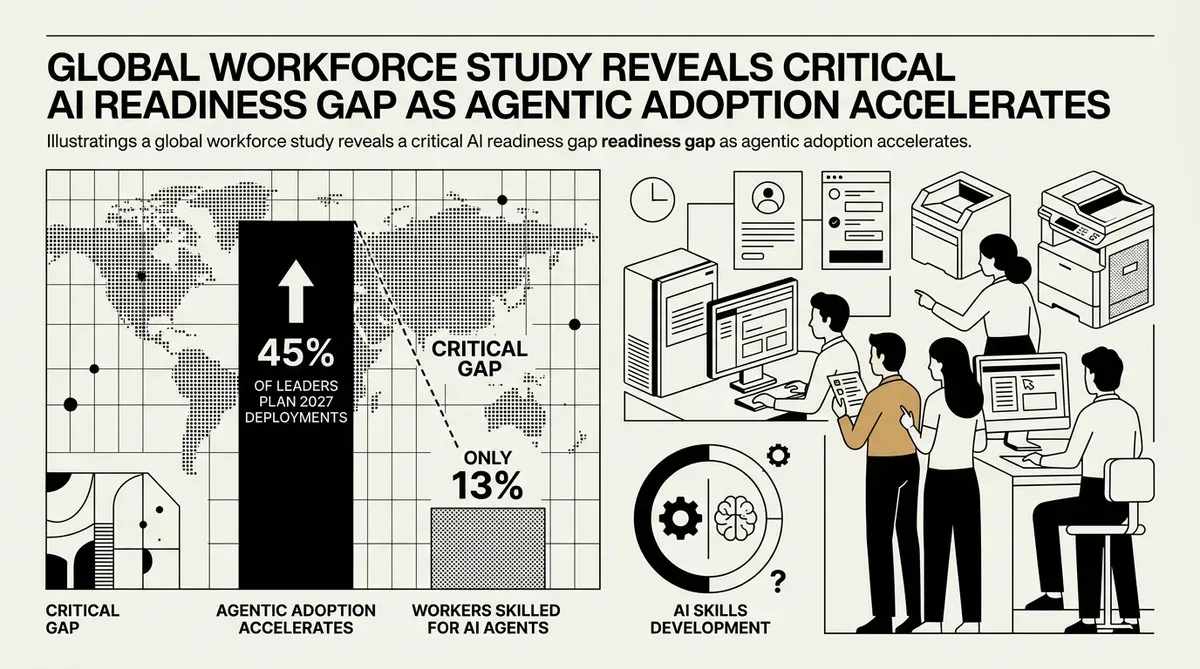
Workera has released its 2026 AI Skills Enterprise Benchmark Report, revealing that only 13% of employees currently possess the necessary skills to work with AI agents. This data, derived from more than 88,000 assessments across 14 distinct AI capabilities, highlights a significant AI readiness gap as corporations move toward agentic workflows. While technical proficiency remains low, the study found that 81% of workers successfully reached an accomplished level in responsible AI after receiving targeted internal training.
The findings arrive as the Adecco Group published a separate study involving 2,000 C-suite executives who oversee approximately 8.6 million workers. This research indicates that 45% of leadership teams expect to integrate AI agents into their standard business workflows within the next twelve months. Despite this aggressive timeline for deployment, only 22% of these leaders expressed confidence that their current workforce is prepared for future-ready operations. This disconnect suggests that the AI readiness gap could become a primary bottleneck for digital transformation initiatives in the coming year.
Strategic Shift Toward Internal Upskilling
The 2026 AI Skills Enterprise Benchmark Report suggests a fundamental change in how organizations approach talent acquisition. Kian Katanforoosh, CEO of Workera, noted that while talent is a major multiplier for business success, the high cost of external AI specialists makes internal upskilling a more viable path for most enterprises. The high success rate of employees in mastering responsible AI frameworks indicates that the workforce is capable of adapting when provided with structured learning paths.
Current data shows that only 36% of executives have a talent strategy that clearly demonstrates how artificial intelligence will create new opportunities for their staff. This lack of strategic clarity may contribute to the low confidence levels reported by leadership regarding workforce capabilities. Organizations that fail to bridge the AI readiness gap risk falling behind competitors who are already transitioning from basic generative tools to autonomous agentic systems.
As of May 2026, the focus for enterprise leaders is shifting from mere tool adoption to comprehensive skill development. The transition to agentic AI requires a deeper understanding of how these systems operate autonomously within a business environment. Companies are now tasked with aligning their rapid deployment goals with the actual technical capabilities of their employees to ensure that the integration of AI agents leads to measurable productivity gains rather than operational friction.
While we strive for accuracy, bytevyte can make mistakes. Users are advised to verify all information independently. We accept no liability for errors or omissions.
AI-generated image.
Related Articles
- Genpact Report: 92% of Executives Forecast Agentic AI Will Reshape Corporate Workflows
- IBM Study: 76% of Global Firms Appoint a Chief AI Officer
- Stanford 2026 AI Index: Adoption Surges, Transparency Falls
✔Human Verified