
Google's Finland AI investment: €13B turns Nordic power into Europe's largest AI program
Google's Finland AI investment commits €13B to four Finnish sites, backed by a 22-year nuclear deal, wind power and a 94 MW battery. Full analysis inside.
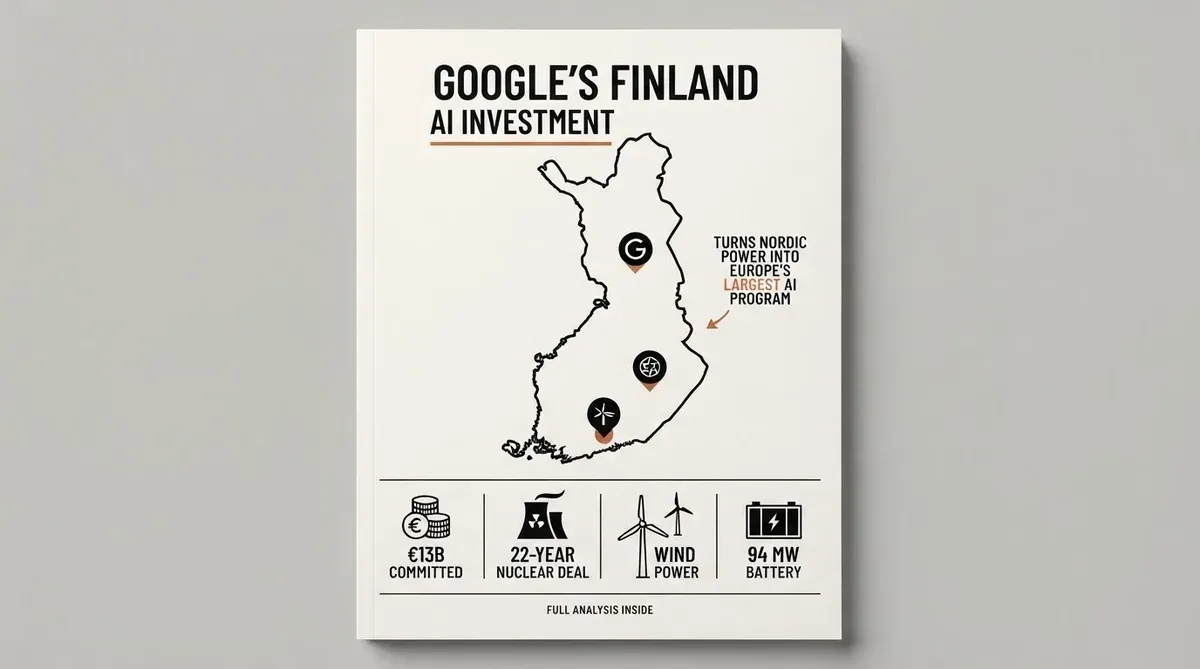
Google's Finland AI investment of €13 billion, roughly $15.1 billion, is the largest single commitment the company has made in Europe. Announced this week, it funds four data centre projects across Hamina, Kajaani, Muhos and Vaala, with the main construction phase running through 2027 and 2028. The capacity targets rising demand for AI services such as Search, Maps and Gemini.
Inside Google's Finland AI investment, the substance sits in the power contracts around the servers. Google has signed a 22-year agreement supporting the life extension of nuclear power capacity in Finland, lined up additional wind supply, and planned a 94-megawatt battery system near Kajaani whose stated function is grid stability. Compute and energy here move on the same clock: the storage unit is scheduled online in late 2027, inside the 2027-2028 construction window.
The expansion deepens a Finnish presence that began in 2009, when the Hamina data centre first went live. That campus will grow, and Google has bought land for new sites in the Muoski area of Kajaani and in Vaala, completing a four-location footprint alongside Muhos. Around those municipalities, the company is directing €31 million in community funding toward education, regional economic development, forest and wetland regeneration, and public recreation.
The scale of the pledge also stands apart from Google's own record in the country. The company describes the figure as at least €13 billion over the next two years, wording that leaves room for further commitments as work proceeds. Earlier Finnish expansions belonged to the first cloud buildout wave, while this round is explicitly framed around AI demand, which is why the energy terms draw as much attention as the construction schedule.
The energy stack behind the buildout
Round-the-clock power is the scarce input in AI data centre economics, and the 22-year agreement that supports keeping Finnish nuclear plants in operation is Google's answer to that constraint. Nuclear generation runs independent of weather, so a contract spanning two decades gives the company predictable, carbon-free baseload for the working life of the hardware it installs. A two-decade horizon matters for hardware economics as well, since it gives the server fleet a power foundation that will outlast several hardware generations. The renewable side of the stack supplies cheaper volume: two onshore wind agreements signed with Valorem and Suomen Hyötytuuli bring Google's new-to-grid wind capacity in Finland to 629 megawatts.
The battery completes the arrangement, and its purpose shows how Google intends to sit on the Finnish grid. Its stated job is grid stability rather than backup power for the company's own halls: it absorbs the swings that large wind volumes introduce so the local system stays balanced as more capacity connects. Framed that way, the data centre becomes an asset the grid can lean on instead of a load it must absorb, a distinction that shapes permitting debates across Europe. Sequencing is part of the design too: the battery switches on in late 2027, early in the construction window, so the regional network holds balancing capacity while wind farms and data halls connect around it.
The economics behind Google's Finland AI investment
Google projects the program will contribute €3.6 billion annually to Finnish GDP and support more than 37,000 jobs during the construction phase, with thousands of permanent roles following once the sites operate. That arithmetic explains the national enthusiasm behind the announcement. Hyperscaler capital converts cheap Nordic electricity and cold ambient air into employment, tax revenue and digital infrastructure without direct public spending, a trade few other industries can offer a small, energy-rich economy.
Finland's advantages for this class of facility are clear: inexpensive clean power, cool temperatures that reduce cooling loads, and a stable regulatory environment. Google layers two site-level measures on top. The Hamina operation uses seawater-based cooling, and waste heat from the buildings is captured for district heating networks that serve local homes and businesses, giving municipalities a visible stake in the machines running nearby.
What the deal signals for Europe
Europe has so far stood on the sidelines of the full-scale AI infrastructure boom concentrated in the United States, and Google's Finland AI investment is among the clearest signs that the balance is shifting. The structure of the deal is what makes it a template. A nuclear life-extension contract, wind purchase agreements and battery storage are wired to one multi-site construction program, so compute demand, power supply and state cooperation move as a single system in the AI capex cycle.
The effects reach beyond the four host municipalities. Finland's data centre sector reads the commitments from Google and Microsoft as confirmation that the country is a safe place to invest, and that signal is drawing demand from the rest of the market, according to Finnish developer Hyperco. The halo effect is part of why national governments court anchor tenants rather than individual projects, since one hyperscale commitment signals the long-term demand smaller investors can build on.
The portfolio logic reflects a simple reality: no single source covers every requirement. Nuclear generation offers firm baseload that runs regardless of weather, wind supplies large volumes of low-cost electricity, and the battery absorbs the intermittency the wind introduces. Spreading the commitment across three technologies lowers the chance that a single contract or failure mode stalls the program, so Google's Finland AI investment carries less single-point risk than a one-source arrangement.
The open questions concern sequencing rather than intent. Construction and the Kajaani battery both land in 2027 and 2028, later than comparable deployments in the United States, and the nuclear life-extension plan must move from signed agreement to operating reality at the plants. How smoothly those pieces line up will decide whether the Finnish formula of energy contracts wrapped around state cooperation becomes a template other European countries can copy or remains a special case built on unusually favourable grid conditions.
For European enterprises, the practical effect of the program arrives on a different clock than the announcement. More hyperscale capacity inside the region changes where AI workloads can be hosted and how close that compute sits to European users, with consequences for latency, cost and data-residency planning. But the campuses come online progressively through 2028, so organisations weighing European supply for AI workloads should treat it as a resource that materialises over the next two years rather than one available today.
For Google, the immediate gain is a secured power position in one of Europe's cheapest electricity markets and the growth of its Hamina base into a multi-site region. For Finland, the announcement locks in a multi-year pipeline of construction employment and permanent technical roles. The concrete milestone to watch is the 94 MW battery scheduled to come online in late 2027, the first element of this energy system with a firm switch-on date.
Why this matters
Hyperscaler AI expansion is as much an energy procurement problem as a compute one, and Finland is the clearest European demonstration of how the two get solved together. The €13 billion commitment shows other markets what it takes to attract this class of investment: abundant clean power, cooperative policy and grid capacity that can absorb both the new load and the storage built around it. For anyone tracking the AI capex cycle, Finland is where those economics become measurable.
Sources
Google deepens its commitment to Finland with a €13 billion investment in AI infrastructure
AI-generated image.
Related Articles
- EU AI Gigafactories: Europe's €30B Sovereign Compute Bet
- Google Initiates Construction of First Swedish Data Center to Support AI Growth
- SoftBank and France Negotiate $100 Billion AI Infrastructure Partnership
✔Human Verified
Researched and cross-referenced against primary sources by the Bytevyte editorial team. This article was generated with the assistance of artificial intelligence and reviewed by the Bytevyte editorial team.