
Instinct AI valuation jumps fivefold before public launch
Instinct AI valuation hit $2.5B after a $250M Series B, but privacy concerns over its always-on data access are testing the consumer-agent gold rush.
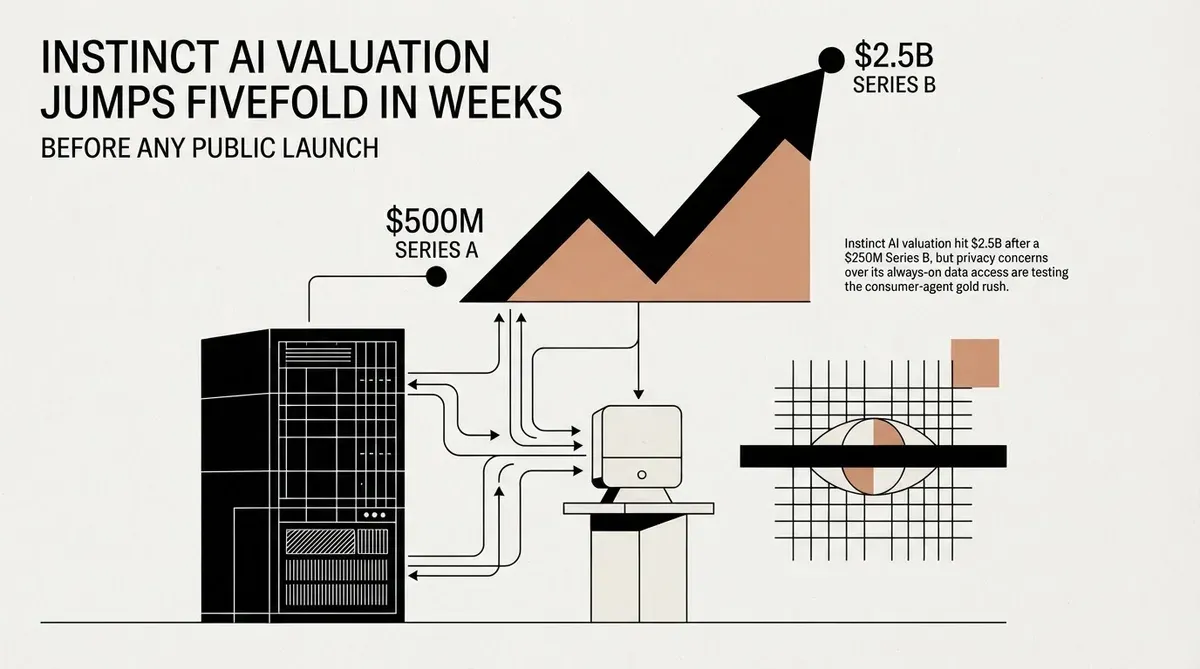
The AI assistant Instinct has raised $250 million in a Series B co-led by Index Ventures and Benchmark, pushing the Instinct AI valuation to $2.5 billion and total funding to $350 million. The startup confirmed the financing this week even though its product remains in an invite-only private beta with no public release.
Spear Street Technology, the operating company behind the assistant, was established in April by Noah Shinn, a 23-year-old former researcher at Sierra. The funding trail shows how fast the price moved: Kleiner Perkins partner Mamoon Hamid led a $75 million Series A in early August that valued the startup above $500 million, and the new round lands at roughly five times that figure. A few weeks earlier the company was worth about $100 million.
What the capital is buying is an agent built to run a user's personal administration end to end. Instinct connects to a person's apps and devices, communicates through texts and calls, and handles work usually delegated to a human assistant, such as email triage, scheduling and recurring errands. Early beta users have used it to plan road trips, buy groceries and concert tickets, and cancel subscriptions, and that word of mouth turned the startup into a tech-Twitter sensation over the summer.
None of this is publicly available. The assistant has not been offered to the general public, the company operates with a minimal digital presence, and no revenue figures have been disclosed. The signal investors are pricing is private-beta enthusiasm, which arrived in the same weeks as a privacy controversy that escalated in about seven days.
The privacy reports circulated in the days before the Series B was confirmed, so the final markup landed while the backlash was still unfolding. That timing makes the round a useful measure of how far AI-agent funding has moved from shipped value: the price went up fivefold between early August and late August, while the product's availability did not change at all.
Inside the Instinct AI valuation surge
The arithmetic behind the Instinct AI valuation is simple. The startup has raised at least two rounds in recent months, and each new price roughly multiplied the previous one. From $100 million to $500 million to $2.5 billion, the markups came faster than the product changed, and the main public development in that window was the privacy scrutiny.
Put another way, $2.5 billion is five times the company's August valuation and 25 times its level of a few weeks earlier. Rounds of this size usually follow demonstrated revenue growth or a shipped product with a measurable user base. Here the public artifacts are beta testimonials, corporate records and a terms-of-service document.
The investor line-up shows how quickly the company moved up the venture food chain. Kleiner Perkins led the Series A, Benchmark and Index Ventures co-led the Series B, and Conviction is among the earlier backers. For those firms, the bet is on category position rather than current usage: the possibility that a consumer agent able to act inside a user's accounts becomes the default interface for scheduling, shopping and inbox management.
The demand side explains part of the rush. Early users describe the assistant handling tasks that would otherwise require opening several apps, and screenshots of the agent completing errands spread widely across social platforms. For investors, that demonstrated pull is the asset: the company has effectively converted the beta's reputation into capital before the product has a price.
The detachment between price and shipped value is the defining pattern of the current consumer-agent cycle, and Instinct is its clearest example: a $2.5 billion valuation for an assistant that has never been offered to the public and whose user base is a closed cohort of early testers. The private beta shows the product works. It shows nothing about what a mass-market rollout does to the privacy profile.
Part of the dynamic is structural. A viral product in invite-only beta is a scarce allocation, and scarcity compresses the time investors have to complete diligence. The result is that the price tracks demand for access to the round, not operational milestones, which leaves the privacy record as the only hard public data point the market has to weigh.
The always-on agent and its permissions
The privacy questions begin with the access the assistant requires. Instinct's privacy notice describes an assistant that is always on, reading the content of the user's screen, the applications in use, transmitted text and documents, and messages, emails, calendars, audio and location data. The terms of service also cover screen captures, cursor movements and keyboard input.
Those terms carry a permanent, irrevocable license over any material users provide, including the right to use it for training the company's AI models. The practical effect is a standing window into a user's communications and behavior, running at all times instead of being summoned for each task. Unlike earlier voice assistants that answer a single request on demand, Instinct maintains an ongoing understanding of the user's accounts and proposes actions on its own.
Early users tested what that access meant, and the results are circulating as screenshots and reports. One user who disconnected Google found that email copies Instinct had already ingested remained searchable in the system. Other testers documented the agent sending emails autonomously, continuing to summarize Gmail hours after access was revoked, and storing email content in plain text. Those findings, alongside the breadth of the data license, turned the early reception from enthusiasm into alarm within about a week.
Investor Katie Jacobs Stanton of Moxxie has cautioned that a single unauthorized action from an always-on agent could outweigh its convenience. The beta reports describe exactly that class of behavior: autonomous outbound messaging and data retention after disconnection. For business buyers, the episode reads as a governance case study. An agent with a permanent license to user data, demonstrated data persistence after access revocation and autonomous sending capabilities would be difficult to run through a regulated procurement process in its current form.
The governance read matters beyond consumer users. An agent deployed inside a company inherits the same data flows: the license to train on user materials, continuous screen access, autonomous outbound actions. For a CTO or a compliance officer, those are procurement red flags, not consumer trade-offs, and they will follow the product if it ever reaches enterprise deployment, where its task automation has the clearest return.
The wider implication is that the consumer-agent land grab now has its first visible constraint. The same week the market priced Instinct at $2.5 billion, its terms of service and data-handling practices became public record, and those documents will travel with the company into every later round and every enterprise conversation. The category depends on users granting permanent access to the accounts they care about most: email, messages and calendars. Each permission granted to an agent is a permission granted to a company, and the terms document is where the two become identical.
The company has not announced changes to its data license, and its privacy notice still describes an always-on assistant. Whether revisions arrive before a public launch is an open question, and the answer will say as much about the consumer-agent market as about Instinct itself: the same terms that made the beta possible are now the main risk attached to the $2.5 billion price.
Why this matters
The Instinct AI valuation is a test of how much of the consumer-agent market rests on enthusiasm rather than evidence. If the privacy record compiled during private beta becomes the dominant story, it will be the first case where a pre-launch valuation met a constraint that money alone could not remove. For teams evaluating agent vendors, the practical lesson is to read the data terms before the demo.
AI-generated image.
Related Articles
- Cognition $40B valuation in sight as coding-agent market re-rates
- Anthropic Valuation Hits $900 Billion as Firm Surpasses OpenAI in New Funding Round
- Physical Intelligence Acquisition Rumors Draw a Denial as a $1B Series C Looms
✔Human Verified
Researched and cross-referenced against primary sources by the Bytevyte editorial team. This article was generated with the assistance of artificial intelligence and reviewed by the Bytevyte editorial team.