
Meta Iris AI Chip to Enter Production in Q3 2026
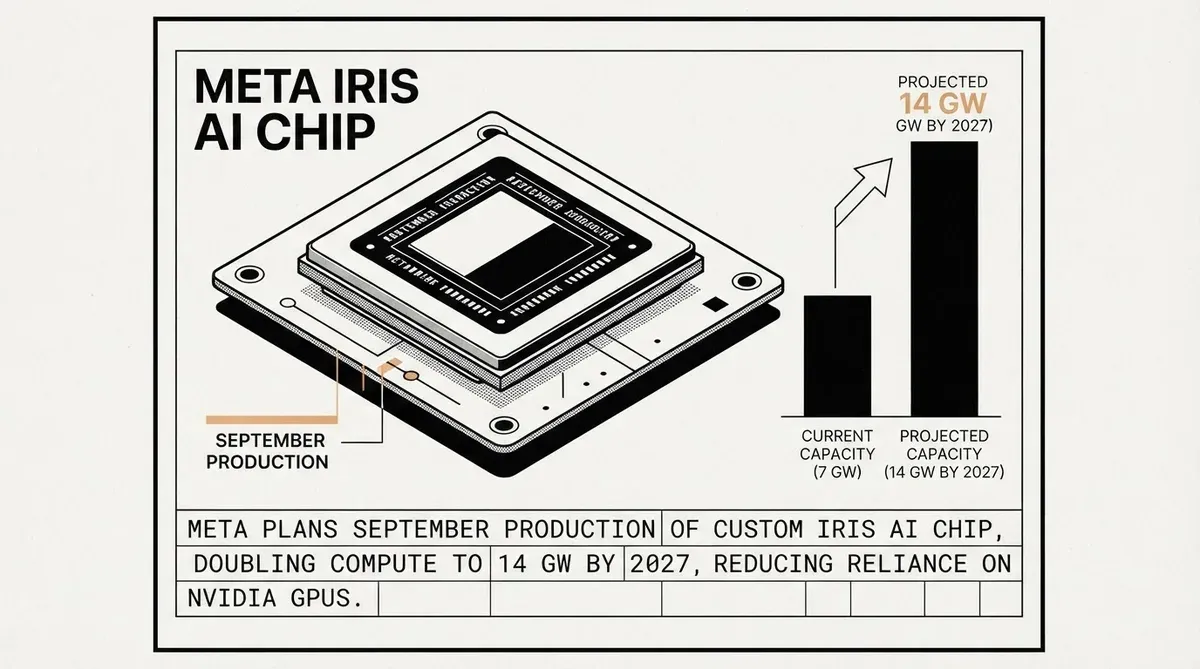
Meta plans third-quarter production of its custom Iris AI chip, doubling compute to 14 GW by 2027 as the Meta Iris AI chip reduces reliance on Nvidia GPUs.
The tension between dependence and independence is playing out in real time across Meta's sprawling data center network. For years, the company has been one of Nvidia's largest GPU buyers, spending billions on H100 and B200 chips to train its Llama models and power recommendation systems for more than 3 billion daily users. Now Meta is moving to manufacture its own answer to that dependence with the Meta Iris AI chip, a custom silicon design aimed at reducing the company's reliance on external GPU suppliers.
The company plans to begin production of its in-house artificial intelligence chip, code-named Iris, starting in the third quarter of 2026, according to an internal company memo. The chip is the latest addition to Meta's Meta Training and Inference Accelerator lineup, a family of custom silicon designed to handle both AI training and the day-to-day inference work that keeps Facebook, Instagram, WhatsApp, and Meta's generative AI products running at scale. The program is the company's most significant move yet toward bringing chip design in-house.
Production Timeline for the Meta Iris AI Chip
According to the memo, the Meta Iris AI chip passed its validation phase in about six weeks and no major issues were found. That relatively fast validation cycle suggests the design is mature enough to move directly into manufacturing through TSMC, which will handle fabrication on a 2-nanometre process. Broadcom is serving as Meta's design partner on the project, a relationship that now runs through 2029 and spans several generations of custom silicon.
If the timeline holds, Iris would arrive as the fifth distinct MTIA variant following the unveiling of four chips (the 300, 400, 450, and 500) in March 2026. Meta has said it aims to ship new MTIA parts on a roughly six-month cadence, significantly faster than the annual release rhythm common across the semiconductor industry.
The MTIA 300 is already in production for ranking and recommendation workloads, the bread-and-butter inference tasks that serve ads and content to billions of users. The 450 and 500 variants are designed for generative image and video inference and are slated for mass deployment through next year. The Meta Iris AI chip appears to sit somewhere within this trajectory, though Meta has not disclosed which specific workloads it will target first.
The Strategic Logic Behind Custom Silicon
The economic calculus driving the Meta Iris AI chip program is straightforward. Every inference task Meta can move onto its own silicon is one it does not have to purchase at Nvidia's margins, and the scale involved is exceptional. Meta has guided 2026 capital expenditure to between $125 billion and $145 billion, with nearly the entire increase directed toward data centers, GPUs, and custom silicon.
Meta plans to expand its total computing capacity from 7 gigawatts in 2026 to 14 gigawatts in the following year, effectively doubling the raw power available across its infrastructure footprint. That growth trajectory places Meta among the largest private infrastructure builders in the world, matching the data center expansion programs of cloud hyperscalers such as Microsoft and Google.
One gigawatt can power roughly 750,000 homes. Meta's 14 GW target would therefore consume the output of several large nuclear power plants. This level of energy demand has already drawn scrutiny from regulators and environmental groups, and Meta has responded with commitments to match its data center electricity use with renewable energy procurement.
Meta's infrastructure push goes beyond chips. The company has announced long-term supply agreements with Samsung, SanDisk, and Sumitomo Electric, locking in components and materials needed to sustain a multi-year buildout. Those deals suggest Meta is planning for the Iris chip and its successors to occupy a growing share of a data center fleet that will keep expanding well beyond next year.
What Iris Means for the Broader AI Chip Market
The move toward the Meta Iris AI chip is not a full divorce from Nvidia. Meta remains one of Nvidia's largest customers and will continue buying GPUs for training its most demanding models. The strategy is one of augmentation rather than replacement. Meta is handling inference at massive scale on custom silicon while reserving Nvidia hardware for the most compute-intensive training runs.
That hybrid approach mirrors what other hyperscalers are doing. Google has its TPU line for both training and inference. Amazon builds Trainium and Inferentia chips for AWS. Microsoft has partnered with AMD and others to develop custom accelerators. Each company is trying to carve out margin savings and architectural control without abandoning the GPU ecosystem that the AI industry has standardized around.
For Broadcom, the MTIA partnership is one of its largest custom chip deals. The company has indicated that the newer Meta chips will be among the first custom AI accelerators built on TSMC's 2-nanometre process, giving Broadcom a marquee reference design to pitch to other hyperscale customers. For TSMC, the Meta contract adds to a backlog of AI chip orders that already consumes a significant portion of its advanced process capacity.
The compute doubling also raises questions about how Meta will utilize the capacity. The company's generative AI products (including AI-powered image generation, chatbot features, and Llama model serving) are still in relatively early stages of monetization. The capital spending assumes those products will grow into the infrastructure, generating enough revenue to justify the billions being deployed now.
For Meta's investors, the Iris timeline provides a concrete milestone to track. The company burned through a significant portion of its operating cash flow on infrastructure in 2025 and the first half of 2026. The ability to shift workloads to lower-cost custom silicon is one of the primary mechanisms by which Meta plans to bring those infrastructure costs under control over time. Each generation of the Meta Iris AI chip that can handle a broader range of workloads reduces the company's exposure to GPU price premiums and supply constraints.
From a competitive perspective, Meta's chip program also affects how the broader AI ecosystem thinks about hardware choice. If Meta can demonstrate that its custom MTIA chips handle ranking, recommendation, and generative inference at competitive performance per watt, other companies operating recommendation-heavy workloads at scale may start evaluating similar strategies. The economics of custom silicon have historically required enormous volume to break even, and Meta's user base of more than 3 billion daily active people provides that volume in a way few other organizations can match.
Why this matters
The Iris chip production launch later this year is a shift in Meta's transition from a pure GPU buyer to a hybrid infrastructure operator. For decision-makers watching the AI supply chain, the implication is clear: the largest technology companies are no longer content to let Nvidia own the entire stack. Each workload moved to custom silicon reshapes competitive dynamics, alters margin structures, and forces chipmakers to compete on integration rather than just raw benchmark scores. Meta's ability to execute on this roadmap at the scale of 14 GW will determine whether its $125 billion-plus capital bet generates the returns the company is counting on.
AI-generated image.
Related Articles
- Meta Increases 2026 Capital Expenditure to $145 Billion for AI Infrastructure
- Meta, Broadcom Extend Custom AI Silicon Partnership
- NVIDIA Starts Mass Production of Rubin R100 GPUs and Vera CPUs for Next-Gen AI
✔Human Verified
Researched and cross-referenced against primary sources by the Bytevyte editorial team.