
Reverse Information Paradox: Enterprise AI Costs More Than Cash
Nadella's Reverse Information Paradox warns enterprises pay for AI twice with cash and proprietary knowledge. Analysis of data leakage and Microsoft position.
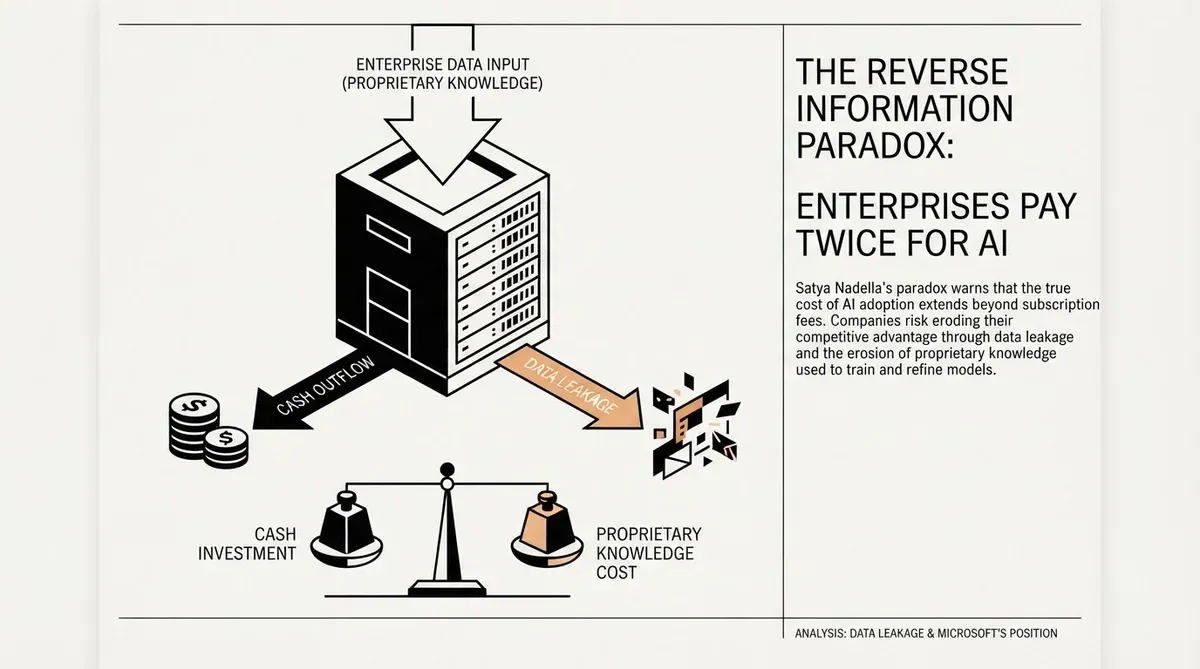
Enterprises that feed proprietary knowledge into AI models may be training their next competitors without realizing it. That is the central warning from Satya Nadella, Microsoft's CEO, who published an essay on July 12 introducing the Reverse Information Paradox, a concept that flips an old economic puzzle to expose a new vulnerability for companies adopting artificial intelligence.
Drawing on Nobel economist Kenneth Arrow's 1966 Information Paradox, which described how a seller cannot prove information's value without giving it away, Nadella argues that AI inverts the risk. Today it is the buyer, the enterprise, that faces exposure. Every prompt sent to a model, every correction made to its output, and every workflow it executes generates what Nadella calls "intelligence exhaust." This exhaust is not discarded. It trains the very models enterprises rely on, effectively handing competitive advantage to the AI providers who operate them.
Nadella argues that enterprises pay for intelligence twice. They pay once in money for token usage and again in proprietary knowledge that must be revealed to make the intelligence useful. The essay targets the prevailing dynamic in which frontier labs such as OpenAI and Anthropic collect usage data, including prompts, corrections, evaluations, and tool traces, as raw material for model improvement. The better an enterprise wants the model to perform, the more of its institutional knowledge it must supply.
The data confirms the scale of the problem. Netskope's 2026 Cloud and Threat Report found that the average enterprise experiences 223 AI related data policy violations per month. Source code accounts for 42 percent of those incidents, and regulated data for 32 percent. Nearly half of generative AI users access tools through personal accounts, bypassing enterprise security controls entirely. A Gartner survey adds another dimension: 69 percent of cybersecurity leaders say they are concerned about AI data exfiltration.
Nadella finds a specific irony in the current arrangement. AI labs scrape public data from the open web without compensation, yet they restrict distillation by competitors and reserve the right to learn from customer data that flows through their APIs. The asymmetry, he argues, is structural. The more you use a model, the more it learns about your business, and the less control you retain over that knowledge.
The Reverse Information Paradox and Competitive Positioning
Nadella's warning should be read on two levels. On its face, it is a genuine structural concern that joins a growing chorus of voices. Palantir CEO Alex Karp and venture capitalists such as Jason Calacanis have issued similar cautions about AI vendor data access. The essay provides enterprises with a framework for thinking about a risk that has been hard to quantify: the slow, invisible transfer of proprietary knowledge across API calls.
But the essay also functions as a competitive positioning document for Microsoft. Nadella's proposed remedy, a hard trust boundary that keeps institutional knowledge proprietary, maps directly onto Microsoft's own Azure AI and Copilot stack. By framing the hyperscaler as the safe intermediary between raw model capability and enterprise data, Microsoft positions itself as the vendor that can offer cutting edge AI without the information asymmetry problem. The company's infrastructure allows customers to deploy models in tenant isolated environments where prompts and outputs stay within the customer's security boundary.
This distinction matters because the Reverse Information Paradox describes a real and growing cost of enterprise AI adoption. But the solution Nadella offers is one that Microsoft is uniquely positioned to deliver. Enterprises evaluating their AI strategy should examine not only whether a model performs well, but what the model learns from their usage and where that knowledge ends up. A model that excels on benchmarks but funnels usage data back to a competitor is a poor long term investment.
The Reverse Information Paradox: The 5-Point Framework
Nadella's essay outlines a five point framework for enterprises to protect their intellectual property while still benefiting from AI capabilities. The core recommendation is that organizations should retain ownership of the knowledge they create while using AI systems, a principle that sounds straightforward but runs counter to the current practices of most major AI providers. The framework also calls for enterprises to establish clear data governance policies for AI interactions, segment model access by data sensitivity, audit the training data policies of their AI vendors, and build the technical infrastructure to enforce the trust boundary.
The practical challenge is that many of these measures require infrastructure and contractual leverage that smaller enterprises lack. A startup using an API key from a frontier lab cannot easily negotiate data usage terms. A large enterprise with a multi-million dollar Azure commitment can. This asymmetry of negotiating power is itself a feature of Nadella's argument and of Microsoft's competitive position. The hyperscaler model, where Microsoft controls the infrastructure layer between models and customer data, makes the trust boundary technically enforceable in ways that direct API access to frontier labs does not.
The Reverse Information Paradox and Vendor Lock-In
The Reverse Information Paradox reveals something more troubling than data leakage alone. It points to an information asymmetry problem in which every interaction an enterprise has with an AI model is simultaneously a transaction and a data contribution. The more specialized and distinctive the enterprise's domain knowledge, the more it has to lose by sharing that knowledge with a model provider who might eventually compete in the same space. This is not hypothetical. OpenAI and Anthropic both operate in enterprise adjacent markets, and the line between model provider and competitor is growing thinner with each product release.
Consider what happens when a financial services firm uses an AI model to analyze proprietary trading strategies. Each prompt teaches the model about the firm's approach to risk, timing, and signal detection. Those patterns, aggregated across thousands of customers, represent a significant competitive asset for the model provider. The firm receives better outputs in the short term, but the long term cost is a gradual erosion of what made its strategy unique.
Nadella's framing draws attention to this asymmetry by invoking Arrow's original paradox but inverting the vulnerable party. Arrow showed that information sellers struggle to monetize knowledge because buyers cannot evaluate it without receiving it. Nadella shows that AI buyers face the mirror problem. They cannot benefit from a model without revealing the knowledge that makes their business distinctive, and that revelation weakens their position relative to the model provider over time.
Why the Reverse Information Paradox Matters
The Reverse Information Paradox reframes a cost that has been invisible on enterprise balance sheets. Every prompt and correction that trains a frontier model is a transfer of value from the customer to the AI provider. In a competitive market, that value flows both ways. Enterprises that treat their AI interactions as proprietary data exchanges rather than simple API calls will retain more control over their competitive edge. The real test is not which model performs best on benchmarks, but which vendor can deliver capability without demanding ownership of the knowledge required to make that capability useful. For CTOs and CIOs, the immediate action is clear: audit where your organization's data flows when it touches an AI model, and negotiate terms that keep that data yours.
AI-generated image.
Related Articles
- Rising Enterprise AI Spending Forces Strategy Shift at Microsoft and Uber
- Enterprises Shift Toward Sovereign AI Amid Rising Geopolitical Risks
- Microsoft MAI Models Cut Copilot Costs in Excel, Outlook
✔Human Verified
Researched and cross-referenced against primary sources by the Bytevyte editorial team.