
US Data Center Electricity Demand Rises as AI Infrastructure Spending Hits $725 Billion
US data center electricity demand is rising as AI spending hits $725 billion for 2026. Learn how power permits and utility costs impact the tech sector.
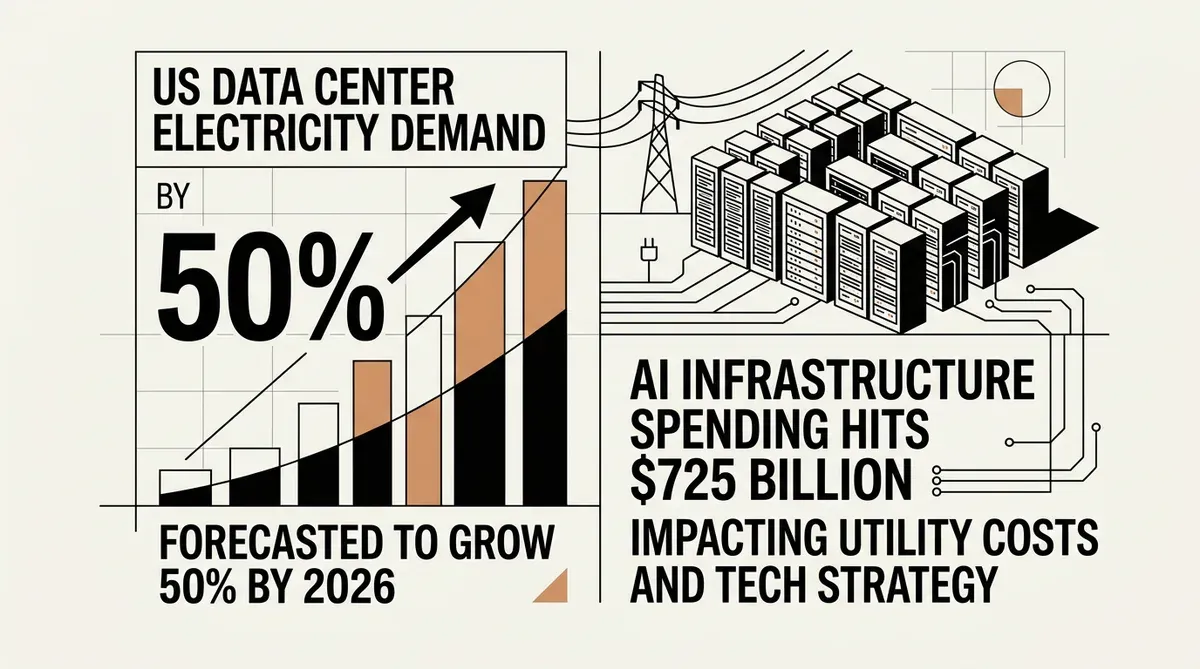
Major technology companies have committed $725 billion to artificial intelligence infrastructure for 2026, driving a sharp increase in data center electricity demand. This revised spending target is up from previous estimates of $610 billion. Four primary firms are leading this capital expenditure, focusing on the hardware and energy supply chains necessary to operate next-generation AI models.
The expansion is forcing a shift in how facilities secure power. By the conclusion of 2025, regulatory authorities had granted over 20 permits for power generation sites specifically designed to support data hubs. Additional project filings increased throughout early 2026. These dedicated energy sources are becoming a requirement as the power-hungry nature of modern AI chips exceeds the capacity of existing utility grids.
Energy Infrastructure as a Competitive Constraint
Analysts identify electricity availability as a potential bottleneck for the technology sector. While Microsoft, Google, and AWS are scaling facilities rapidly, the time required to build traditional grid infrastructure often exceeds data center construction timelines. This gap has raised concerns among investors that high valuations for AI firms may outpace actual returns if energy costs and hardware expenses continue to climb.
The surge in data center electricity demand also affects the broader energy market. Utilities are currently attempting to increase capacity to meet the needs of these large-scale computing hubs. This pressure on the grid may lead to higher costs for residential and commercial energy users as utilities fund new generation facilities and infrastructure upgrades.
Reliable power access is now a primary differentiator for companies deploying large-scale AI. Firms with secured energy pipelines can maintain deployment schedules, while others face delays due to grid congestion. By mid-2026, the industry focus has transitioned from the supply of semiconductors to the stability of the underlying power infrastructure.
While we strive for accuracy, bytevyte can make mistakes. Users are advised to verify all information independently. We accept no liability for errors or omissions.
AI-generated image.
Related Articles
- Global AI Infrastructure Spending to Drive $2.59 Trillion Market by 2026
- Tech Layoffs Surpass 142,000 as Firms Reallocate Capital to $715B AI Infrastructure
- Meta Increases 2026 Capital Expenditure to $145 Billion for AI Infrastructure
✔Human Verified