
Global AI Infrastructure Spending to Drive $2.59 Trillion Market by 2026
Gartner forecasts global AI infrastructure spending will drive the market to $2.59 trillion by 2026, a 47% increase led by hyperscalers and hardware demand.
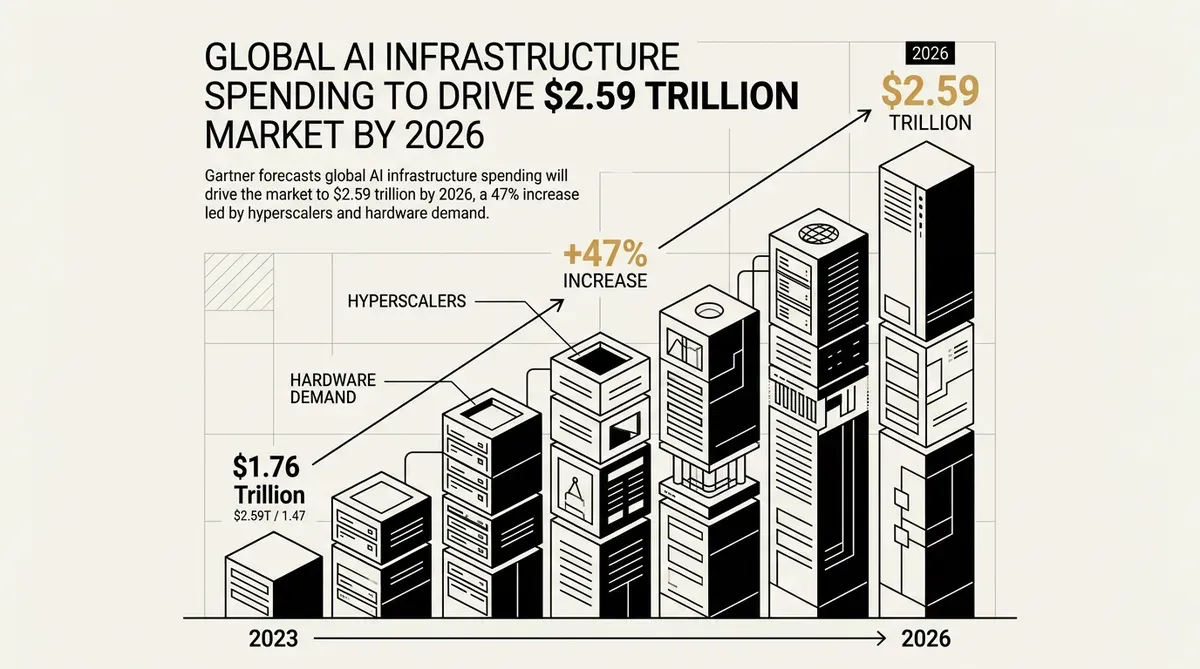
Gartner has projected that global spending on artificial intelligence will reach $2.59 trillion by 2026, representing a massive 47% increase over the previous year. This surge in AI infrastructure spending is primarily driven by technology vendors and hyperscale cloud providers rather than traditional enterprise buyers. The forecast, released this week, highlights a shift toward massive capacity expansion as the industry prepares for the next phase of generative AI deployment.
The infrastructure segment is expected to remain the dominant force in the market for several years, accounting for more than 45% of total expenditures. According to the data, AI infrastructure spending will likely hit $1.43 trillion by 2026. This category includes the physical hardware and cloud resources necessary to train and run large-scale models, with spending on AI-optimized servers expected to triple over a five-year period.
Infrastructure Dominance and Enterprise Software Growth
While hardware and data centers command the largest share of the budget, enterprise software remains a significant secondary market. Gartner estimates that software spending related to artificial intelligence will reach $453.2 billion by 2026. However, the rapid growth in infrastructure suggests that the industry is still heavily focused on building the foundational hardware required to support advanced applications.
This aggressive scaling comes at a time when Chief Information Officers (CIOs) are under pressure to prove the financial viability of these investments. As initial productivity gains from basic AI tools begin to level off, leadership teams are demanding clearer evidence of return on investment (ROI) and long-term business value. The transition from experimental pilots to scaled production is proving difficult for many organizations.
The Execution Gap in AI Deployment
A separate study from HCLTech identifies a growing execution gap that threatens the success of these massive investments. The report suggests that 43% of enterprise AI initiatives are at risk of failure. This high failure rate is attributed to the inability of organizations to scale their internal infrastructure and processes quickly enough to meet the rising pressure from business stakeholders.
The disparity between the trillions being spent by hyperscalers and the struggle of individual enterprises to implement these technologies creates a complex market dynamic. While the supply of AI capacity is growing at a 47% annual rate, the ability of the average corporation to absorb and utilize that capacity effectively remains a bottleneck. Organizations that fail to align their infrastructure strategy with specific business outcomes may find themselves part of the 43% of unsuccessful projects.
As the market moves toward the $2.59 trillion mark, the focus is shifting from simple adoption to operational efficiency. The next eighteen months will likely determine which enterprises can successfully bridge the gap between infrastructure investment and tangible economic performance.
While we strive for accuracy, bytevyte can make mistakes. Users are advised to verify all information independently. We accept no liability for errors or omissions.
AI-generated image.
Related Articles
- Meta Increases 2026 Capital Expenditure to $145 Billion for AI Infrastructure
- Sandisk Revenue Surges 215 Percent as AI Infrastructure Demand Reshapes Storage Market
- Stanford 2026 AI Index: Adoption Surges, Transparency Falls
✔Human Verified