
ZoomInfo AI Pivot: $650M Charge, Agent Data Bet
ZoomInfo AI pivot: Q2 revenue rose just 1.2% to $310.4M, a $650M goodwill charge hit results, and the company now bets its data will power AI agents.
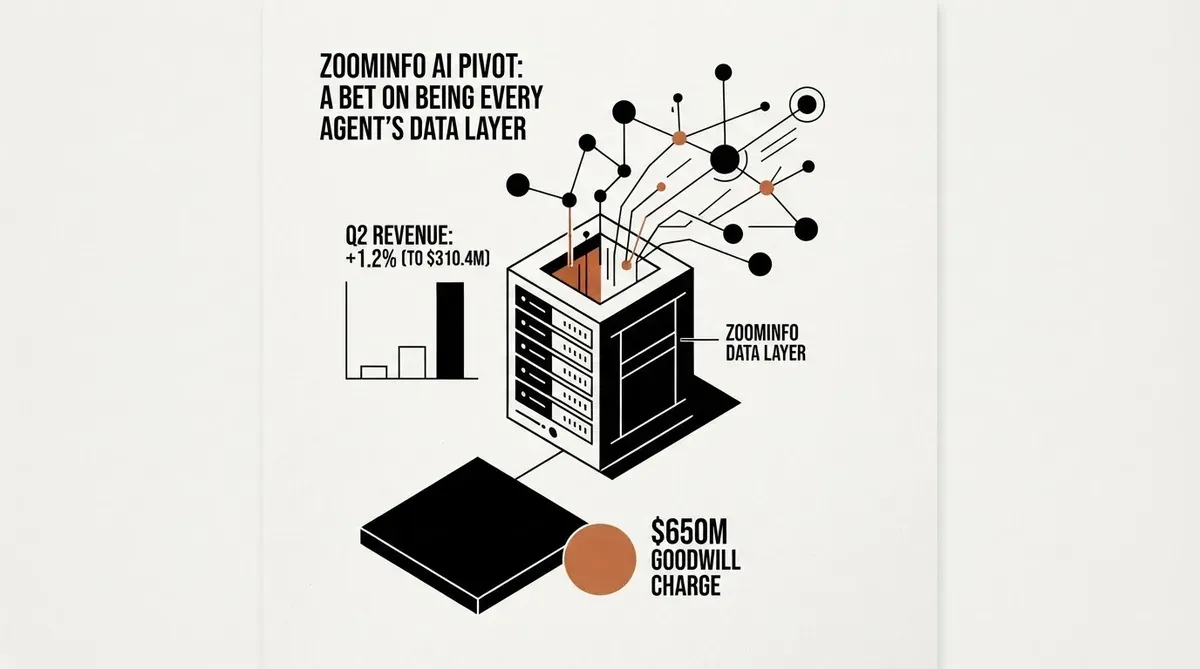
The ZoomInfo AI pivot is now visible in the numbers, and those numbers point in opposite directions. The company posted $310.4 million in GAAP revenue for the quarter ended June 30, up 1.2% from a year earlier, while a $650.5 million goodwill impairment drove a $622 million GAAP operating loss. ZoomInfo attributes the non-cash charge mainly to the decline in its market capitalization, a repricing of what its B2B data is worth at a moment when agents, not logged-in users, are becoming the primary consumers. The ZoomInfo AI pivot is a bet that this repricing is permanent: value is moving from the subscription database to the agent layer that queries it.
The top line still cleared expectations. Analysts had modeled $301.5 million for the quarter, so the print came in about 2.8% ahead of consensus. Adjusted operating income rose 5% year over year to $110 million, holding the adjusted operating margin at 35%, and management put profitability and free-cash-flow generation at the center of the quarter's narrative, alongside product work aimed at embedding ZoomInfo data in AI-driven workflows.
The customer base leans heavily upmarket. ZoomInfo counted 1,891 customers paying more than $100,000 in annual contract value, a group that accounts for 76% of total contract value. That concentration supports the margin story, but it also leaves the business exposed to a handful of renewal decisions and pushes the company into direct competition with full-suite sales software.
The forward-looking signals are softer. Net revenue retention slipped to 89%, a step down from the 90% recorded in each of the prior three quarters, although gross retention held in with improvements outside software. Q3 guidance of $298 million to $301 million implies a sequential decline from Q2, and full-year guidance, cut after Q1 to $1.185 billion to $1.205 billion, points to roughly 4% revenue contraction at the midpoint. Q1 itself brought $310 million, up 1.5%. The math is stark: the first half delivered $620.4 million combined, so the full-year range implies the second half lands near $575 million, and with Q3 guided at the $299.5 million midpoint, the implied Q4 is roughly $275 million.
The retention math is the clearest window into churn. At 89% net revenue retention, existing customers are spending less this year than last after accounting for expansions and contractions, a level that forces the sales engine to find new logos just to hold the top line flat. ZoomInfo frames the slowdown as a mix of macro headwinds and AI-driven customer confusion: buyers re-evaluating what a data subscription is for now that agents handle outreach. The company's response is a shift toward flexible packaging and consumption-based pricing, with new options slated for testing and introduction later this quarter.
Why a $650M Charge Is a Repricing of Data
The goodwill impairment is the largest single item in the quarter, and it is not a cash event. Write-downs occur when the carrying value of acquired assets exceeds what the market says the business is worth; ZoomInfo points to the decline in its market capitalization as the primary trigger. The charge resets a balance-sheet line to a level the market no longer supports, and it does not touch adjusted operating income or cash flow, which is why a 35% adjusted margin and a $622 million GAAP loss can appear in the same report. The ZoomInfo AI pivot gives the charge its context: the market is pricing the legacy subscription model down and the agent-data model up.
The write-down and the revenue line belong to the same story. The legacy franchise, subscriptions to a database of more than 500 million verified B2B contacts, is growing around 1% a year. The impairment is the market pricing that franchise at a lower terminal value than ZoomInfo's acquisition history assumed, while the company redirects its focus to a future in which the same data is consumed by AI agents rather than by logged-in users.
| Metric | Q1 2026 | Q2 2026 | Q3 2026 guide |
|---|---|---|---|
| Revenue | $310.0M | $310.4M | $298M-$301M |
| Year-over-year growth | +1.5% | +1.2% | n/a |
| Adjusted operating margin | 35% | 35% | n/a |
How the ZoomInfo AI Pivot Rewires Data for Agents
ZoomInfo's AI product work runs through the GTM Context Layer, which the company describes as a headless data service. An API carries verified B2B records to AI assistants, with no user-facing screen in between. Claude, ChatGPT, Microsoft Copilot, Salesforce Agentforce, and HubSpot Breeze are among the surfaces it feeds. The range of integrations signals an intent to sit beneath whichever agent a customer's team adopts. GTM.AI, launched in June, is the API and Model Context Protocol home for that layer. Its Agent API already includes endpoints for retrieving "pulses", prioritized plain-text insights on companies and contacts built for agents to read and act on directly, and the GTM Context Graph pipes the same intelligence into any agent through MCP or a single API. A data-execution partnership with DemandScience ties the same context layer to measurable demand generation.
ZoomInfo is also building the measurement layer for agentic go-to-market. GTM Bench, a versioned benchmarking system, scores large language models and autonomous agents on actual revenue operations tasks. Early customer results point the same way: in company case studies, Seismic linked 39% of its active pipeline to signals and reported 54% faster speed to lead after adding AI-assisted prospecting, and Drips reported a 700% jump in platform usage after bringing sales prospecting in-house with an AI assistant.
The strategic logic is that value in go-to-market software is migrating downstream, from the database to the agent that queries it. Rivals are converging on the same position from opposite ends: Clay started as a workflow engine and added a data plane, while ZoomInfo is a data vault adding an agent interface. Clari and Salesloft now ship MCP servers, Gong has wired MCP interoperability into the Microsoft ecosystem, and Zoom folded Common Room's buyer intelligence into Revenue Accelerator. Each is aiming to be the context layer every agent checks before it acts. The ZoomInfo AI pivot is the company's version of that bet: third-party referential data is what turns go-to-market AI from a demo into a revenue engine, and GTM Bench exists to make that claim testable.
The consumption-based pricing shift is the commercial counterpart to the ZoomInfo AI pivot. If agents become the primary consumers of ZoomInfo data, per-seat subscriptions fit the product poorly; usage-based pricing lets the company charge for what agents actually query. Management expects the flexible options introduced later this quarter to support retention over time, but the near-term trade-off is already visible in Q3 guidance.
For buyers, the quarter is a reason to separate two businesses inside one company. The core database franchise is mature, growing in single digits, and now carries a goodwill charge that reflects that reality. The agent-facing products, GTM.AI, the Context Layer, and GTM Bench, are early, consumption-priced, and unproven at scale. Contracts signed over the next two quarters will show which side of the company is winning.
Why This Matters
The ZoomInfo AI pivot is the enterprise-AI transition in miniature: a legacy data business growing about 1% while the value it creates shifts to the agents sitting on top of it. The $650 million charge is the market's repricing of that shift, and the consumption-pricing experiment is the company's answer to it. For teams evaluating go-to-market AI, the practical consequence is that data access is becoming a metered input to agents rather than a subscription for people.
AI-generated image.
Related Articles
- ClickUp Cuts 22% of Staff to Pivot Toward 100x Efficiency with 3,000 Internal AI Agents
- Mag 7 AI Reckoning: Spending Scrutiny Erases $2.3 Trillion
- Wix Lowers 2026 Financial Targets Amid Strategic AI Realignment
✔Human Verified
Researched and cross-referenced against primary sources by the Bytevyte editorial team. This article was generated with the assistance of artificial intelligence and reviewed by the Bytevyte editorial team.