
Alibaba AI Capex Jumps 75% as Net Income Plunges 75%
Alibaba AI capex jumped 75% in the June quarter, cutting net income 75% and swinging free cash flow to a $6.6 billion outflow.
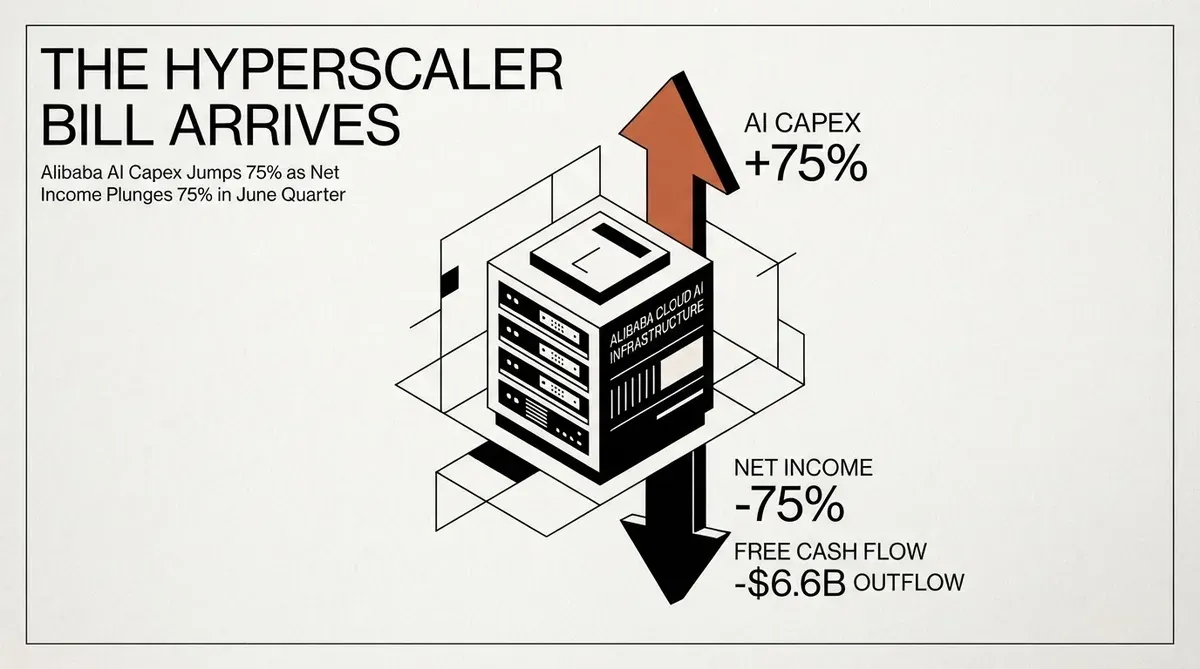
Alibaba Group's June-quarter report attaches a concrete price to the global AI infrastructure arms race: net income fell 75% year over year to about $1.6 billion even as revenue rose 9%, and Alibaba AI capex jumped 75% to roughly $10 billion. The results, published on August 20 for the three months ended June 30, 2026, beat analyst revenue estimates while sending US-listed shares down about 5% in premarket trading.
The quarter crystallizes the central trade-off of the 2026 AI buildout: hyperscalers can grow AI revenue at record rates and still watch profits collapse while capacity is being financed. Alibaba swung to a free-cash outflow of $6.6 billion, and it has already deployed about half of the 380 billion yuan (US$56.4 billion) earmarked for AI investment during 2026. The spending will keep climbing; the open question is when it starts paying back.
The numbers behind the 75% profit collapse
Revenue reached RMB 268.95 billion (US$39.64 billion), up 9% year over year and ahead of estimates. Adjusted EBITDA fell 30% to RMB 27.3 billion, and GAAP net income dropped to RMB 10.4 billion. The profit decline combines the investment surge with a goodwill impairment and a legal provision, which means the 75% headline overstates the deterioration in the underlying operating business.
Free cash flow swung to a RMB 44.67 billion outflow, about $6.6 billion, after the company directed cash into AI infrastructure and computing capacity. The reversal is the sharpest signal in the report: the same line was positive a year earlier, and the outflow is roughly two-thirds the size of the quarter's capex bill. Customer management revenue, the advertising engine tied to Alibaba's core commerce, fell 7% year over year as Chinese consumer demand stayed soft, so the top line now leans on cloud growth while the legacy retail business stalls.
| Metric | June quarter 2026 | Year-over-year |
|---|---|---|
| Revenue | RMB 268.95B (~US$39.6B) | +9% |
| GAAP net income | RMB 10.4B (~US$1.6B) | -75% |
| Adjusted EBITDA | RMB 27.3B | -30% |
| Free cash flow | -RMB 44.67B (~-US$6.6B) | swung to outflow |
| AI infrastructure capex | RMB 67.68B (~US$9.98B) | +75% |
| Cloud EBITA margin | 12% | expanded |
| AI-related product revenue | RMB 12.4B | triple-digit growth |
Taken together, the quarter describes a company in transition. The customer management decline means the commerce business that once funded everything is no longer the growth engine, and the profit squeeze is concentrated exactly where Alibaba is deliberately scaling, the cloud and AI unit. Management framed the period as an investment phase, which is why the market reaction focused on the size of the bill rather than the direction of the business.
What the AI spending is buying
Alibaba Cloud's externally billed revenue rose 45% year over year. The unit's AI-related product line grew at a triple-digit rate for the twelfth quarter in a row, reaching RMB 12.4 billion. That line is still only about 5% of the group's quarterly revenue, which keeps the AI boom in perspective against the much larger commerce base. Eddie Wu, Alibaba's chief executive, tied the momentum to better commercialization of the company's full-stack AI portfolio, and chief financial officer Toby Xu said operating leverage pushed the cloud unit's EBITA margin to 12%.
Alibaba AI capex rose 75% year over year to RMB 67.68 billion, about $9.98 billion, in the April-to-June period, more than six times the quarter's GAAP net income. Management has said Alibaba expects to break even on AI-related capex within three years based on current average gross margins, a timeline that will now be tested quarter by quarter against a program that has already consumed half of its 380 billion yuan budget.
The releases behind that spending are aimed at corporate buyers. Alibaba's newest models cover language, coding, video, audio, image and music, alongside QwenWork, an agent positioned as an AI workforce for business customers. That portfolio is the channel that turns new data-center capacity into billed cloud workloads, the same monetization route Big Tech's cloud units are pushing this earnings season.
Alibaba AI capex and the margin trade-off
The pattern is familiar across Big Tech's latest earnings season: AI services revenue accelerates while the infrastructure bill presses on profit and free cash flow. Alibaba's quarter makes the exchange unusually explicit, a 75% jump in quarterly capex matched by a 75% fall in net income. The market's first reaction was muted, then turned negative: shares fell about 5% in premarket trading after the report and slid another 7% to $121.17 in Friday trading, leaving the stock down more than 10% year to date.
The tension in the report is that revenue came in ahead of estimates while adjusted profit fell short, a combination that forces investors to choose which side of the story to price. The revenue beat came from the cloud, and the profit miss came from the same place: the capex that generates the growth is booked as a cost in the same quarter. That is the structural reason the stock fell even on an otherwise solid top line.
The sell-off was company-specific rather than sector-wide. The benchmark ETF and Alibaba's closest e-commerce competitors barely moved on the same news, which suggests investors are judging the buildout on its own merits instead of treating it as a signal for Chinese tech as a whole. For decision-makers, the practical test is what the three-year break-even claim requires: the cloud unit's 12% EBITA margin, 45% external revenue growth, and triple-digit AI product growth must eventually absorb a capex run rate near $10 billion a quarter.
Two offsetting forces will decide the outcome. Depreciation on the new AI infrastructure will keep climbing as capacity comes online, pressing on reported profit even if demand holds. Working the other way, the expanded model lineup and the QwenWork agent are designed to convert AI usage into billed enterprise workloads. The goodwill impairment and legal provision will not recur, so the operating trend is less severe than the headline percentage suggests, but the structural pressure from depreciation is just beginning.
What it signals for hyperscaler capex returns
Read across both markets, the quarter is a data point on hyperscaler capex returns. Big Tech's earnings this season have shown the same divergence between AI-driven revenue growth and rising capital intensity, and Alibaba's numbers demonstrate the dynamic is not confined to the United States. Alibaba's three-year break-even timeline now functions as a public benchmark: if a company spending half of a 380 billion yuan program can reach cash-flow neutrality on AI capex by 2029, the model works; if not, the industry's buildout math comes under review.
The metrics to watch in the next two quarters are specific. Cloud external revenue growth needs to stay in the mid-40% range, the cloud EBITA margin of 12% needs to keep expanding, free cash flow needs to turn positive again, and Alibaba AI capex will show whether the $10 billion quarterly run rate is a peak or a plateau. Each of those lines will test whether the exchange of current profit for future capacity is actually working.
Why this matters
The June quarter makes the accounting side of the AI arms race visible on both sides of the Pacific: hyperscalers can post record AI revenue growth and sharply lower profits in the same period. For Alibaba, the bet is that roughly three years of compressed margins converts into a durable cloud franchise. For the wider market, the quarter is a reminder that hyperscaler capex returns are not automatic, and the gap between growth and profitability can widen for years before it closes.
AI-generated image.
Related Articles
- Microsoft's 15% Surge vs Meta's $784M Cash Flow: The AI Capex Reckoning Arrives
- Alphabet Q2 2026 Earnings: Cloud Up 82%, Capex at $205B
- AI Spending Skepticism Triggers $797 Billion Magnificent 7 Selloff as Capex Reality Bites
✔Human Verified
Researched and cross-referenced against primary sources by the Bytevyte editorial team. This article was generated with the assistance of artificial intelligence and reviewed by the Bytevyte editorial team.