
Commerce Department Closes US AI chip export loophole for Chinese Firms Overseas
The U.S. Commerce Department has closed a US AI chip export loophole, requiring licenses for Chinese firms operating outside China to buy advanced AI hardware.
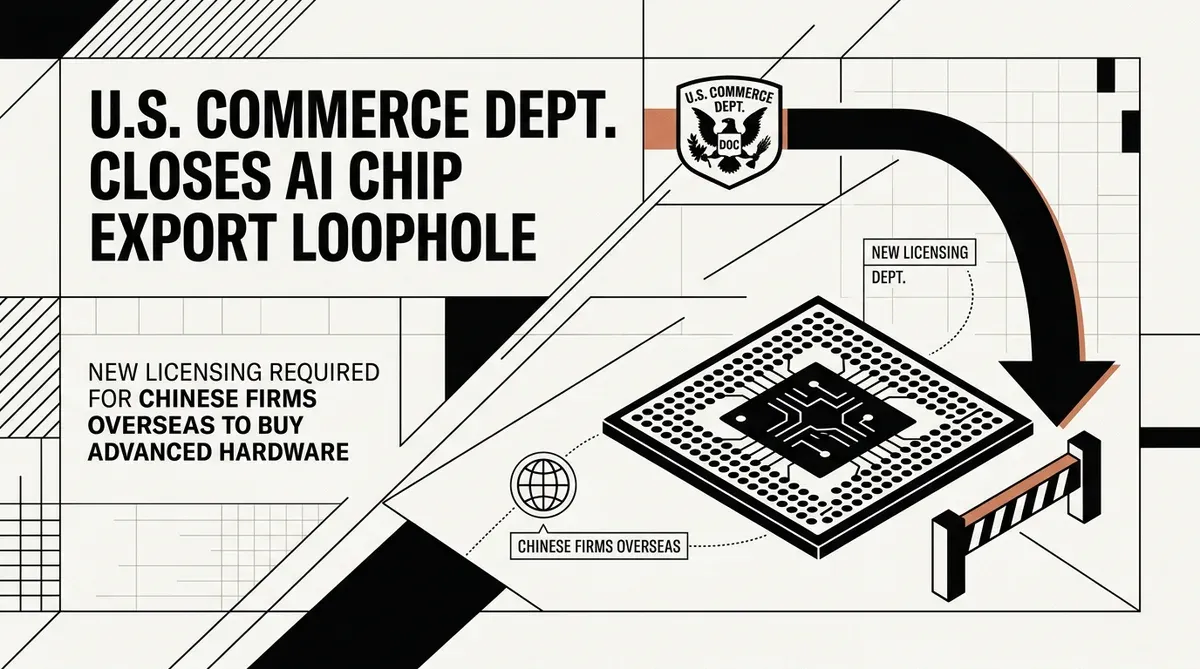
The U.S. Department of Commerce has expanded its export controls to prevent Chinese companies from accessing high-end artificial intelligence hardware through international subsidiaries. New guidance issued by the Bureau of Industry and Security (BIS) on June 1, 2026, stipulates that licensing requirements for advanced AI chips now apply to any entity headquartered in China, regardless of where the specific business unit operates geographically. This regulatory adjustment effectively closes a US AI chip export loophole that previously allowed Chinese firms to procure restricted silicon via overseas branches.
Under the updated rules, the US AI chip export loophole is addressed by focusing on the parent company's location rather than the physical destination of the hardware. Previously, export restrictions primarily targeted shipments directly to mainland China. This allowed subsidiaries located in third-party countries to place orders for advanced processors, which could then be used to train large-scale models or potentially be diverted back to the parent organization. The new BIS clarification ensures that the same rigorous vetting process applies to these international outposts.
Impact on Advanced Semiconductor Shipments
The policy change directly affects the distribution of the industry's most powerful hardware, including NVIDIA Blackwell and H100 processors. These chips are essential for developing the next generation of generative AI and autonomous systems. By extending the licensing mandate to all China-headquartered firms globally, the U.S. government aims to maintain a technological gap in high-performance computing capabilities. Manufacturers must now obtain specific authorization before fulfilling orders for these entities, even if the delivery address is in a region not typically subject to such strict oversight.
Strategic implications for the global supply chain are significant. Tech leaders and investors should anticipate longer lead times and increased compliance costs as vendors implement more granular tracking of their customer base. The US AI chip export loophole closure signals a shift toward a more comprehensive enforcement strategy that prioritizes corporate ownership over physical borders. This move likely forces Chinese technology giants to accelerate their internal development of domestic alternatives or seek hardware from non-U.S. sources that do not utilize restricted American technology.
The Commerce Department stated that these measures are necessary to protect national security interests by limiting the military and surveillance applications of advanced AI. This update follows a series of incremental tightenings of export policy since 2022. As of June 2026, the BIS continues to monitor global trade patterns to identify and mitigate further methods of circumventing these technology transfers. Companies involved in the AI infrastructure sector will need to update their internal compliance frameworks to match this broader definition of restricted entities.
While we strive for accuracy, bytevyte can make mistakes. Users are advised to verify all information independently. We accept no liability for errors or omissions.
AI-generated image.
Related Articles
- U.S. Restricts AI Hardware Shipments to Malaysia to Block NVIDIA Chip Loophole
- U.S. Commerce Department Secures AI Safety Agreements with Google, Microsoft, and xAI
- NVIDIA H200 China Sales Hit Zero as Beijing Blocks Domestic Tech Giants from U.S. Chips
✔Human Verified