
Databricks Storage Ecosystem Debuts to Unify Governance Across Hybrid Environments
The Databricks storage ecosystem provides unified governance for hybrid and on-premises data using the OpenSharing protocol for secure, zero-copy access.
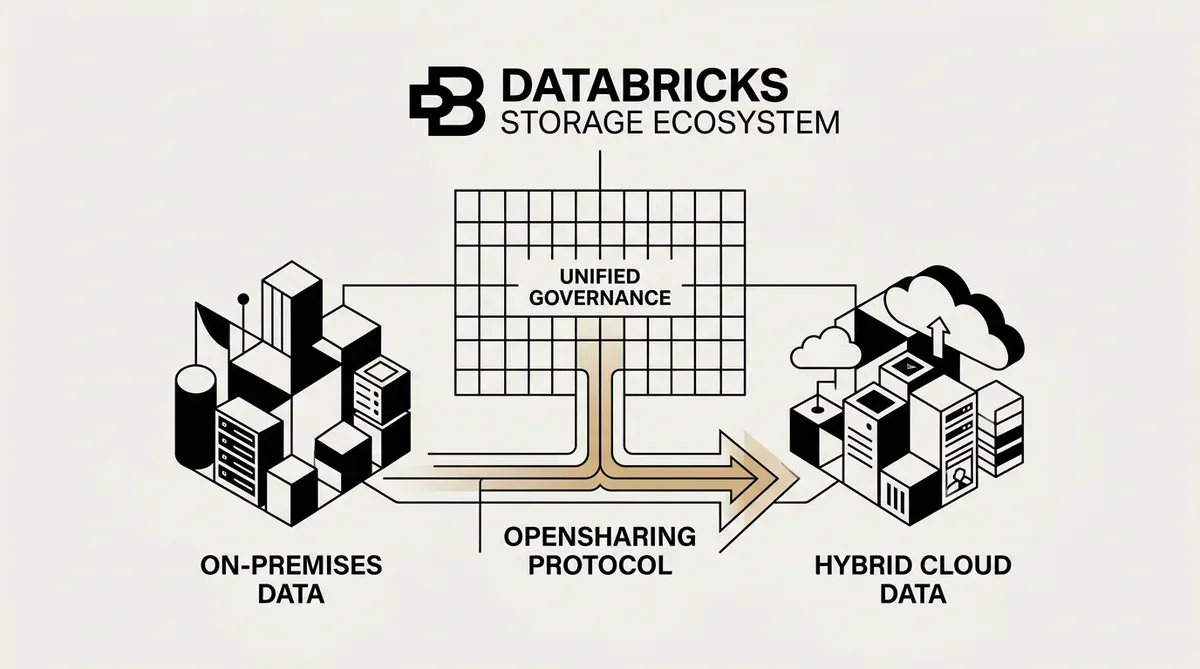
Databricks launched the Databricks storage ecosystem on June 10, 2026. This framework provides unified data governance for information kept in on-site hardware, edge locations, or private clouds. Companies can process and evaluate their data locally, which eliminates the necessity of transferring large datasets into public cloud environments.
The Databricks storage ecosystem is built on the OpenSharing protocol. This open-source standard enables remote datasets to be accessed securely without creating duplicate copies. By removing the need for data migration, the platform helps businesses comply with regional sovereignty laws, lower network egress expenses, and manage the physical constraints of data gravity. This release indicates a strategic pivot by Databricks toward decentralized data management.
Strategic Integration and Partner Support
The new ecosystem is integrated with Databricks Unity Catalog to offer a centralized management interface for various data types. Users can execute Databricks Serverless Compute, Genie, and machine learning training tasks on their own local storage hardware. This setup keeps sensitive data within a company's controlled perimeter while providing access to modern analytics and AI tools.
Multiple storage vendors provide native support for the initiative. MinIO is available at launch. Qumulo is expected to join in July 2026, followed by VAST Data in August 2026. NetApp is also a confirmed partner, which provides coverage for a significant portion of existing enterprise storage systems.
Implications for Enterprise AI Strategy
The Databricks storage ecosystem provides a path for organizations that cannot easily move to the cloud. Firms in regulated industries, such as healthcare and finance, can train AI models on-premises to meet strict security standards. The ability to avoid high egress fees is a financial benefit for companies maintaining massive datasets outside of major cloud providers.
This development suggests that enterprise AI is moving toward a hybrid model. As Databricks enters the data center, it functions as a governance layer that is independent of physical storage locations. The use of the OpenSharing protocol shows a reliance on open standards, which may influence how other vendors approach interoperability in multi-cloud environments.
While we strive for accuracy, bytevyte can make mistakes. Users are advised to verify all information independently. We accept no liability for errors or omissions.
Sources
Announcing the Databricks storage ecosystem: Governing the enterprise data estate, wherever it lives
AI-generated image.
Related Articles
- Databricks Enables External Engine Access to Unity Catalog via Open APIs
- Databricks Automates Data Integration with New Native Lakehouse Sync Feature
- Databricks Launches Genie Agent Mode for Data Analysis
✔Human Verified