
GPT-5.6 on Amazon Bedrock: OpenAI's Sol, Terra, and Luna Models Arrive for Enterprise Deployments
OpenAI's GPT-5.6 on Amazon Bedrock brings Sol, Terra, and Luna models to enterprise customers with tiered pricing, zero-operator security, and AWS compliance.
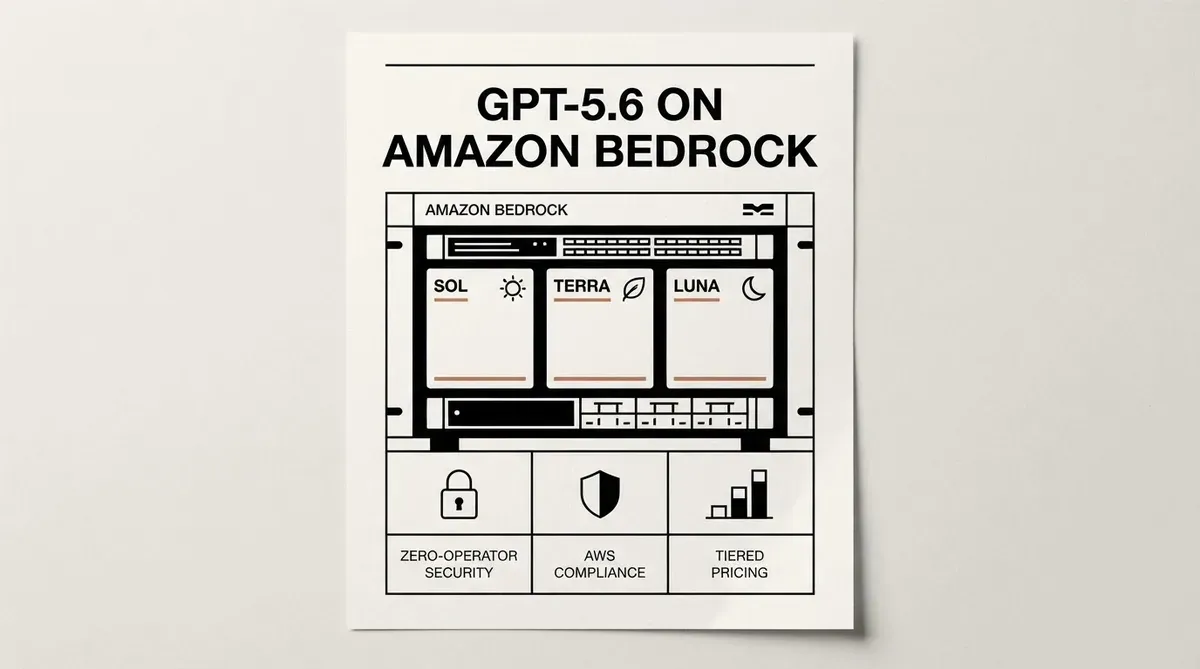
OpenAI's latest GPT-5.6 on Amazon Bedrock deployment brings the three-tier model family — Sol, Terra, and Luna — to enterprise customers through the AWS managed service environment. The availability, confirmed this week, extends OpenAI's flagship reasoning model and its lighter siblings to organizations that require the security, governance, and compliance posture of the AWS cloud. For enterprise architects evaluating AI infrastructure, this is one of the most significant model availability announcements since Bedrock launched.
The GPT-5.6 family adopts a new naming convention from OpenAI where the number indicates the generation and the name designates the capability tier. Sol is the flagship model designed for complex reasoning, autonomous coding, and cybersecurity research. Terra is the balanced option for standard production tasks. Luna is optimized for high-speed, low-cost workloads where throughput and efficiency take priority over raw capability.
Pricing and Performance Tiers
Pricing on Amazon Bedrock aligns with OpenAI's first-party rates. Sol costs $5 per million input tokens and $30 per million output tokens, placing it as the premium tier for demanding reasoning tasks. Terra runs at $2.50 input and $15 output per million tokens. Luna, the most cost-efficient of the three, charges $1 per million input tokens and $6 per million output tokens.
This tiered structure gives enterprises the flexibility to route different workloads to the appropriate model based on complexity and budget. A cybersecurity team analyzing sophisticated threat patterns might use Sol for deep analysis, while a customer support chatbot handling routine queries could run on Luna with minimal latency and cost. Terra fits between the two for standard automation and data processing tasks that need moderate reasoning depth. The three tiers span a 5x price range from Luna input to Sol output, giving cost-conscious teams room to experiment at the low end before committing to premium inference spend.
In benchmarks shared by OpenAI, Terra slightly surpasses Fable 5 on key evaluation metrics, while Luna exceeds the capabilities of Opus 4.8. On Terminal-Bench 2.1, which measures command-line workflow capabilities, GPT-5.6 Sol scored 91.9 percent, outperforming prior generations on autonomous coding and system administration tasks. Sol approaches the top tier in Ultra mode, competing with the most capable models currently on the market. These comparisons give procurement teams a data-driven framework for model selection within the three-tier lineup.
Enterprise Infrastructure on Bedrock
Beyond the models themselves, Amazon Bedrock provides infrastructure capabilities that matter for regulated industries. The platform supports prompt caching with a 90 percent discount on reused input, which can materially reduce costs for applications that repeat common queries or system prompts. Enterprises processing millions of similar requests per day for document classification, code generation, or customer inquiry routing can achieve substantial savings by structuring their input for cache hits.
Security is enforced through a zero-operator access model applied at the hardware level. AWS personnel cannot access customer data or model requests under this architecture. The models integrate with AWS Identity and Access Management, Virtual Private Cloud, and CloudTrail, giving enterprise teams the logging, network isolation, and access controls required for compliance frameworks including SOC 2, HIPAA, and GDPR.
For organizations in healthcare, financial services, and government sectors, these controls address the compliance barriers that have historically slowed enterprise AI adoption. Teams that could not justify the risk of routing sensitive data to a third-party API can now run OpenAI's most capable models within their own VPC boundaries with the same infrastructure controls they apply to any other AWS workload.
Regional Coverage and Ecosystem Integration
Sol is available in the US East (N. Virginia) and US East (Ohio) AWS regions. Terra and Luna add US West (Oregon) coverage, offering broader geographic distribution for latency-sensitive applications. Enterprises operating across multiple AWS regions can deploy the models close to their existing compute and storage infrastructure.
The integration also extends to Codex CLI, which added Amazon Bedrock support for all three GPT-5.6 models. Developers working within the Codex environment can now route agentic coding tasks through Bedrock's infrastructure, combining OpenAI's model capabilities with AWS's enterprise tooling in a single workflow. The Responses API also supports programmatic tool calling and an ultra multi-agent mode, enabling developers to build complex multi-step workflows that span multiple models and tools.
Alongside the model availability, OpenAI launched ChatGPT Work, an enterprise productivity tool targeting workplace teams. The product goes after Microsoft Copilot and Google's AI suite, signaling OpenAI's ambition to compete in the enterprise productivity market beyond the API and model access business. ChatGPT Work integrates with GPT-5.6 Sol for complex workplace tasks while routing simpler queries through the lighter tiers as needed.
GPT-5.6 on Amazon Bedrock: Strategic Procurement Implications
The Bedrock availability of the models gives enterprises a second pathway to OpenAI's latest models alongside the direct API and ChatGPT interfaces. For organizations already invested in AWS, this removes the friction of managing a separate AI provider and consolidates AI spending under existing cloud contracts and procurement processes. It also creates a backup channel for enterprises that want redundancy across inference providers.
The tiered pricing structure reshapes how enterprise teams think about model procurement. Rather than negotiating for a single model, teams can architect a multi-model strategy where Sol handles the hardest problems, Terra manages the bulk of production traffic, and Luna absorbs the highest-volume, lowest-complexity queries. This mirrors the approach cloud infrastructure teams have used for years with compute instances matching resource tier to workload requirements rather than over-provisioning for the peak case.
Prompt caching at a 90 percent discount creates a concrete cost advantage for high-volume applications. A large enterprise running hundreds of thousands of daily inference requests could see API costs drop significantly by optimizing system prompts and common prefixes for cache reuse. This changes the unit economics of deploying AI at scale and makes previously marginal use cases viable.
For AWS, adding OpenAI's flagship models to Bedrock strengthens its position as a multi-model AI platform. Bedrock already hosts models from Anthropic, Meta, Mistral, and Amazon's own Titan family. The addition of GPT-5.6 means enterprises evaluating AI platforms can benchmark OpenAI's latest against competitors within the same managed environment, with consistent security policies and data handling procedures applied across all models.
The broader industry trend points toward platform consolidation in enterprise AI. Companies increasingly prefer to access multiple frontier models through a single cloud provider rather than managing separate API integrations, billing relationships, and compliance reviews for each vendor. Bedrock, Google Cloud Vertex AI, and Microsoft Azure AI are competing to become the primary interface through which enterprises consume foundation models, and the inclusion of OpenAI's latest generation gives Bedrock a stronger hand in that competition. Microsoft also offers GPT-5.6 through Azure AI, meaning enterprise buyers now have two major cloud channels for OpenAI's latest models.
For current GPT-5.5 Instant users evaluating the upgrade path, OpenAI has indicated that GPT-5.5 Instant remains the default for fast, everyday responses in ChatGPT. GPT-5.6 Sol powers the reasoning options on eligible plans, while Sol Pro is the enhanced tier for Pro and Enterprise users tackling the most complex tasks. This means the GPT-5.6 family does not fully replace the previous generation but adds capability layers that enterprises can adopt incrementally based on use case requirements.
Why this matters: The availability of GPT-5.6 on Amazon Bedrock removes a major deployment barrier for enterprises that have been waiting to run OpenAI's most capable models within their existing cloud governance frameworks. Organizations that faced compliance or security objections to adopting frontier AI can now proceed with confidence, while the tiered pricing structure gives them the flexibility to scale from cost-efficient Luna queries to full Sol-powered reasoning as their use cases mature. The move also accelerates the consolidation of AI model access through cloud platforms, reshaping how enterprises evaluate, procure, and deploy foundation models at scale.
Sources
OpenAI GPT-5.6 Sol, Terra, and Luna are now generally available on Amazon Bedrock
GPT-5.6: Frontier intelligence that scales with your ambition | OpenAI
GPT-5.6 in ChatGPT | OpenAI Help Center
OpenAI frontier models on Amazon Bedrock – AWS
Previewing GPT-5.6 Sol: a next-generation model | OpenAI
AI-generated image.
Related Articles
- OpenAI GPT-5.5 and GPT-5.4 on Amazon Bedrock Reach General Availability for Enterprise Use
- GPT-5.6 Government Review: OpenAI Launches Sol, Terra, Luna
- OpenAI GPT-5.5 and Managed Agents Arrive on Amazon Bedrock
✔Human Verified
Researched and cross-referenced against primary sources by the Bytevyte editorial team.