
McKinsey Shifts to Performance-Based AI Consulting Pricing as Automation Scales
McKinsey is moving to performance-based AI consulting pricing as automation replaces manual analysis, tying fees to measurable business outcomes and results.
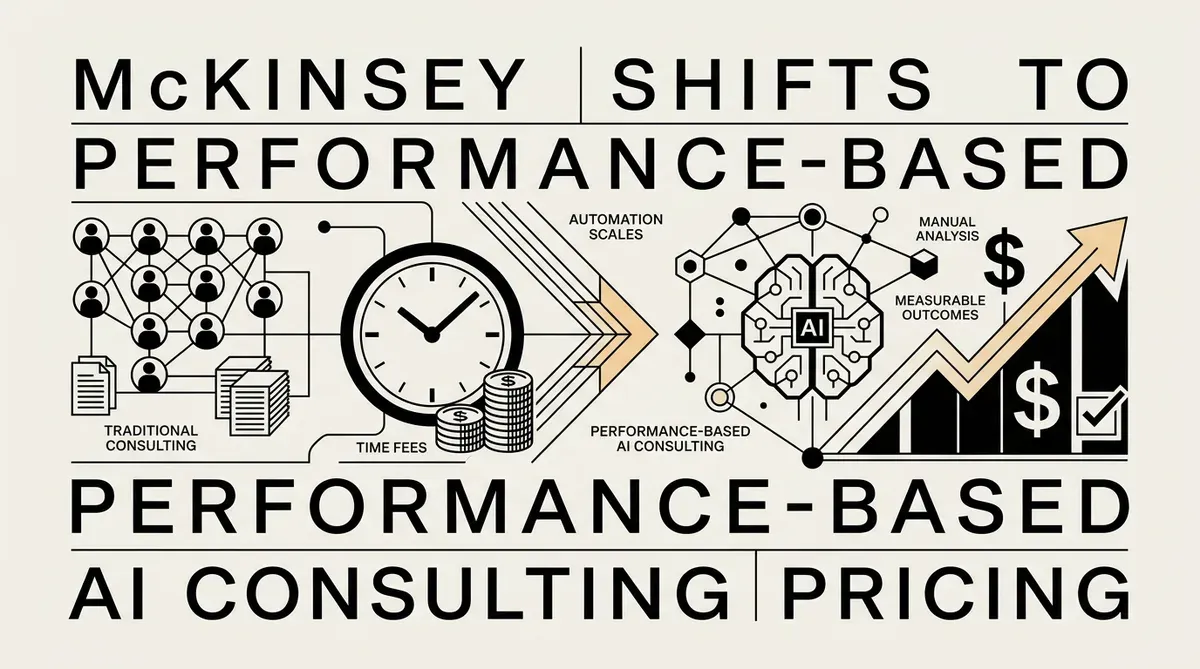
McKinsey & Company is overhauling its traditional billing structure as artificial intelligence automates the analytical tasks once performed by junior consultants. The firm has begun shifting toward performance-based pricing, where fees are tied to measurable business outcomes rather than the number of hours logged by staff. This transition, confirmed this week, signals a fundamental change in the economics of the professional services sector as AI consulting pricing models adapt to rapid technological gains.
The move comes as generative AI and advanced data tools handle research and complex data analysis with increasing speed. Historically, consulting firms relied on a model that charged clients for the time spent by teams of analysts. With AI now capable of executing these functions in a fraction of the time, the hourly billing method is difficult to sustain. Clients are increasingly demanding that AI consulting pricing reflect the actual value created, such as specific cost reductions or profit increases, rather than the labor hours required to reach those conclusions.
The Shift to Outcome-Based Fees
By linking compensation to results, McKinsey is attempting to decouple its revenue from manual labor. This strategy allows the firm to capture the financial benefits of its internal AI efficiency. When a project that previously took months is completed in weeks using automated tools, a performance-based fee ensures the firm is rewarded for the quality of the solution rather than penalized for its speed. This shift is particularly relevant for enterprise clients who are integrating AI into their own operations and expect similar efficiency from their external advisors.
The impact of this change is most visible in the roles of junior consultants. Tasks that were once the training ground for new hires, such as gathering data, building spreadsheets, and conducting market research, are now primary candidates for automation. As AI consulting pricing evolves, the value proposition of major firms is moving away from providing extra staff and toward providing high-level strategic judgment and proprietary technological implementation.
Industry observers note that this pricing pivot is likely to spread across the Big Four and other global strategy firms. As of 2026-05-25, the pressure to demonstrate tangible ROI is at an all-time high. Firms that fail to adopt AI consulting pricing structures based on outcomes risk losing market share to leaner, AI-native competitors that can offer similar insights at a lower cost base. McKinsey's adoption of this model is a significant milestone in the commercialization of AI within the professional services industry.
While we strive for accuracy, bytevyte can make mistakes. Users are advised to verify all information independently. We accept no liability for errors or omissions.
AI-generated image.
Related Articles
- EY and Microsoft Commit $1B to Accelerate Enterprise Agentic AI Adoption
- ServiceNow Adopts Consumption-Based Models to Counter AI Seat Cannibalization
- Genpact Report: 92% of Executives Forecast Agentic AI Will Reshape Corporate Workflows
✔Human Verified