
Meta AI Discrimination Lawsuit Sent to Arbitration
Meta AI discrimination lawsuit heads to arbitration after judge allows layoffs. AI cuts start July 22, testing algorithmic bias.
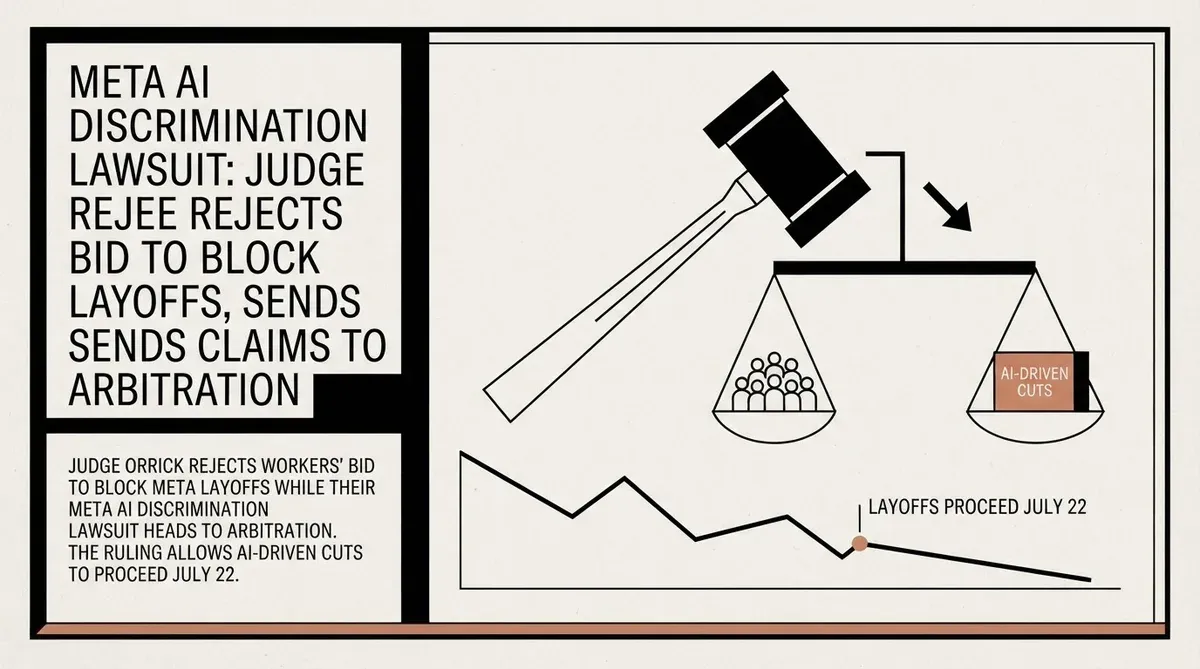
A federal judge cleared the way for Meta to proceed with layoffs beginning July 22, turning down an emergency request from 26 workers as the Meta AI discrimination lawsuit moves forward. The employees argue that the company's AI tools discriminated against those with disabilities or who took approved medical leave.
The employees filed suit earlier this month claiming that Meta's internal AI systems failed to account for approved absences when determining who to cut during a May 2026 workforce reduction that cut about 10% of the global headcount. The ruling sends the discrimination allegations to arbitration while the layoffs proceed. The judge concluded that the workers did not demonstrate immediate, irreparable harm needed for an injunction.
The ruling is procedural, not a decision on the merits of whether Meta's AI tools were biased. Emergency injunctions are rare, and the legal standard is high. The court determined that the workers' claims must go to arbitration as required by Meta's employment contracts.
The procedural outcome is significant for the broader debate about AI in HR. Meta, Amazon, and other companies have automated parts of hiring, evaluation, and termination. The stated goal is efficiency and eliminating human bias. But the Meta AI discrimination lawsuit highlights how algorithms can also encode bias, possibly in harder-to-detect ways.
The Core Allegation in the Meta AI Discrimination Lawsuit
The plaintiffs' central claim is that Meta's AI tools did not properly incorporate information about approved medical leave and disability-related absences when calculating performance metrics used in layoff decisions. If true, workers who took legitimate time off for health reasons were systematically penalized, not by a biased manager but by a system that lacked the data for a fair assessment.
This is a novel legal theory. Traditional employment discrimination cases focus on human decision-makers and bias. The Meta AI discrimination lawsuit asks courts to consider a system that discriminates because its design fails to account for protected characteristics and reasonable accommodations, according to the lawsuit. The law around this question is still forming, and Orrick's decision to route the case to arbitration means no definitive judicial opinion on the merits soon.
Meta has not publicly commented on the specifics of the AI systems, but the company has defended the workforce reduction as a business necessity. The May 2026 layoffs were part of a broader restructuring that cut approximately 10% of Meta's workforce.
Legal Precedent and Strategic Risks for Meta
A fair reading of the ruling is that the judge followed the law. Employment contracts with arbitration clauses are enforceable. Emergency injunctions require a showing of imminent, irreparable harm. The workers asked to freeze a restructuring Meta says is essential. The ruling is defensible on its own terms, but the procedural win does not resolve whether AI-driven decisions can discriminate. That question goes to arbitration, where discovery may force Meta to open its AI systems to expert scrutiny. If experts find systematic undervaluation of workers with disability-related absences, the resulting findings could be more damaging than an injunction.
There is also a regulatory dimension. The Equal Employment Opportunity Commission has been monitoring AI-driven employment decisions. A finding of discrimination in arbitration could provide evidence for an EEOC enforcement action. California's Civil Rights Department has similar grounds.
More broadly, this case highlights a gap in how employment discrimination law interacts with algorithmic decision-making. The current legal framework was designed for human actors. It is poorly equipped to handle systems that make many decisions simultaneously from data that may encode bias. Until legislatures or courts address that gap, more cases like this will emerge, and more judges will apply old rules to new problems.
What the Plaintiffs' Path Looks Like Now
In the Meta AI discrimination lawsuit, the 26 employees will pursue their claims through mandatory arbitration, a process less public than courtroom litigation. Arbitration hearings are private, discovery is more limited, and grounds for appeal are narrow. That structure favors employers and makes it harder for plaintiffs to build public pressure.
But arbitration can still provide a path for novel legal theories. A skilled arbitrator with technical expertise, chosen by both sides, may be better equipped than a generalist judge to evaluate evidence about AI system design and data inputs. If the arbitrator issues a ruling with detailed factual findings about how Meta's AI tools operated, that ruling could have persuasive value in future litigation even without formal precedential weight.
Why the Meta AI Discrimination Lawsuit Matters
The Meta AI discrimination lawsuit is a test case for an emerging legal question: who is liable when an algorithm discriminates? Courts and regulators have not yet answered that question, and this week's procedural ruling does not provide one. But the fact that 26 workers with a novel legal theory forced a federal judge to engage with the issue tells you the conversation is no longer theoretical. Companies that rely on AI for hiring, evaluation, and termination decisions should watch this arbitration closely, because the legal framework for those systems is being written now.
AI-generated image.
Related Articles
- Meta AI Layoffs: 8,000 Jobs Cut as Company Shifts to AI-Native Structure
- Meta AI Workforce Restructuring: 8,000 Layoffs as 7,000 Staff Pivot to Agentic Teams
- Meta Realigns Workforce with $135 Billion AI Infrastructure Push
✔Human Verified
Researched and cross-referenced against primary sources by the Bytevyte editorial team.